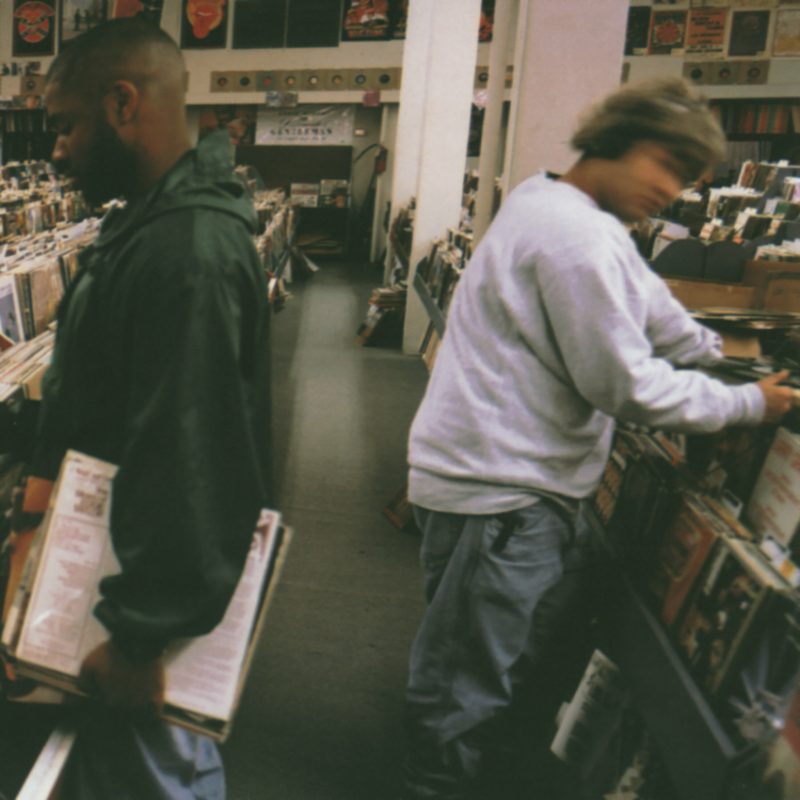
DJ Shadow's 1996 debut was built from other people's records on one sampler and one turntable. It's a near-perfect piece of construction, and a less certain piece of writing.
- Released
- 16 September 1996 (UK, Mo' Wax); 19 November 1996 (US, Mo' Wax/FFRR)
- Label
- Mo' Wax (UK: MW059 2×LP, MW059CD, MW059MC); Mo' Wax/FFRR (US: 697-124 123-1 2×LP, 697-124 123-2 CD)
- Producer(s)
- DJ Shadow (written, produced, mixed and engineered); Dan the Automator, assistant engineer
- Runtime
- 63:26 (13 tracks, US CD sleeve timings)
- Chart peak (US)
- Did not reach the Billboard 200. #44 on Billboard's Heatseekers chart of 12 April 1997, in its sixth week
- Chart peak (UK)
- #17 (Official Albums Chart, week of 22–28 September 1996); 10 weeks on the chart
- Certifications
- BPI Platinum (11 April 2024; Silver and Gold 7 May 1998); Music Canada Gold (26 November 2010)
- Awards & honours
- Guinness World Records: 'First album made completely from samples'. #4 in the Village Voice Pazz & Jop critics' poll for 1996. #7 on Pitchfork's list of the 1990s (2003). #329 on Rolling Stone's 500 Greatest Albums (2020)
Guinness calls it the first album made completely from samples, a title one critic thinks premature and which misses the point anyway. Endtroducing is great because of how it was built, under tight limits after a forced restart, and where it sags, borrowed tunes are doing the work.
In the summer of 1994, Josh Davis, who records as DJ Shadow, began work on his first album. Mo' Wax, the London label that would release it, wanted a single first. So he gave them half the album. 'What Does Your Soul Look Like' went out as one piece 34 minutes long, and Davis started again late that year. The single reached the UK chart in March 1995, at #59. Looking back in 2011, he still wondered what the first, darker version would have sounded like.
Guinness lists the record that came out of that restart as the first album made completely from samples. One critic has called that title premature, and either way it isn't why Endtroducing is worth your time. It's great because of how it's built. Davis worked inside hard limits: a sampler that held only a few seconds of sound on each pad, one turntable, and an album whose first half was already gone. As construction it's close to flawless. Its weakness is the material. The loveliest tunes on it are often the source records' own, and a few are thinner than the frame Davis builds around them.
Davis had been digging for about a decade by then. He started buying hip-hop records in the mid-1980s (he has given both 1983 and 1985), and by about 1987 he was hunting the old soul and rock records he heard inside them. He saw Public Enemy in Oakland as It Takes a Nation of Millions was coming out. That album sampled Isaac Hayes's Hot Buttered Soul, a record he knew from his father's collection, and he remembers thinking that he could do this too. His first release, 'Lesson 4' in 1991, was made on a Yamaha four-track with no sampler at all. In 1992 he bought an Akai MPC60, on Stretch Armstrong's advice and with help from the rapper Paris.
His aim, he told Keyboard in 1997, was an album built entirely from samples. He chose instrumental music because it was harder. Without a singer, he told Song Exploder in 2016, the arrangement has to hold your attention by itself. That's a craftsman's reason rather than a manifesto, and you can hear it. He was also low. He has said he was often depressed while making the album, and that his self-doubt comes through in the music. The restart left him gutted that he'd missed trip hop's moment, though he said he'd had nothing to do with that scene. He finished in the spring of 1996.
The limits explain the sound. The rig was an MPC60 MkII, one Technics 1200 and an Alesis ADAT, synced together. The sampler's memory was tiny, about 5 seconds a pad as Davis remembered it, so he worked in fragments. A drum break would be cut into about 9 pieces and rebuilt, with the strongest kicks and snares swapped in to make a better break than the record had. Parts played straight off the turntable were tuned by hand on its pitch control. He slowed samples far down and stretched single notes by hand, before there were tools to do it. Gaps were filled with the faint 'air' off a record, faded in. The tapes then went to the Glue Factory, Dan the Automator's home studio in San Francisco. It was a crawlspace in his parents' house, reached by a ladder and a hatch, and the album was mixed there from ADAT to DAT.
The sources were a discipline of their own. He sampled no CDs, reissues, bootlegs or compilations, he told Keyboard: original records only, and obscure ones as a rule. He auditioned them in shops on a battery-powered Fisher-Price turntable. The shop on the cover was his muse, he told Song Exploder, and he went once or twice a week while he worked. That rule shapes the sound as much as the sampler does. Records the listener can't place stop being references and become material, so the album speaks in one voice rather than setting a quiz. The sleeve credits only about one sample a song. Davis told Keyboard he had always been pro-sampling. The fight between De La Soul and the Turtles at the end of the 1980s had made him rebellious, and he simply used what he wanted.
You can hear the method most plainly on 'The Number Song'. Its drums come from a 45, chopped into about 16 pieces with the singer's words cut out. The count that gives the track its name arrives at 0:41. The UK sleeve credits Metallica's 'Orion', which tells you how wide the net went. 'Mutual Slump' is subtler, and better. Davis pitched a sample of Björk's 'Possibly Maybe' far down, breaking his own rule of using only obscure records. He bent a vibraphone part into tune with a flute. The voice that enters at about 1:15 belongs to Lisa, then his girlfriend and now his wife. He recorded her for about 20 minutes in the dark below the Glue Factory's hatch, then sampled the tape like any other record.
The long tracks are where all that building pays off. 'Stem/Long Stem' opens close to ambient and then breaks into a breakbeat, the moment NME's Simon Williams picked out in September 1996. 'Building Steam With a Grain of Salt' rests on Jeremy Storch's 'I Feel a New Shadow'. Jason Fine of Rolling Stone heard its snare and organ riffs as what drives it. From about 2:20 it goes two and a half minutes without a sampled voice, and never sags. Three Transmissions, built from John Carpenter's 1987 film Prince of Darkness, close three of the tracks. They make the album feel like one broadcast rather than a run of 13 tracks. None of this is song form, and it doesn't need to be.
The short pieces are another matter. Three of the 13 tracks run under a minute: 'Best Foot Forward', an untitled interlude and 'Why Hip Hop Sucks in '96'. They're sketches, and the last one's title reads as a jab at that year's rap. Vinyl buyers in 1996 heard a shorter album anyway. The original UK and US double LPs left off 'What Does Your Soul Look Like (Part 4)' and the untitled track. The first vinyl to carry both was the 2016 Endtrospective box. The longest piece, 'Napalm Brain/Scatter Brain', runs 9:23 and is the album at its most patient.
The weak spots come when the album stops building and settles into mood. Reviewing it for Rolling Stone in January 1997, Jason Fine heard 'Midnight in a Perfect World', the lead single, as generic trip hop with a cloying organ riff. We think he was half right. Its piano comes from David Axelrod's 'The Human Abstract', Treble noted in 2016, and its synth hook from Pekka Pohjola's 'The Madness Subsides'. Davis frames them beautifully, but the hook and the piano are theirs, and the track asks little more of him than taste. Fine also heard a sax solo on 'What Does Your Soul Look Like' going nowhere. He didn't name a part, but the only part whose sleeve credits a saxophone record is Part 1. At 7:28 it's the slackest stretch on the record, and it's the one that closes it.
The Guinness claim needs the same care. Davis told Keyboard the whole record was sample- or vinyl-based, as he'd intended. John Doran argued in The Quietus in 2010 that the title was premature anyway, because Lyrics Born and Gift of Gab add a couple of live vocal snippets. He's the only source we found who says so. Either way, the record book misses the point. The album was played as well as programmed, with parts dropped in live off the turntable. This is a DJ playing records, and you can hear the hands. Calling it the first all-sample album turns a performance into a statistic.
Critics heard it at once. NME gave it 8/10 in September 1996. Robert Christgau gave it an A+ and made it his album of the year, and the Village Voice's Pazz & Jop poll of critics put it at #4. In Britain it entered the chart at #17, a good start, but it spent only 10 weeks there in all. American buyers were slower still. It never reached the Billboard 200, and it had sold 290,000 copies there by April 2005. The BPI certified it Gold in May 1998, but Platinum only in April 2024. It was never a big seller. It became a reference instead. Jonny Greenwood is quoted in Rolling Stone's 2020 list calling it a big influence on OK Computer.
Its standing has held, with a dip. Pitchfork put it #7 on its list of the 1990s in 2003, and gave the 2005 deluxe edition 10.0. By 2022 it was #49 on the magazine's list of the decade's 150 best albums. Rolling Stone placed it #329 of the 500 greatest albums in 2020. Oliver Wang told the Boston Phoenix in 2005 that it went a long way towards legitimising instrumental hip-hop. Jeff Chang, in the same piece, said it changed how rock bands produced their drums. In 2021 Miles Showell remastered it at half speed at Abbey Road, from the rediscovered DAT of the final mix. Davis said he heard details he'd forgotten. What has dated is the mood, not the method. The slow, sad passages that sounded new in 1996 now sound like a style. The rebuilt drums haven't aged at all.
So the Guinness line undersells the record, and the reputation slightly oversells it. As production, Endtroducing still sounds beyond improvement. The drums are rebuilt piece by piece, and the long tracks move like arguments. As writing it's less sure of itself. Its best melodies often belong to the records it sampled, and when it settles into mood, on 'Midnight' and the closing sax, it drifts. That's a real flaw, and you can hear it. It doesn't stop this being one of the great records of the 1990s. Play it from start to finish, and listen to how much of the beauty lives in the joins.
Pressing guide — the one to own
The original is the UK double LP, Mo' Wax MW059, released on 16 September 1996 and pressed by Orlake. Its runouts read MW 059 A, MW 059 B1, MW 059 C and MW 059 D. The gatefold came in two forms. One opens on the outside with a disc in each panel. The other holds both discs in the right panel, entered from inside, and adds '2 O' to each runout. Nothing records which came first, so neither is a first state. Both leave off 'What Does Your Soul Look Like (Part 4)' and the untitled interlude. The US original, Mo' Wax/FFRR 697-124 123-1 from 19 November 1996, was cut by Rick Essig at Frankford/Wayne and pressed by Hub-Servall. Check for 'RE-1 F/W RCE' in its runouts.