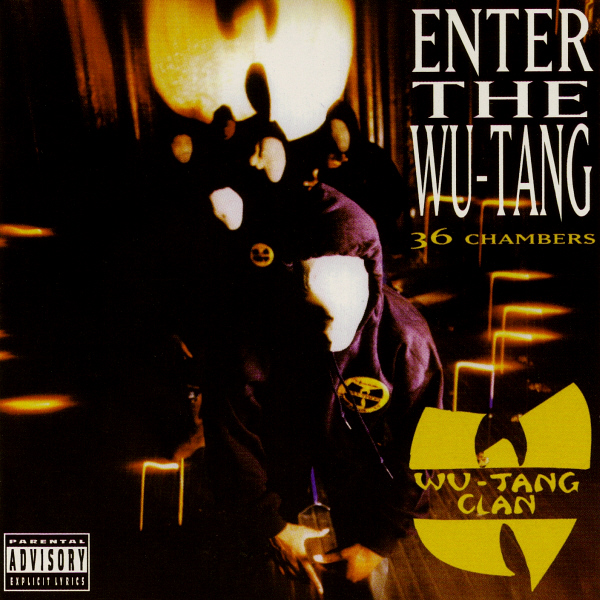
Wu-Tang Clan's 1993 debut put nine rappers from Staten Island and Brooklyn on RZA's beats, and New York rap followed. As an album, it's lumpier than its legend.
- Released
- 9 November 1993 (US, Loud/RCA); 2 May 1994 (UK and Europe)
- Label
- Loud Records / RCA (US CD 07863 66336-2; LP 07863 66336-1)
- Producer(s)
- RZA, credited as Prince Rakeem; co-producers Ol' Dirty Bastard (track 6) and Method Man (track 7)
- Runtime
- 58:23 (12 tracks)
- Chart peak (US)
- #41 (Billboard 200, first week, chart dated 27 November 1993); #8 (Top R&B/Hip-Hop Albums, 23 April 1994)
- Chart peak (UK)
- #83 (Official Albums Chart, 14 May 1994)
- Certifications
- RIAA 4× Platinum (10 November 2025)
- Awards & honours
- Library of Congress National Recording Registry (class announced 13 April 2022)
The grime is the famous part, and the mastering engineer says he kept it on purpose. He also says a lot of the mixes weren't great. The voices are the triumph. The album around them was never quite shaped.
Near the end of 'C.R.E.A.M.', Method Man's last word bends out of tune. It isn't a fault in the tape. The engineer Ethan Ryman told Spin in 2013 that RZA rocked the pitch wheel on his sequencer while he was sampling Method Man's chorus. The same track opens with the sound of a new reel of tape going onto the machine, as Pitchfork noted in 2022. A tidier record would have lost both. This one kept them, and it's full of moments like that.
Enter the Wu-Tang (36 Chambers) has spent more than 30 years being described as a sound: dusty, grimy, the dirt left in on purpose. That's half right. When the Library of Congress added it to the National Recording Registry in 2022, it put the lo-fi mix down to RZA's equipment. Chris Gehringer, who mastered it, kept the dirt deliberately. He has also said that a lot of the mixes weren't great. Some people at the label asked whether that was all there was. What lifts the record isn't the grime. It's nine rappers fighting for room, and a producer with an ear for which voice belongs on which beat. What holds it back is that nobody ever quite shaped it into an album.
The group is older than the name. RZA and his cousins GZA and Ol' Dirty Bastard had a group as early as 1984, first called Force of the Imperial Master and then All in Together Now. By the early 1990s RZA and GZA had each seen a solo deal fail. GZA's was at Cold Chillin'. RZA's, as Prince Rakeem, was at Tommy Boy. The next plan didn't rest on one star. RZA built a crew out of kung-fu films, Five Percenter teaching and comic books. He named it after Shaolin and Wu Tang, a kung-fu film he and Ol' Dirty Bastard loved.
The business plan was the clever part. The group signed to Loud as a unit, but the contract left each member free to sign solo deals elsewhere. The Library of Congress picked out that clause in 2022. Ryman remembers RZA saying he'd turned down a million-dollar offer from RCA for the members and the group together. The calling card was 'Protect Ya Neck', released in December 1992 on the group's own Wu-Tang Records. Every copy carried RZA's phone number. Its first session, at Firehouse Studio's original Brooklyn site, cost $300, paid largely in quarters. Loud reissued it in summer 1993.
By the time the album was being made, Firehouse had moved to 38th Street in Manhattan. Ryman told Spin that the whole group usually came to every session, and that sometimes it felt like their whole neighbourhood had come too. Now and then he and RZA had to clear the room to reach the equipment. The studio's co-owner, Yoram Vazan, says RZA was there for about 6 months and couldn't pay at first. RZA's instrument was a battered Ensoniq keyboard sampler that came from RNS of the U.M.C.'s. Pitchfork calls it a trade, and Rolling Stone a loan. Vazan remembers him bringing in a guitar he couldn't play, just to sample it. Even the opening track is a second attempt. The first 'Bring da Ruckus' used a blues sample RCA couldn't clear, so it was recorded again.
Listen to what the beats are made of, and they're built from whatever was lying around. 'Bring da Ruckus' opens on dialogue from Shaolin and Wu Tang. Under the verses, a piano from the Dramatics' 'In the Rain' sits against a snare RZA made by slapping a microphone in a paint bucket. 'Wu-Tang Clan Ain't Nuthing ta F' Wit' is the theme from the Underdog cartoon, slowed down over drums from Joe Tex and Biz Markie records. None of this is precious material. RZA's gift is making it menacing. A children's cartoon, slowed and darkened, becomes the album's war cry.
'Protect Ya Neck' is the plan in miniature. Eight members rap in a row, Inspectah Deck first and GZA last, and nobody sings a chorus. The title phrase doesn't arrive until the last few seconds, at 4:46. Before the single came out, RZA remade the beat and rearranged the verses. The beat is built on the J.B.'s 'The Grunt'. Pitchfork compares its kettle-whistle squeal to Public Enemy's 'Rebel Without a Pause', and the debt is there. The difference is the queue. Eight voices each try to outdo the last, and the competition is the hook. The album version opens with a radio caller requesting it, most likely on WPGC in Washington, by RZA's account. The single's word of mouth is written into the record.
The rapping is the real event, and RZA's best decisions are about casting. On 'Da Mystery of Chessboxin'' seven members take turns, with dialogue from Five Deadly Venoms in the gaps. U-God opens it. Ol' Dirty Bastard gets the mandolin sample, and the match sounds inevitable now. Masta Killa, who isn't among the eight members named on the sleeve, has the last verse. It's his only one on the album. On 'Can It Be All So Simple', Raekwon and Ghostface Killah work over Gladys Knight & the Pips' 'The Way We Were'. Pitchfork hears a song about lost innocence, and the pairing was the find of the record. Less than 2 years later it carried Raekwon's Only Built 4 Cuban Linx, with Ghostface billed as guest star.
'C.R.E.A.M.' is the song everyone knows, and the one that charted best: #60 on the Hot 100 in April 1994. Raekwon and Inspectah Deck tell their stories over the Charmels' 'As Long As I've Got You', and Method Man takes the chorus. He also gets a track named after him, which spends almost a minute on a skit before his first verse. After that it's a chain of nursery rhymes, Dr Seuss and cartoons, and it's the most charming thing here. Reviewing it for Rolling Stone in 1994 alongside Black Moon and Kurious, Touré found all three acts short on personality. Method Man was his one exception. The solo careers proved him wrong about the group. About this record he had a point. U-God and Masta Killa are glimpses, and only Method Man and GZA get a track to themselves.
The trouble is the album around those songs. It was assembled more than it was shaped, and you can hear the joins. Gehringer describes copying the kung-fu clips from VHS to DAT and editing them in, on digital editors that couldn't cross-fade more than half a second. He thinks putting the skits together was more work than anything else on the record. Ryman says another 10 to 15 skits and clips were cut, which was a mercy. Film dialogue turns up on more than half the tracks, by Pitchfork's count. 'Can It Be All So Simple', the album's loveliest song, gives way to a 2:07 'Intermission' of talk. It's the first place the album stalls, and not the last.
The record never settled on a running order, either. On the LP, 'Protect Ya Neck' moves to the end of side A, and the two sides are titled 'Shaolin Sword' and 'Wu-Tang Sword'. On the CD it sits at track 10. Either way the ending is weak. The last two tracks are 'Tearz', which first appeared on the B-side of the 1992 single, and 'Wu-Tang: 7th Chamber – Part II', a stripped-down remix of track 4. So the album ends by repeating itself. Gehringer told Spin that a lot of the mixes weren't great, and that the single version of 'C.R.E.A.M.' sounded better than the album's. Pitchfork gave the record 10/10 in 2022. When the people who made it say that, a perfect score needs a footnote.
None of that held it back for long. It entered the Billboard 200 at #41 in its first week, with about 30,000 copies sold, and never climbed higher. It went Gold in March 1994 and Platinum in May 1995. In Britain, where it came out in May 1994, it reached #83. Its real reach came through the contract. Within 3 years five members had solo albums out, and the first four were on four different labels. Method Man's Tical reached #4, and Ghostface Killah's Ironman #2. The sound travelled too. Pitchfork says the album paved the way for harder New York rap from Nas, Mobb Deep and the Notorious B.I.G. Rolling Stone linked RZA's sped-up soul samples to a young Kanye West.
The reputation has grown faster than the sales. The first reviews were warm, and James Bernard's in Entertainment Weekly in December 1993 was enthusiastic. In his book of 1990s reviews, published in 2000, Robert Christgau gave it an A− with a warning. Anyone expecting the masterwork of the reputation, he suggested, would probably be disappointed. He told readers to expect "a glorious human mess" instead. Since then the institutions have caught up. The Library of Congress registry took it in 2022, and the RIAA certified it 4× Platinum in November 2025, 32 years after release.
Christgau's warning is the right way in, but it undersells the voices. As performances, these songs are close to unbeatable. Raekwon and Ghostface over that Gladys Knight loop, and eight voices queuing up on 'Protect Ya Neck', still sound like the start of something. The new ideas were as much about business as about sound, and they worked. But as an album it's lumpy: padded with talk, unsure of its own order, and finished with a remix. That flaw is real, and you hear it each time a skit starts. Enter the Wu-Tang is a great record, not a perfect one. Play it for the voices, and forgive it the joins.
Pressing guide — the one to own
The original is the 1993 US LP, Loud/RCA 07863 66336-1: a single LP in a single sleeve, pressed by SRC, with 'DMM' etched in both runouts and 'HFM cg' in side A's. It has red labels, and the stamper ring fully circles the Wu-Tang Records logo without touching it. A late-1990s repress has the same runouts but slightly lighter labels and a smaller ring that cuts into the logo. Its two catalogue pages disagree on its spine, white on one and light yellow on the other, so go by the labels and the ring. The unofficial copy gives itself away in the runout, which is stamped rather than etched.