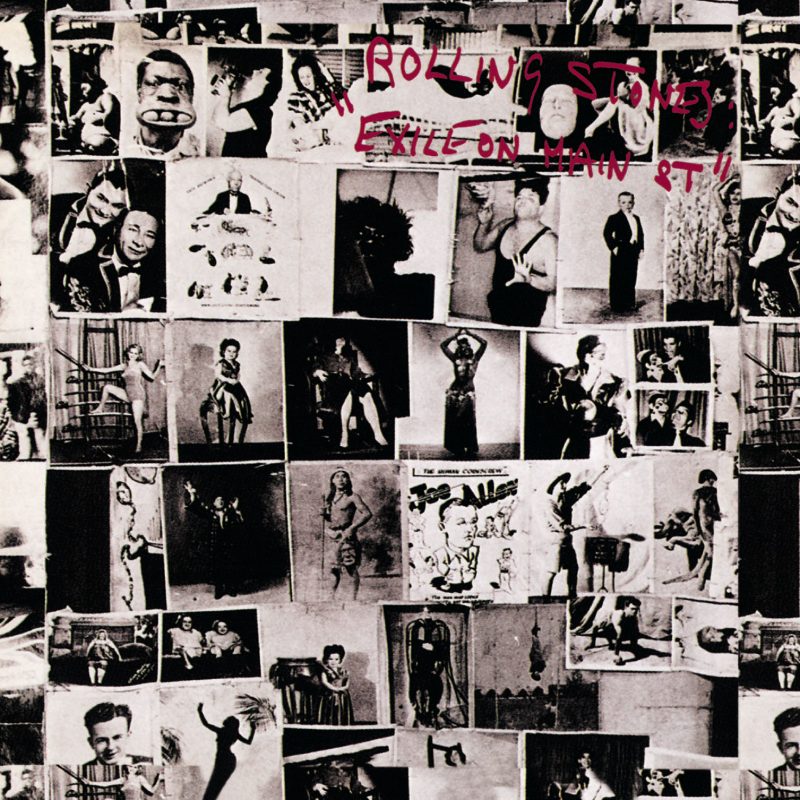
The Rolling Stones' 1972 double album, famous as the record of one summer in a French basement. It's a patchwork of old and new tapes, finished in Los Angeles, and better for it.
- Released
- May 1972
- Label
- Rolling Stones Records: UK COC 69100 (distributed by Kinney), US COC 2-2900 (distributed by Atlantic)
- Producer(s)
- Jimmy Miller · engineers Andy Johns, Glyn Johns, Joe Zagarino and Jeremy Gee
- Runtime
- About 67 minutes, 18 tracks over 4 sides
- Chart peak (US)
- #1 (Billboard Top LPs, 4 weeks, 17 June to 8 July 1972)
- Chart peak (UK)
- #1 (Official Albums Chart, 1 week, chart dated 10 June 1972)
- Certifications
- RIAA Platinum (31 May 2000); BPI Platinum (16 August 2013)
- Awards & honours
- Robert Christgau's #1 album of 1972 (Newsday); Grammy Hall of Fame (2012)
Exile is sold as an accident caught in a French cellar, and only half of it was recorded there. It's an assembly of tapes from three countries, held together by the band's best playing and let down by a mix that buries its singer.
The song on Exile on Main St. that sounds most like an accident is 'Casino Boogie'. Its words were made by the cut-up method. Phrases were written on scraps of paper, thrown into a hat, pulled out and assembled into verses. It's easy to picture that happening in a haze in the south of France. Jagger told Uncut, at the end of 2009, that they did it in Los Angeles, in the studio. In the same interview he said only half the album was recorded at Nellcôte, the villa Keith Richards rented at Villefranche-sur-Mer.
That matters, because the story of Exile is the story of a room. A band in tax exile, a damp basement, a recording truck parked outside, Keith using heroin again. All of that happened. But the record isn't a document of one summer. Charlie Watts told Uncut that some of it was made at Olympic in London and some at Jagger's house in Berkshire. Then they went to France, he said, and finished it in Los Angeles. 'Sweet Black Angel' had been taped at that house, Stargroves, on the band's own mobile studio. 'Tumbling Dice' grew out of 'Good Time Woman', a song on tapes brought out from London. Its words were rewritten in Los Angeles, and the album was mixed there. Exile is an assembly of tapes from three countries, made to sound like one room. That's the real achievement. It's also where the flaw comes from.
The band were in France because of money. Marshall Chess told Uncut that their manager, Allen Klein, had let them believe they had more money than they did. Jagger put it more bluntly. They were broke and owed the Inland Revenue. With tax at 90%, he said, the only way to pay it back was to live abroad. Their adviser, the merchant banker Prince Rupert Loewenstein, found the way out. They left in April 1971, after a short farewell tour of Britain. Jagger married Bianca in Saint-Tropez on 12 May. Keith and Anita Pallenberg moved into Nellcôte with Marlon, their 18-month-old son. Nobody could find a suitable French studio, so the band used their own.
Why a double album? Partly because the tapes already existed. Trevor Churchill, the label's European manager, found a pile of them in the band's old rehearsal room in Bermondsey. He copied them to cassette and took them to Nellcôte. On them were early versions of 'Sweet Black Angel' and 'Tumbling Dice'. Churchill told the Guardian that this is how Exile turned into a double, and that it earned the band an extra half a million dollars. Charlie Watts called the record a way of using up old tracks. So the length was inherited as much as chosen. That isn't a fault in itself, but you can hear it on side four.
The truck was the Rolling Stones Mobile, a studio on wheels that had cost £65,000. It reached Nellcôte on 7 June 1971, after a four-day drive from London, and parked outside in its khaki camouflage. Bill Wyman remembered playing from 8pm to 3am every night for the rest of June, and not everyone turning up. Andy Johns, the engineer, was 21. He said the humidity pulled guitars out of tune halfway through songs. Mick Taylor remembered damp, a leaking roof and power cuts. The talkback and camera linking the truck to the basement barely worked, so Johns ran between them. One night Keith fell asleep during an overdub on 'Rocks Off', and Johns drove home after 3am. Keith phoned him there with an idea for another guitar part. Johns drove back, and at 5am Keith began playing it.
That part is the record in small. Johns said it was a counter-rhythm on two Telecasters, one on each side of the stereo, and that it made the song work. So the opening track's guitars come from both speakers, and Jagger's voice sits down among them. Robert Christgau, who loved the album, still wrote that it buried Mick's voice. 'Tumbling Dice' uses the same method at a slower tempo. The sleeve credits Mick Taylor on bass, not Wyman. Clydie King and Venetta Fields sing behind Jagger. He rewrote the words in Los Angeles because, he told Uncut, the first ones were no good. From 1:42 there's no lead vocal for 25 seconds, and the band carries the groove alone. It's the album's best idea, stated once: a groove that doesn't need its singer.
Side two turns to country, and it holds the album's best writing. Jagger plays harmonica on 'Sweet Virginia', and Ian Stewart, the band's original pianist, plays piano. 'Torn and Frayed' is better still. Al Perkins plays pedal steel on it, his only credit on the record, and Jim Price plays organ. Keith told Uncut that it's one of only two songs on the album whose words he wrote. Gram Parsons, Keith's American friend, was living at Nellcôte that summer. Lenny Kaye, reviewing the album for Rolling Stone, thought side two dragged. He wished the Stones could play country without hoking it up. That's fair to 'Sweet Virginia'. It isn't fair to 'Torn and Frayed', where a British band plays American country as if it belonged to them.
The rest of the album's character was made in Los Angeles, and who made it is still argued over. Uncut's David Cavanagh writes that Jagger has often implied he rescued the record there. Marshall Chess told the Guardian that in Los Angeles, 'Mick took control'. Keith calls that version nonsense. He told Uncut that LA added only extras, such as three singers for 'Let It Loose'. The sleeve credits six backing voices on that song, among them Tami Lynn, Shirley Goodman and Dr. John, as Mac Rebennack. Billy Preston plays organ and piano on 'Shine a Light'. 'I Just Want to See His Face' is a chant, and Kaye heard Jagger and the chorus weaving around a bank of drums. This is the side of Exile that its legend leaves out, because none of it needs a basement.
What makes the assembly work is the playing, and much of it comes from outside the obvious places. On 'Happy', Keith sings lead and plays bass, and the producer, Jimmy Miller, is on drums. Bobby Keys, the band's saxophonist, plays percussion on it. 'Ventilator Blues' is the only song with Mick Taylor among its credited writers. Kaye heard most of the album's drive coming from Charlie Watts's snare drum. He also complained that Keith's guitar was hard to find behind Nicky Hopkins's piano and the horns of Price and Keys. He meant it as a fault, but it describes the album's method. Nobody here is showing off, and the record's unity lives in players listening to each other.
The price of that sound is Jagger. Christgau made Exile his album of 1972 in Newsday, and still said it buried the singer. Kaye went further. He wrote that Jagger's voice had been dropped 'to the level of just another instrument', and that much of the record was unintelligible. Jagger himself has long complained about the muddy production, Cavanagh writes. Keith's reply, in the same piece, was that lead singers never think their vocals are loud enough. Both are right. On 'Rocks Off', the buried voice is part of the weight. On 'Let It Loose', which Kaye counted as the album's second claim to a classic, you want every word and don't always get it.
The bigger problem is length, and Kaye named it in Rolling Stone on 6 July 1972. His case was that strong songs blunt each other over four sides, and that side four slides. He was right about the slide. 'Stop Breaking Down', a Robert Johnson song, is well played and is the least necessary thing here. Kaye called it an overdone blues cliché. 'Soul Survivor' is a decent rocker and a weak ending, and Jagger told Uncut he isn't sure he even wrote it. Nor is Exile as new as its reputation. Two of its songs are covers, of Slim Harpo and Robert Johnson, and its gospel side borrows its forms from the church. What's new is the way these old forms sit side by side.
Jagger and Keith both remember the first reviews as hostile, Uncut reported. That's half true at most. Kaye was mixed, and Lester Bangs, in Creem, called it the Stones' worst studio album. But Cavanagh found that most of the 1972 reviews were favourable, and Christgau gave it an A+. It went straight to #1 in Britain, on the chart of 10 June 1972. It reached #1 in America a week later and stayed there for 4 weeks. What changed later was the reason people gave for loving it. By 2010 Cavanagh could describe it as heard like a documentary, an open door on the band's lives. The songs came to matter less, and the basement more.
The basement story is also what the record handed on. Liz Phair told Ira Robbins in 1993 that Exile in Guyville answers Exile song by song. She'd played the Stones album non-stop for 6 weeks before recording, and kept notes on how her songs matched theirs. Pussy Galore covered all 18 songs in 1986, and Phish played the whole album on Halloween in 2009. The 2010 reissue went back to #1 in Britain and #2 in America. Its single, 'Plundered My Soul', reached #13 on Britain's physical singles chart and missed the main one. Charlie Watts told Uncut that the bonus songs Uncut heard had existed only as instrumentals, so Jagger's vocals on them were new. Jagger wouldn't say when he'd added them. Even the archive had to be finished in a studio.
Exile is the strongest argument for the Stones as a band. Taylor, Keys, Hopkins and Watts play as well here as they ever did, and the joins between tapes made in three countries don't show. 'Tumbling Dice', 'Torn and Frayed' and 'Let It Loose' are among the best things the Stones recorded. The flaw is real, though, and you feel it. The mix hides the singer on the songs that most need him, and the fourth side runs down instead of ending. It's a great record that's a side too long. It's still the one to hand someone who wants to know what this band could do.
Pressing guide — the one to own
The original to own is the 1972 UK double LP, Rolling Stones Records COC 69100, in its Unipak gatefold with two printed inner sleeves and 12 perforated postcards. It was pressed by CBS at Aston Clinton from lacquers cut at Artisan in Los Angeles. The earliest sleeve has no grey TM beside the lips on the back. Its runouts are stamped COC 69100 A1 to D1 and etched with the US master numbers ST-RS-722507 to 722510.