
Deep Dive
Funeral
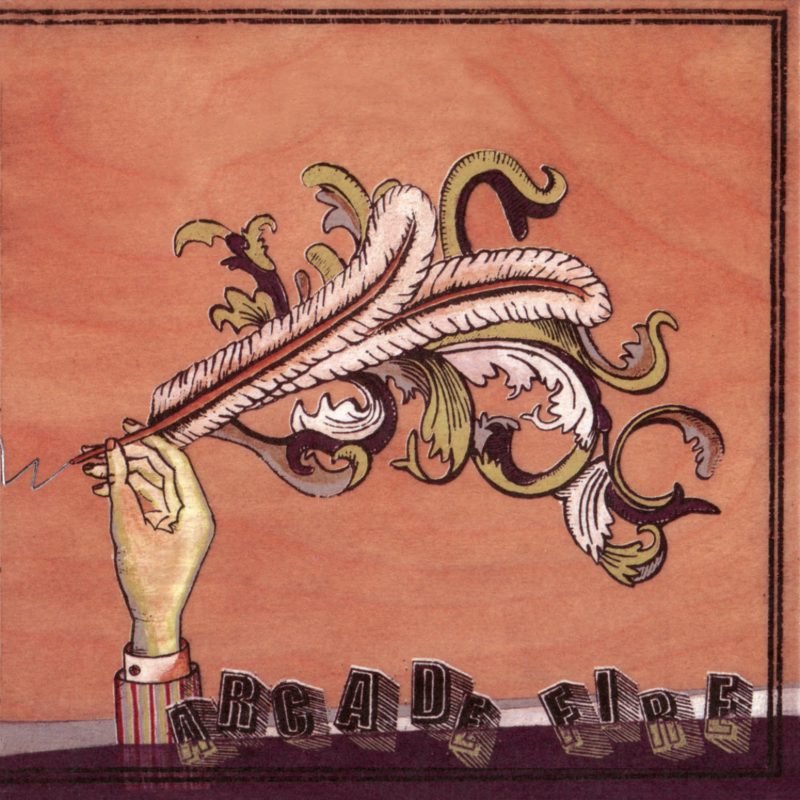
Funeral by Arcade Fire (2004) — what a copy is worth and which pressing to own, in a full Lead-In dossier: Arcade Fire's debut, made for about $10,000 in Montreal and named as Win Butler's grandfather died.
Funeral by Arcade Fire (2004) — what a copy is worth and which pressing to own, in a full Lead-In dossier: Arcade Fire's debut, made for about $10,000 in Montreal and named as Win Butler's grandfather died.
Arcade Fire's debut, made for about $10,000 in a Montreal studio and an apartment, and named as Win Butler's grandfather died. Its playing is better than its sound.
Funeral took its name from a death at the end of its making, yet many of its songs were under way well before it. What lasts is the sound of a big band playing as one, and what doesn't is the cheap recording that caught it.
About 50 seconds into 'Haïti' there's a click. Win Butler says it's the stop button of a dictaphone. Régine Chassagne sang the song in the bathroom of the loft she shared with Butler, in the dark, and the little machine caught it, button and all. The band kept the take. Butler told the story in 2014, for an oral history marking the album's 10th anniversary. It's a tiny sound, and it explains most of what's good about Funeral, and the one thing that isn't.
Funeral is remembered as a grief record, and its title asks for that. Three people in the band's families died while it was being made. But many of the songs were well under way before the deaths, and the best of them are about something else: a neighbourhood, a blackout, a family's flight from Haiti. What makes the record last is a big band playing as one, in rooms they could only sometimes afford. What holds it back is how those rooms were recorded. It's a great album that has never quite sounded as good as it plays.
The band started in Montreal around 2001, with Butler and Josh Deu, and Chassagne joined early. Butler had grown up in suburban Houston and moved north to study religion at McGill. A first line-up made an EP in 2002, just as it was falling apart, Butler said. Will Butler, Win's brother, and Tim Kingsbury came in alongside Richard Reed Parry. Without a drummer, they wrote much of the album in Butler and Chassagne's house. 'Wake Up' and 'Power Out' were among the first songs written, Butler told Clash in 2009.
Then the deaths came. Chassagne's grandmother died in June 2003. Alvino Rey, the Butlers' grandfather, a swing bandleader and steel-guitar pioneer, died in February 2004, aged 95. Parry's aunt Betsy died early that year. The title arrived last. Rey died as they were finishing, Butler said, and the family drove to his memorial. So the name belongs to the end of the work more than to its start. Butler told Pitchfork in 2005 that the lyrics were less autobiographical than they seemed. Parry said in 2024 that the band didn't set out to channel grief "in a quantifiable, conscious way", though he and Sarah Neufeld acknowledge what loss did to its early years. The insert's dedication points the same way. It names nine people, including Luise Rey, who died in 1997, years before any of these sessions.
Critics heard the deaths everywhere anyway. David Moore's review for Pitchfork, which gave the album 9.7 two days before release, read them into the songs. The reading stuck, and it isn't baseless: the closer, 'In the Backseat', is about a death, though not one of the three. Mark Beaumont wrote that it concerns the death of Chassagne's mother, in 1999. But listen to what the other songs describe. 'Power Out' grew from a Montreal blackout that Chassagne lived through and described to Butler, he said. Beaumont calls it week-long and dates it to the winter of 1998, and ties 'Tunnels' to the same winter. 'Haïti' draws on her parents' flight from the Duvalier regime in the 1960s. 'Laïka' is named for the Soviet space dog. These are songs about neighbours, weather and history. Grief is the frame that was put round them.
It was made cheaply and in pieces. The sleeve gives a week of August 2003 and the winter of 2004, at Hotel2Tango and at Butler and Chassagne's apartment. The first studio session was meant for a 7-inch single of 'Wake Up' and 'Power Out'. Howard Bilerman engineered it, liked the band and offered to drum. He also deferred his fee, and show money paid for the studio. When they couldn't afford Hotel2Tango they worked in the loft, and the tape machine travelled in Butler's pick-up. Beaumont put the total cost at about $10,000. Some of the album went onto used tape, Butler said. Bilerman sometimes left them the keys. Parry remembers experimenting, and Bilerman pushing back. The string parts were worked out by four players standing in the loft. None of this was a plan for a sound. It was a way of getting a record made at all.
You can hear the method from the first track. 'Tunnels' opens on organ, strings and a repeating piano figure, as Moore described it, and the voice arrives at 0:25. Butler's guitar on that song was caught only by the vocal microphone across the room, he said, and they kept it. 'Laïka' shifts up a gear every 20 seconds or so, to Dave Simpson's ear. Chassagne drummed on the first recording of 'Power Out', Butler said, and the sleeve puts that session in August 2003. Chris DeVille hears the Rapture's Echoes in the disco-punk drums of 'Power Out'. These songs work by piling up. Each player seems to turn up with one more part, and the song keeps room for it.
The biggest moments come in the second half. 'Crown of Love' starts as a slow waltz and then breaks, abruptly, into a fast dance section with choppy violins. 'Wake Up' has a choir's worth of voices and a stomp, as Jenny Eliscu put it in Rolling Stone. Its closing section began as a melody Parry brought in on organ, and only later turned into singing. Arlen Thompson plays the drums, with a string trio added for this one song. 'Rebellion (Lies)' has its odd snare sound because the best take lost the snare in a patching mistake, Butler said. Chassagne overdubbed a new one. The record is full of accidents and workarounds, and it wears them well.
The price of working this way is the sound. Writing at the 10th anniversary, DeVille called Funeral the band's worst-produced record, short on crispness and clarity. He's right, and the making of it shows why: a guitar caught by the wrong microphone, a vocal on a dictaphone, a lost snare, used tape. Some of that is the charm of a record made in a loft. Much of it is simply a cheap recording of a band that deserved a better one. Robert Christgau, who gave it an A− in 2005, was put off by Butler's sob, and called the lyrics histrionic. Clash, naming it the best album of 2004 to 2009, still allowed that Butler is "not the most naturally gifted singer". Those complaints have worn less well. The strain in the voice is the performance, and the performance is the best thing here.
It wasn't new, either. DeVille's map of its sources runs to Modest Mouse in 'Laïka' and Bright Eyes in 'Crown of Love'. He says the accordion and the old-time dress were borrowed from the Decemberists. The ambition, in his account, came from U2 and Springsteen. Butler named Motown songwriting and the production of 'I Am the Walrus' as his own models. None of the parts was original. What the band added was size, and the nerve to play small songs as if a crowd depended on them.
It didn't arrive as a hit. Pitchfork named it the album of 2004, and the Village Voice's critics' poll put it 6th. Still, it had sold only about 60,000 copies by early February 2005, and it peaked at #123 in America. In Britain, where Rough Trade released it on 28 February 2005, it reached #33 almost a year later, in January 2006. The famous admirers came in between. David Bowie, who by Pitchfork's account called it his favourite album of the year, sang 'Wake Up' with the band at Fashion Rocks in New York in 2005. U2 played the recording before every show on the Vertigo tour, and took Arcade Fire as support on several dates. By then the band were still managing themselves, and they turned down a Spin cover in the middle of 2005. In February 2006 the album was up for the Grammy for Best Alternative Music Album. It lost to The White Stripes' Get Behind Me Satan.
Its influence is easy to trace. Florence Welch has said she was listening to Funeral while writing 'Dog Days Are Over', and that Arcade Fire changed how she wanted to make music. Stuart Berman, in Pitchfork in 2014, traced the wordless chorus of 'Wake Up' through a decade of group chants on rock radio, the Lumineers' 'Ho Hey' among them. Parry has said he finds the songs that ape 'Wake Up' annoying. He's right to. The imitators kept the chant and dropped what it was carrying. The deeper change was in what an indie band thought it was allowed to be. Berman argued that Funeral turned indie from a fringe people played out of necessity into a career. DeVille credited it with bringing arena ambition into indie, and noted that its choirs and extra percussion soon turned into clichés. Britt Daniel of Spoon told Mac McCaughan that seeing them on the Funeral tour made him want to quit, or make a new record.
Rolling Stone's 2020 list of the 500 greatest albums found room for it only at #500, the last place. In 2022 Pitchfork published allegations of sexual misconduct against Butler. He acknowledged the relationships and denied that any were non-consensual. The allegations hung over the 20th-anniversary tour in 2024, Beaumont wrote. In October 2025 Butler and Chassagne announced their separation. None of that changes the record. It does change the room you hear it in.
Now, 22 years on, Funeral still earns most of its reputation, though mostly for reasons the reputation gets wrong. Its songs hold up, 'Tunnels', 'Power Out' and 'Wake Up' above all, and so does the playing. The recording doesn't, and '7 Kettles' shows the suite running thin. It's a great record with a flaw you can hear: a band this good deserved better tape.
The vinyl to own is the first US pressing, Merge mrg255, released on 22 February 2005 in an embossed gatefold. Its lacquers were cut at Golden Mastering and plated at RTI, and the runouts read MRG-255-A GOLDEN 12458.1(3) and MRG-255-B GOLDEN 12458.2(3). The 2009 180-gram repress has the same catalogue number and the same runouts. The barcode tells them apart: 0 36172 95551 0 on the 2005 pressing, 6 73855 02551 3 on the 2009 one. The 2009 copies also came with a download coupon and a 4-page leaflet.
© The Lead-In · an independent, reader-supported music publication.