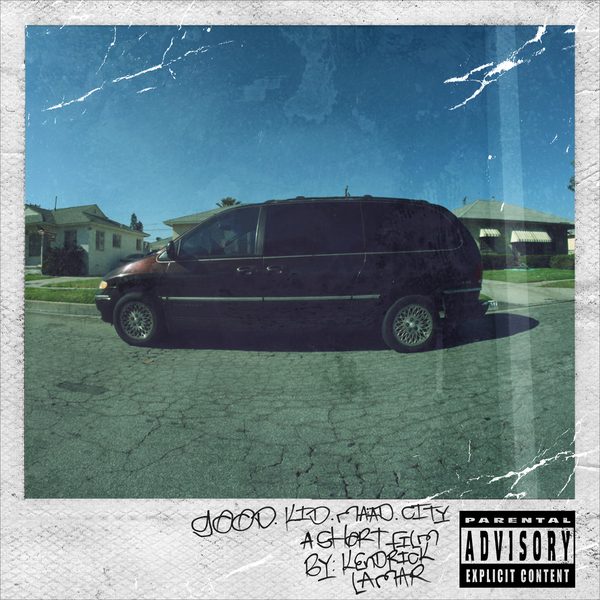
Kendrick Lamar's first major-label album: one day of his Compton adolescence, told in 12 tracks and his parents' voices. Built like a film, and better made than it is new.
- Released
- 22 October 2012 (US)
- Label
- Top Dawg Entertainment / Aftermath / Interscope; Polydor in the UK
- Producer(s)
- Tha Bizness, Sounwave, Hit-Boy, Tabu, DJ Dahi, Scoop DeVille, Pharrell Williams, Terrace Martin, T-Minus, Like, Skhye Hutch and Just Blaze; executive producers Dr. Dre and Anthony 'Top Dawg' Tiffith
- Runtime
- 68:16 for the 12 tracks by the deluxe CD sleeve (68:14 on the standard CD sleeve, which lists 'Money Trees' as 6:24); the deluxe adds three tracks, 83:03 in all
- Chart peak (US)
- #2 (Billboard 200, chart dated 10 November 2012), 241,000 copies in its first week; #1 on Top R&B/Hip-Hop Albums and Rap Albums
- Chart peak (UK)
- #16 (Official Albums Chart, 28 October–3 November 2012); #1 on the UK Hip Hop & R&B Albums Chart in November 2022
- Certifications
- RIAA 3× Platinum (June 2018); BPI 2× Platinum (2 January 2026); Music Canada Gold (13 August 2013)
- Awards & honours
- Four nominations at the 2014 Grammys for the album and its songs, including Album of the Year and one for the deluxe track 'Now or Never', and no wins. #1 on Rolling Stone's 50 Greatest Concept Albums (2022); #6 on its 250 Greatest Albums of the 21st Century (2025).
It takes old parts, the skit album and smooth beats under rough scenes, and binds them to one day so tightly that no track can be moved. That discipline is the strength, and it makes the long final stretch hard to miss.
Kendrick Lamar told Complex in the week of release that his movie ends after 'Real', and that listeners will hear a cassette loading. 'Compton', the track after it, starts the next chapter. The sleeve calls the whole record a short film by Kendrick Lamar, and it means it. Its 12 tracks follow one day in the life of Lamar and his friends. Skits tie them together, and in those skits his real mother and father play themselves. You can shuffle most rap albums without losing much. Shuffle this one and the story stops making sense.
That's the album's great strength, but it isn't a new idea. TDE's president, Punch, says the label always loved albums with skits, like Dr. Dre's The Chronic from 1992, and wanted that for this one. The beats lean on an older West Coast method too. Sasha Frere-Jones of the New Yorker compared its smooth music under rough scenes to early-90s G-funk. What Lamar did was tie those familiar parts to a single day, with every track doing a job in the story. That kind of discipline is rare in rap. It also has a price. When the story is over, the record keeps going.
The idea is older than the deal. Punch told Complex that Lamar had the title and the concept before his 2009 EP, and had already written a project called good kid, m.A.A.d city. Then the buzz outran the plan. Two songs on the 2010 mixtape Overly Dedicated, 'Average Joe' and 'Keisha's Song', began as pieces of it. Lamar said he'd had the cover photograph for years. Dr. Dre's interest was reported in December 2010, and Section.80, an independent album on TDE, followed on 2 July 2011. A joint venture with Aftermath and Interscope was reported in March 2012, with TDE staying his primary label. So the major-label album wasn't a debut built to order. It was the record he'd been planning since before his first EP.
Lamar described it to Complex as a dark movie album about his teenage years. It covers one day, built from twists and paybacks so that every piece connects, and he named Pulp Fiction as the feel. Derek 'MixedByAli' Ali, his engineer, dates the story to 2004. Lamar said he had total creative control, and that he couldn't have made a record this dark without it. The skits carry the plot. His real mother and father play themselves, and so do his real friends. They're performing for the album, not being overheard, and that's a strength. It lets the family sound like family while the story stays his to shape.
It was put together in pieces, often far from home. Punch says much of it was written on the road over about two years of touring: written on a plane, recorded at home, then back out again. Every track on the sleeve credits TDE Red Room in Carson, and three of the 12 standard tracks also list sessions in Atlanta, Los Angeles or Burbank. The beats came from everywhere. Like sent the one for 'Sing About Me' at about 3am, after a Thanksgiving off-day in South Carolina during a Mac Miller tour in 2011. Terrace Martin made 'Real' in New York that December, on a laptop running Logic, software he'd never used. Lamar heard the 'Backseat Freestyle' beat at Hit-Boy's house and recorded his vocal on the road. MC Eiht came to the studio, heard 'm.A.A.d city' and wrote his verse there.
What holds the scatter together is the engineering. Ali recorded every track and mixed all of them except 'Compton'. Dr. Dre, the executive producer, has no production credit anywhere on the album, which will surprise anyone who thinks of it as a Dre record. His mark is in the mix instead. He co-mixed six tracks with Ali and mixed 'Compton' alone, and Ali says Dre told him he'd never mixed alongside anyone before. 'Compton' was the first song Lamar made with Dre, at their first meeting. Just Blaze says the beat was first built for Dre's own Detox, and that Dre kept it for himself and Lamar when that album went on hold. Just Blaze then added the synth and vocoder ending, which he says was meant to make the track an event.
The album's best trick is turning songs that could stand alone into scenes. 'Backseat Freestyle' is a brag over a Hit-Boy beat, and on a playlist that's all it is. Lamar frames it as him and his friends in the back seat at the start of their day. In sequence it becomes a kid performing for his friends, just before 'The Art of Peer Pressure' shows where that leads. Punch calls that next track the film's action scene. 'Swimming Pools (Drank)' was the hit, #17 on the Hot 100. On the album it's an argument with himself, and Ali set out to make the argument audible. When Lamar's conscience comes in on the second verse, Ali says, he switched the mix up, with panning and vocal effects. It's a mixing decision doing a writer's job.
The songs are cut to fit the story. 'Sherane' opens the album as a scene rather than a song. Punch says the album version was about the third attempt, rebuilt so that no hook would break up the story. 'B*tch, Don't Kill My Vibe' goes the other way: its title hook arrives at 0:32 and comes round 25 times. Placed second, it's Lamar setting out his terms before the plot starts. Then 'm.A.A.d city' is the hinge. A B.B. King sample couldn't be cleared, so Sounwave brought in the violinist Mary Keating. Lamar says the first half works as an interlude, and the actual song starts when MC Eiht comes in. Eiht is the album's link to Compton's rap past, a living voice rather than a sample. Lamar named him as an influence who showed him he didn't have to rap about a life that wasn't his. This record would rather lose a chorus than a scene.
The famous guests are handled the same way. Lamar says he and Pharrell cut about five songs, and he took 'good kid' as the title track because of how dramatic it sounds. Lady Gaga recorded a part for 'B*tch, Don't Kill My Vibe' and missed the deadline. Drake, whom Lamar had toured with, got the 'Poetic Justice' track and sent it straight back, Ali says. Sasha Frere-Jones heard a cost in that company: he wrote that Lamar often sounds like Drake. That's half fair. The company is there, but nobody else gets to steer. 'Money Trees' shows how. DJ Dahi built it on Beach House's 'Silver Soul', and the first chorus doesn't arrive until 1:42. Jay Rock's verse was meant for a remix, Punch says, until it fit the story too well to leave off. The song with a labelmate's verse has had the longest life. By 4 October 2026 it had 2.34 billion Spotify streams, far more than anything else on the album.
The trouble comes when the film runs long. 'Sing About Me, I'm Dying of Thirst' lasts 12:03, and its title refrain is last heard at 6:43, with 5:20 still to go. 'Real' runs 7:23. Both have fine passages, and both sag next to the tight first half. Then comes 'Compton', which by Lamar's own account opens a new chapter after the movie has ended. It's a victory lap with Dre, and it lets the air out of the story it follows. Even the hit runs long. The album carries the extended 'Swimming Pools', 5:13 against the 4:07 single edit, and Punch says the extra time plays into the story. In sequence it does, but it's another minute on a record already past an hour. Because the structure is so strict, a stretch that sags has nowhere to hide.
Critics at the time found other costs. Alex Macpherson, in the Guardian, wrote that Lamar's "depiction of downtrodden women is unnecessarily prurient and unconvincing". Robert Christgau gave the album an A−, but wrote that "the commitment to drama has musical drawbacks". He meant that it has few fully distinct songs, though he credited the beats with holding it together. Christgau's complaint goes to the method. A song built as a scene doesn't always stand up on its own, and outside 'Money Trees' and 'Swimming Pools', most of these songs lean on the album around them.
None of that slowed it down. It entered the Billboard 200 at #2 with 241,000 copies in its first week, behind Taylor Swift's Red. It topped the R&B/Hip-Hop and Rap albums charts. Pitchfork gave it 9.5 and put it at #1 on its list of 2012's best albums, one place above Frank Ocean's Channel Orange. The Grammys were less sure. The album and its songs earned four nominations at the 2014 awards, including Album of the Year, and won none. Daft Punk took Album of the Year, and Macklemore and Ryan Lewis's The Heist took Best Rap Album. Macklemore then posted on Instagram the text he'd sent Lamar, with a caption saying Lamar deserved Best Rap Album. The Academy got the rap category wrong, and the winner said so. In 2022 Rolling Stone's Andre Gee was still calling the loss an infamous snub.
Its standing has grown since. By September 2019 it had become the longest-charting standalone hip-hop album on the Billboard 200, with 358 consecutive weeks. By October 2022 it was 10 years into its run on the chart. Rolling Stone placed it at #115 in its 500 Greatest Albums in 2020, then at #1 among the 50 greatest concept albums in 2022. In January 2025 the magazine ranked it #6 of the 21st century so far, 27 places above To Pimp a Butterfly. On Rolling Stone's evidence at least, the reputation has moved toward this record and away from its grander successor. Its effect on other artists is harder to show. It's easy to assert and hard to document, and its clearest legacy is endurance rather than imitation.
So is the reputation right? Mostly. To Pimp a Butterfly is the more daring record, and DAMN. won Lamar the Pulitzer, but neither is as complete as this one. His first major-label album doesn't invent much. It takes the skit album and the West Coast beat and makes both serve one day and one kid's point of view. Its main weakness is length, not shape: the story holds to the end, but the closing run doesn't know when to stop. In October 2012, as HipHopDX reported, Lamar called it "classic worthy", but said it had to stand with time. Time has mostly taken his side. This is a great album with a soft final act, and the best-built record he's made.
Pressing guide — the one to own
The original to own is the 2012 US 2×LP deluxe, B0017695-01, released with the CD on 22 October 2012. United Record Pressing made it, from lacquers cut by Scott Stratton, whose '!' etching is on side C. The runouts read 'II B0017695-01LP01-A Ⓤ' and so on, and the barcode is 602537192267. The catch is that the same catalogue number is on many later pressings. It appears on the 2012 and 2015 European pressings, the 2019 clear and 2020 black US reissues, and a 2021 Australasian pressing. It's also on an undated US reissue, a Canadian one, the 2022 Rashid Johnson box and the 2023 picture disc. The 2020 US repress, pressed by GZ Media, even repeats the original barcode. So the number, the barcode and the country prove nothing on their own. The runouts do. The 2015 European and 2020 US pressings, both from GZ Media, read 53720470 and 53720471. Even the 2019 clear copy that reuses the 2012 runouts drops the 'II' on side C. The 2012 original has 15 tracks; the 2022 anniversary LPs have only the 12 of the standard edition.