
Deep Dive
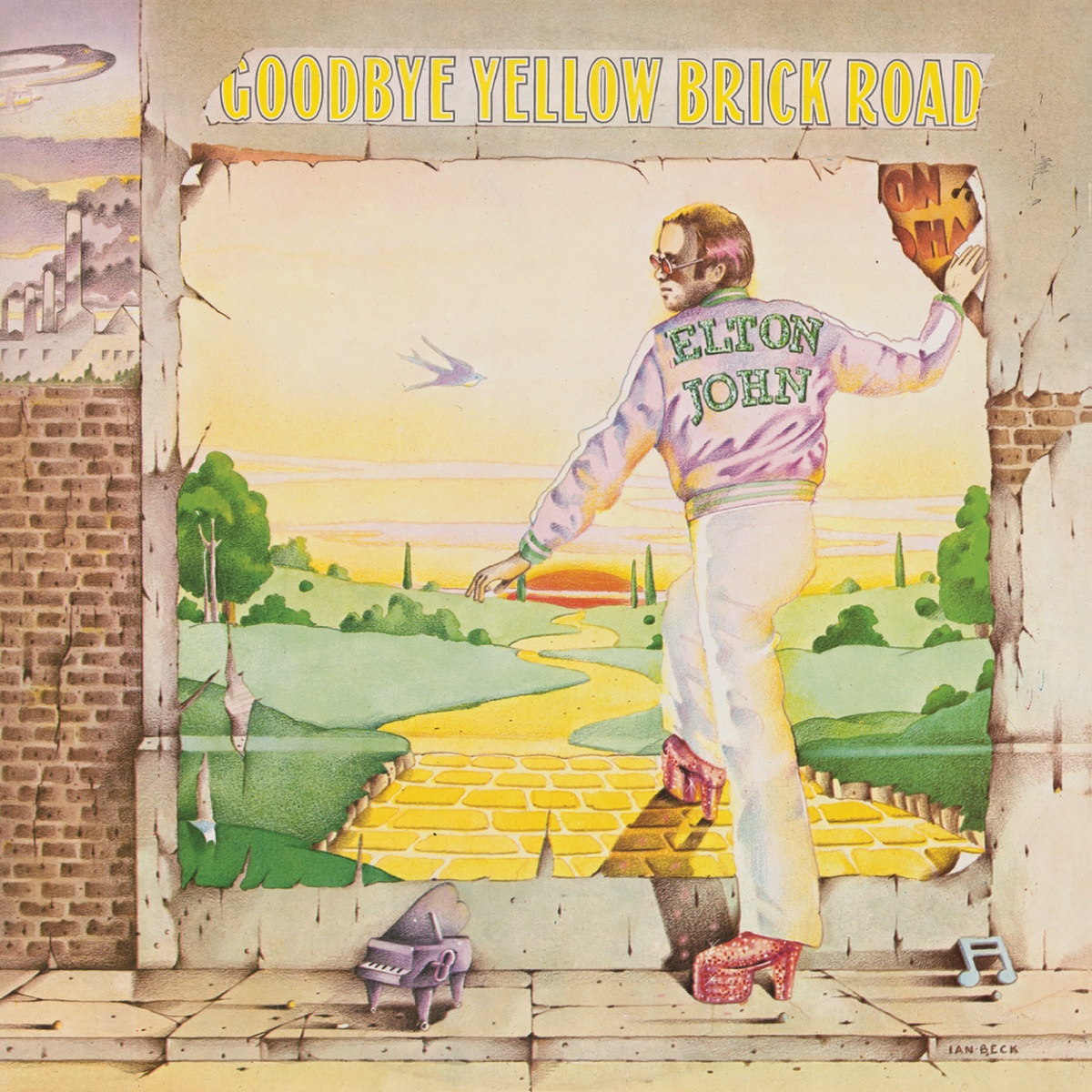
Goodbye Yellow Brick Road
Goodbye Yellow Brick Road by Elton John (1973) — what a copy is worth and which pressing to own, in a full Lead-In dossier: They tried to record it in Kingston and gave up within a couple of days.
Goodbye Yellow Brick Road by Elton John (1973) — what a copy is worth and which pressing to own, in a full Lead-In dossier: They tried to record it in Kingston and gave up within a couple of days.
Elton John's 1973 double album, made in a French château after a failed trip to Kingston. A great songbook that nobody had time to edit into a great album.
Recorded at 3 or 4 tracks a day, usually in two or three takes, Goodbye Yellow Brick Road holds some of the best songs Elton John and Bernie Taupin ever wrote. That speed is also why the weaker ones stayed in.
On 10 November 1973, Goodbye Yellow Brick Road went to #1 on the Billboard 200. The album it replaced was the Rolling Stones' Goats Head Soup, made at Dynamic Sound in Kingston, Jamaica. That January, Elton John's band had tried to record in the same studio. They lasted one or two days. By November they'd knocked the Stones off the top with the record they made instead. It stayed there for 8 weeks.
It's tempting to hear that as a revenge story. It's more useful as a story about speed. Back in France, the band cut 3 or 4 tracks a day, usually in two or three takes. Where the songs were written is less settled. Elton says most were made up on the day they were recorded. The engineer, David Hentschel, says only three or four were written at the Château, after most had been written in Jamaica. Either way, the method left little room for second thoughts. 'Jamaica Jerk-Off' went on the record, and it stayed there. Taupin isn't sure they ever set out to make a double album. He thinks the number and quality of the songs decided it. Goodbye Yellow Brick Road is a great songbook. As an album it's something less, and the reason is the same speed that made the songs sound unforced.
The pressure came from success. Don't Shoot Me I'm Only the Piano Player came out in January 1973 and went on to top the charts in Britain and America. Its single 'Crocodile Rock' became Elton's first American #1. Rolling Stone later counted seven Top 40 singles in the two years before this record. Sound on Sound adds that his contract with MCA asked for two albums a year. The new album's release date was fixed when the Jamaica sessions were booked, Elton's website reported in 2014. Taupin's handwritten draft of the title song is dated 10 January 1973, so some of the words existed before the trip. Elton has said Jamaica was meant as a change of climate. The Stones had made Goats Head Soup there, and Cat Stevens had made Foreigner.
Kingston went wrong quickly. Elton says the band had to cross a picket line of striking studio workers. Davey Johnstone remembers a carpeted room with about two microphones. Equipment broke and was promised for tomorrow. The city was hosting the heavyweight title fight between Joe Frazier and George Foreman. Taupin recalls barbed wire and armed guards. Elton says he never felt in danger, and that leaving was purely about money. The one song they tried was 'Saturday Night's Alright for Fighting'. Taupin called the take atrocious. Johnstone said it sounded 'like a bunch of angry bees'. Within a couple of days they gave up, and the band took a holiday in Ocho Rios. Elton had written a number of songs in the hotel, so Kingston cost the record time rather than material.
In May they went back to the Château d'Hérouville in France, where they'd made the previous two albums. Elton described the routine to Rolling Stone in 2014. There'd be instruments around the breakfast table, and he'd sit at an electric piano. As the band came down to eat, they picked up each song while he wrote it. He remembers Taupin at a typewriter. Taupin says he wrote longhand, on a notepad on his bed. Johnstone says some days they cut only one song. Elton puts the whole record at about 18 days. Hentschel's count, with the overdubs and mixing in London, comes nearer 5 weeks. He'd started at Trident as a 17-year-old tea boy in 1969, and got this job because Ken Scott wasn't available. 'Candle in the Wind' was on tape about an hour after Elton set it, Hentschel says. A method like that trusts first instincts. On this record, the first instincts are mostly right.
The grandest moment on the album was made last, and by the engineer. Gus Dudgeon had wanted to open the record with a film studio's fanfare, and couldn't get it licensed. So after the French sessions, Hentschel built an overture for 'Funeral for a Friend' on an ARP 2500 synthesiser at Trident in London. He wove in lines from other songs on the record, including 'Candle in the Wind' and 'The Ballad of Danny Bailey'. He played single lines so that he could control the dynamics. By his own accounts, it took a few days to write and about a day to record. Nobody sings until about 5:50. Stephen Davis of Rolling Stone mocked the prologue's whooshing in 1973. He missed what it does. It's a trailer cut from the album's own themes, and it gives a loose collection of songs the frame it otherwise lacks.
Some of the best moments are accidents that were kept. Dudgeon said in 1993 that Elton played the opening chord of 'Bennie and the Jets' a bar early, and that it suggested a fake live record. The crowd is a construction. By Hentschel's account, three people clapped out of time, and digital delay multiplied them into about 40. Applause from an older Royal Festival Hall show went on top, with the audience from Jimi Hendrix's set at the Isle of Wight. On 'Saturday Night's Alright for Fighting', Elton lay on the floor and sang live while the band played, then added his piano afterwards. Dudgeon said Elton improvised the title song's falsetto in the studio. Some of these calls were made at the Château and some at the Trident mix. None of them was planned, and they're why the singles still sound alive.
Taupin's half of the bargain was cinema. He told Rolling Stone in 2014 that his lyrics came from the American films and television he grew up on. The title song is about leaving Oz to get back to the farm, which he says is still how he lives. 'Candle in the Wind' uses Marilyn Monroe as a metaphor for fame and dying young. Taupin didn't particularly admire her, and says it could as easily have been James Dean or Montgomery Clift. Elton, by contrast, was a huge fan. 'The Ballad of Danny Bailey' started from a first line and became a bootlegger's story. Elton says he doesn't analyse Taupin's lyrics much, and Taupin never told him what kind of song to write. That distance is the method's hidden cost. On 'Candle', a fan's melody meets a cooler lyric, and the tension makes the song. On 'Dirty Little Girl', nothing in the music questions the sneer.
Side three shows the range best. 'Sweet Painted Lady', 'The Ballad of Danny Bailey', 'Dirty Little Girl' and 'All the Girls Love Alice' are four portraits in a row. 'Danny Bailey' is one of six songs Del Newman arranged for orchestra at Trident. Its story ends at 2:32, and nearly 2 minutes of music follow. 'All the Girls Love Alice' does the same thing harder. Its vocal ends at 3:40, and the band plays on for another minute and a half. Kiki Dee sings backing vocals on it, and Ray Cooper plays tambourine. Davis rated 'Alice' one of the two best things on the record, and he was right. It tells of a 16-year-old's death without comment, then lets the band carry on as if nothing has happened. That refusal to moralise is the song's strength.
The case against the record was made at the time. Davis, in Rolling Stone in November 1973, compared its format to British music hall. He thought it would've made a lovely single LP. He also attacked the hatred of women he heard across the songs, and gave 'Dirty Little Girl' as his example. Robert Christgau gave it a B, and called it another double that would make a good single. Both had a point. 'This Song Has No Title' is a sketch, with Elton playing every keyboard himself. 'Jamaica Jerk-Off', credited to Reggae Dwight and Toots Taupin, is a joke that doesn't survive a second listen. Rolling Stone put it fourth on a 2025 list of terrible songs on great albums.
The trouble is that nobody agrees which single album it should have been. Davis rated 'All the Girls Love Alice' and 'Saturday Night' highest, and thought side four ran downhill. Christgau called 'Bennie' great, liked the title song and rated side four good to great. Davis called the closer, 'Harmony', nothing special. Elton said in 2014 that they could have released 'Harmony' as a single too. Every listener's edit is different, and that's the best defence of the double. It isn't a full acquittal. The record holds together through its band and its producer, not through any design. Its new ideas are few: a synthesiser overture and a fake crowd. Most of the rest is Tumbleweed Connection's American myths and Honky Château's band sound, done bigger.
Its reach isn't in doubt. It was Billboard's top album of 1974, ahead of John Denver's Greatest Hits and Stevie Wonder's Innervisions. In Britain it was the Christmas #1 of 1973 and spent 102 weeks on the chart. 'Bennie and the Jets' reached #15 on the American R&B chart. In May 1975 Elton played it on Soul Train. The documented influence is thinner than the sales. Rolling Stone has linked Guns N' Roses' 'November Rain' to 'Funeral for a Friend', and Dream Theater covered it in 1995. Worldwide sales claims run from 20 million to more than 30 million, and none is audited. Rolling Stone placed it #91 among its 500 greatest albums in 2003.
Elton told Rolling Stone in 2014 that the record caught them at the height of their creative powers, and the songs bear him out. 'Candle in the Wind', 'Bennie and the Jets', the title song and 'Saturday Night' are as good as anything he and Taupin wrote. Dee Murray, Nigel Olsson and Johnstone play them like a band that has stopped needing rehearsal. As an album, though, it's very good rather than great, and its limits are easy to name. It sprawls because nobody stopped it, and it repeats more than it invents. Admire it, keep the songs close, and skip 'Jamaica Jerk-Off' without guilt. It's a record to admire, not to revere.
The copy to want is a clean UK original, and there are plenty about. On 4 October 2026, 10,614 collectors listed the main UK release in their collections. It's DJM DJLPD 1001, pressed by Tranco, in a six-panel tri-fold with DJLPD.1001-1A on the side-one label. The American issue is harder. One catalogue number, MCA2-10003, covers MCA's plants at Pinckneyville and Gloversville and at least three record-club editions. Club editions show it on the sleeve: a Record Club of America licence line on the back, or a CRC mark on the back cover or spine. Some share the retail runouts.
© The Lead-In · an independent, reader-supported music publication.