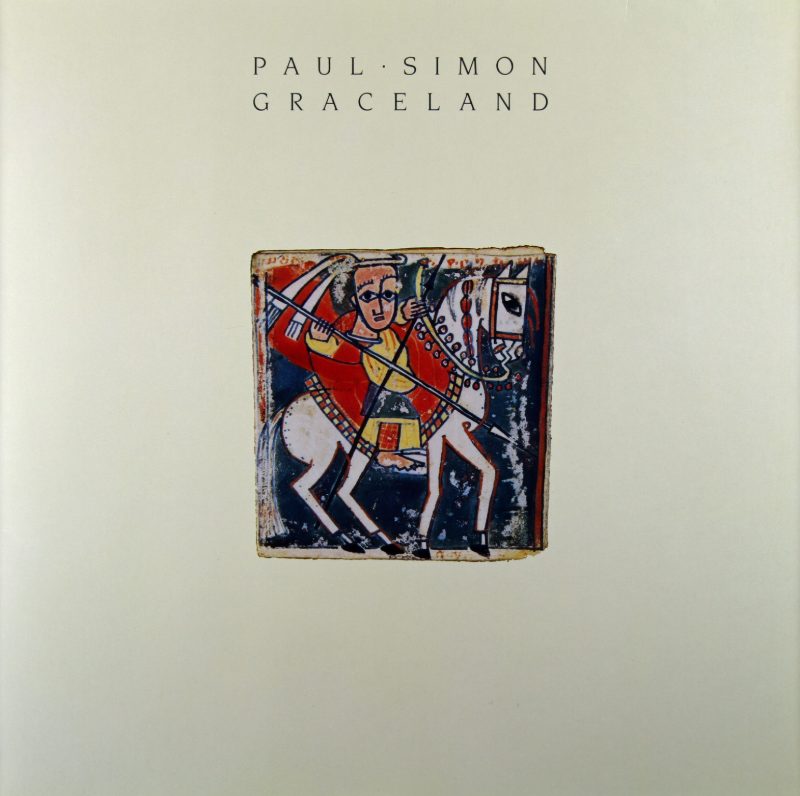
Paul Simon's 1986 album was built mostly on grooves South African bands played before the songs existed. The players are why it lasts, and why its credits are still argued over.
- Released
- 25 August 1986 (US, Warner Bros.); launched in London on 27 August 1986
- Label
- Warner Bros. (US 1-25447; UK and Europe WX 52 / 925 447-1; Japan P-13311; South Africa WBC 1602)
- Producer(s)
- Paul Simon (engineer: Roy Halee)
- Runtime
- 42:37 (11 tracks, 1986 sleeve timings)
- Chart peak (US)
- #3 (Billboard 200, chart dated 4 April 1987), 105 weeks on the chart
- Chart peak (UK)
- #1 (Official Albums Chart), 8 weeks at #1 and 163 weeks on the chart
- Certifications
- BPI 9× Platinum (21 August 2025); RIAA 5× Platinum (31 January 1995)
- Awards & honours
- Grammy Album of the Year (February 1987); 'Graceland' Record of the Year (1988); National Recording Registry (2006 list); Rolling Stone 500 Greatest Albums #46 (2020)
Graceland's best moments belong to its players: Ray Phiri, Bakithi Kumalo, Isaac Mtshali and Ladysmith Black Mambazo. Simon's gift was knowing how to write on top of them. When he leaves that method behind, on the last two tracks, the record goes slack.
On his birthday, at the Hit Factory in New York, Bakithi Kumalo recorded the bass break in 'You Can Call Me Al'. It isn't quite what it sounds like. Kumalo played a one-bar descending phrase on a fretless Washburn. That bar was then copied, reversed and flown back in, so the climb back up is the descent played backwards. Sound on Sound told the story in 2008, and Rolling Stone later called the break a palindrome. What sounds like a virtuoso's flourish is half a performance and half its reflection in the edit.
That bar is Graceland in small, because the whole album was built backwards. Simon told the New York Times that 'the tracks preceded the songs'. Bands played, he sang melodies over them as they went, and the words came later, in New York and at Montauk. The usual story is a songwriter discovering South Africa. The better one is about players whose grooves came first, and a writer with the nerve to build on them. That's where the record's greatness lies. It's also where its trouble starts. A song made on someone else's groove raises a question the credits only partly answer. Graceland is a great record whose best moments belong to the people playing, and it weakens when Simon walks away from them.
Simon came to it out of ideas. Hearts and Bones, his 1983 album, had begun as a Simon and Garfunkel record and sold poorly. He told David Fricke of Rolling Stone in 1986 that afterwards he had no idea what to write. In the summer of 1984 Heidi Berg lent him a homemade cassette of township jive. She'd been a bandleader on The New Show, and Simon had agreed to produce her album. He first played the tape in the car, driving to Montauk. In 1986 he told Stephen Holden of the New York Times only that 'a friend' had given it to him. When Simon told Berg his plan for an album, she demanded her share, and their working relationship soon soured. The record began with a borrowed tape, and arguments about credit have followed it ever since.
He wanted the players, not just the tape. Lenny Waronker at Warner Bros. put him in touch with Hilton Rosenthal, a South African record producer who had worked with Juluka. Rosenthal identified the Boyoyo Boys as the band on 'Gumboots'. He sent records by about a dozen groups and suggested a whole album. Simon had thought of simply buying the rights to the track, and Rosenthal steered him towards recording instead. That meant Johannesburg, and a cultural boycott the UN General Assembly had called for in December 1980. Simon asked Quincy Jones and Harry Belafonte for advice. Belafonte told him to talk to the ANC first. He didn't. He had twice turned down Sun City, and he drew a line between playing to segregated audiences and recording.
In February 1985 Simon flew to Johannesburg with Roy Halee, his longtime engineer. They spent 2 to 2½ weeks at Ovation Studios, depending on whose account you read. Sessions began at noon and ended when a track was done. Simon told Fricke the musicians grew anxious as dark came, because of the curfew and the pass laws. In 2012 he recalled that the saxophonist Barney Rachabane once had to leave by 5pm. He had no permit to be in Johannesburg after that. Simon paid $196.41 an hour, three times the American union rate, by Holden's account. By the second week a core band had formed: Ray Phiri on guitar, Isaac Mtshali on drums and Bakithi Kumalo on bass.
You can hear that order of work from the first seconds. 'The Boy in the Bubble' gives Tao Ea Matsekha, a band from Lesotho, 28 seconds before Simon sings. Their accordionist, Forere Motloheloa, shares the music credit. Simon's voice arrives inside a groove recorded before most of the words were written. He told Fricke it held the only lyric fragment he brought home from South Africa. The title track, played by Phiri, Kumalo and Demola Adepoju on pedal steel, waits 40 seconds for his voice. 'I Know What I Know' is the strangest fit, and one of the best. General M.D. Shirinda and the Gaza Sisters play Shangaan music, and Simon sets his own words on top. Halee later admitted that many of the album's lyrics were 'very wordy'. That friction is the album's real subject: an American voice, in its own accent, inside someone else's music.
Then came the second half of the method. In May 1985 the trio flew to New York for more sessions. The Hit Factory, where most of the overdubs were done, had an SSL console and a Sony PCM-3324 digital multitrack. Halee reckoned the tapes went between analogue and digital at least 20 times as the songs were edited, overdubbed and edited again. He said the album couldn't have been made without digital editing. Simon usually sang into a Neumann U67. He'd sing the same vocal 15 times, and Halee comped the best of it into one. On 'You Can Call Me Al', Rob Mounsey's horn arrangement was doubled by his own synthesiser part. Pitchfork heard the era's production hallmarks in 2012, but said the record had 'refused to age'. It has, and Halee gave the reason himself. He said he'd tried to capture 'the integrity of the South African sound, not my own sound'.
The album's centre is a song with no instruments at all. Simon was listening to tapes of Ladysmith Black Mambazo on a Simon and Garfunkel tour of Australia in 1982. In October 1985 he recorded 'Homeless' with them at Abbey Road in London. For its introduction, the group's leader, Joseph Shabalala, adapted the words of a traditional Zulu wedding song. Simon joined them around one microphone. Rob Tannenbaum, reviewing the album for Rolling Stone, called it the most moving track. Simon told Fricke that when politics came up in it, they came up naturally. Seven months later Ladysmith were in New York for Saturday Night Live, and 'Diamonds on the Soles of Her Shoes' was made at the Hit Factory. Its opening section is credited to Shabalala and Simon. On these two tracks Simon sounds most like a guest. They're the best things on the record.
The weakness comes at the end. By Tannenbaum's count, 9 of the 11 songs come out of South African music, and the last two don't. 'That Was Your Mother' was cut in Crowley, Louisiana, with the zydeco band Good Rockin' Dopsie and the Twisters. 'All Around the World or the Myth of Fingerprints' was made with Los Lobos. Tannenbaum heard them as afterthoughts in 1986, and Robert Christgau, in the Village Voice, thought they fell 'a little flat'. They were right. Both are likeable. But the album's argument is complete by then, and these two restate it in other accents, with less at stake. They also bring the credit question back. Both are credited to Simon alone. Rolling Stone noted in 2016 that the first resembles 'My Baby, She's Gone', registered to Alton Rubin Sr, better known as Good Rockin' Dopsie. The band reacted with little more than annoyance, and Rubin made no further claim. In 2008 Steve Berlin of Los Lobos said the second was the band's, that they got no credit or payment, and that Simon told them to sue. Simon says the first he heard of it was a lawyer's letter, 6 months after release.
The politics are harder, and the music can't settle them. Linda Ronstadt sings on 'Under African Skies', and she supplied images from her childhood in Tucson for its lyric. She had played six shows at Sun City in May 1983. Simon had refused to sing on 'Sun City', the protest record, because its demo named her. Christgau, who rated Graceland Simon's best record since 1972 for listeners who liked him thorny, called her presence 'a slap in the face' to the anti-apartheid movement. At the London launch on 27 August 1986, Simon's remarks provoked Jerry Dammers. He argued that Simon was helping maybe 30 people while damaging solidarity over sanctions. The UN's anti-apartheid committee added Simon to its register of artists who had broken the boycott. By February 1987 it had stepped back. Hugh Masekela, who had known Simon since the 1960s, proposed the tour with Miriam Makeba that followed.
The sales didn't wait for the argument to end. Graceland reached #1 in Britain on the chart dated 4 October 1986. It spent 8 weeks at the top and 163 on the chart in all. In America it climbed slowly, to #3 on 4 April 1987. It won Album of the Year at the Grammys in February 1987, and the title song won Record of the Year at the next ceremony. Its influence is genuine, but narrower than its reputation. Pitchfork pointed out in 2012 that it wasn't the first world-music album, as some critics claim. Simon had heard Talking Heads' Remain in Light, which Fricke called 'high-life-influenced', and told him it was his favourite of their records. The clearest documented heir is Vampire Weekend's 2008 debut, which was compared to it constantly. Simon said they were drawing from the same well. The deeper change was for Ladysmith Black Mambazo. Simon produced their Warner Bros. album Shaka Zulu the next year, and the Library of Congress cited Graceland for introducing them to American audiences.
So the reputation is right about the playing and generous about the whole. At its best, on 'Homeless', 'Diamonds', 'The Boy in the Bubble' and the title track, this is as good as anything Simon has made. Most of the credit for that is shared with the people in the room. The flaws are real, and you can hear one of them. The record goes slack in its last 6 minutes, and the question of who owns these songs has a sharper edge than the sleeve admits. Neither stops Graceland being a great album. It does mean the right way to hear it is as a band record with a famous singer. The names worth taking away from it are Ray Phiri, Bakithi Kumalo and Joseph Shabalala. Simon's is the one you knew already.
Pressing guide — the one to own
There's no gatefold and no 'first state' of Graceland. The 1986 originals came in a single sleeve, with the horseman embossed and a printed inner of lyrics and credits. The US original is Warner Bros. 1-25447 on the labels and 9 25447-1 on the spine. Greg Calbi cut it at Sterling Sound by DMM, and Sheffield Lab plated it, so the runouts read STERLING DMM with △12646. Two plants pressed the US store copies. Allied copies have an embossed 'A' in the label's inner ring, and Specialty copies have 'E A S T' near the spindle hole. The US and European originals share that metalwork, and the catalogue credits the Japanese P-13311 to Sterling and Sheffield Lab too. The exceptions are a UK cut by Barry Grint, marked 'BAZZA', and the South African WBC 1602, whose runouts carry none of the US marks.