
Deep Dive
Highway 61 Revisited
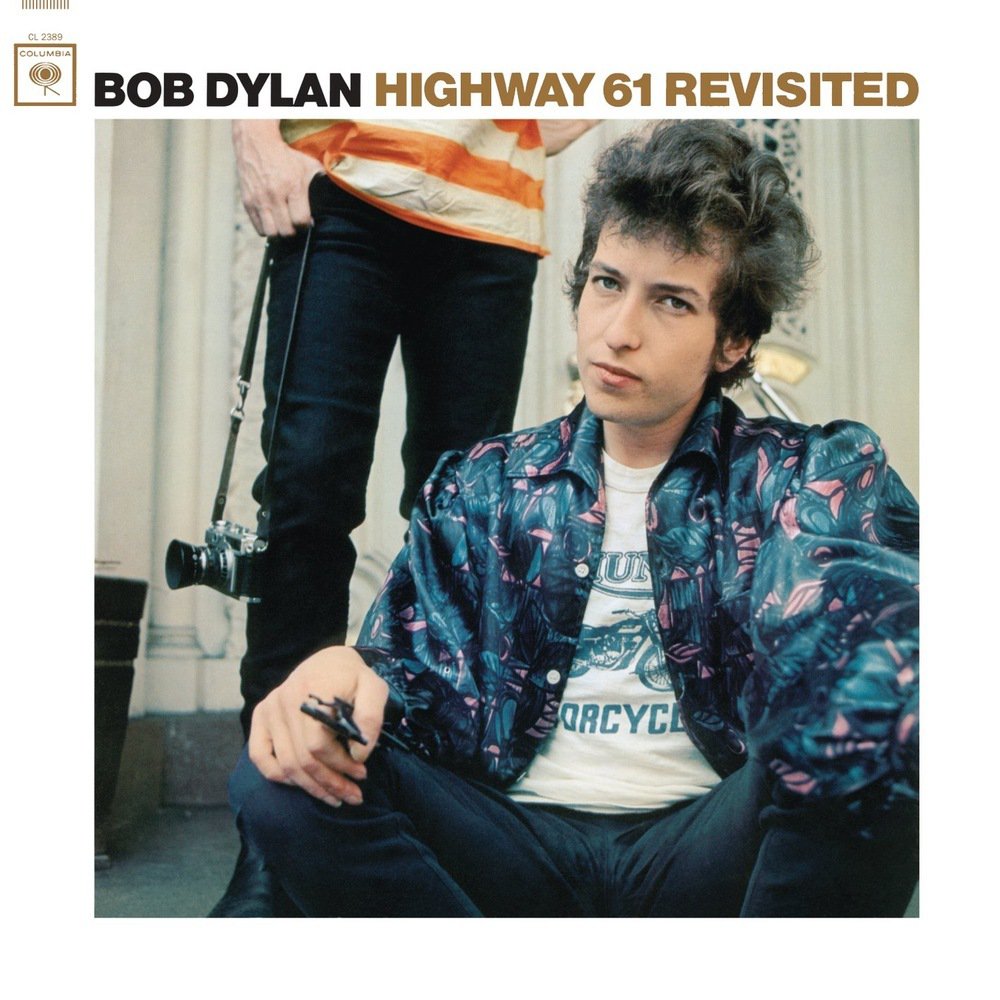
Highway 61 Revisited by Bob Dylan (1965) — what a copy is worth and which pressing to own, in a full Lead-In dossier: Dylan's sixth album, cut in six days at Columbia's Studio A in the summer of 1965.
Highway 61 Revisited by Bob Dylan (1965) — what a copy is worth and which pressing to own, in a full Lead-In dossier: Dylan's sixth album, cut in six days at Columbia's Studio A in the summer of 1965.
Bob Dylan's sixth album, nine songs cut in New York in summer 1965. The writing is as strong as anything he made. The record around it was made in a hurry, and it shows.
Highway 61 Revisited holds the best songs Dylan had yet written, recorded in six days by players who'd often met them only days or hours before. The speed gave the record its nerve, and it left the middle undercooked.
On the afternoon of 16 June 1965, in Columbia's Studio A in New York, the organ on 'Like a Rolling Stone' was played by a guitarist. Al Kooper was 21. By his own account, the producer Tom Wilson had invited him to watch from the booth, not to play. He brought his guitar anyway, and Rolling Stone's Joe Levy says he bluffed his way in. Olof Björner's session log, compiled from the studio sheets, even has him playing guitar the day before. When Paul Griffin moved from the organ to the piano, Kooper sat down at the keyboard he'd left. Wilson laughed and let it go, and Kooper says he faked his way through. On playback Dylan asked for the organ to be turned up. Wilson said Kooper wasn't an organ player. Dylan didn't care. The fourth take of that day's remake became the record.
That small argument explains the whole album. All that summer Dylan chose nerve over polish, and the songs he brought were strong enough to carry the risk. Highway 61 Revisited has the best set of songs he'd yet put on one record, and maybe the best he ever would. It was also made in six recording days, by players who'd often met the songs only that weekend or that night. The words are close to faultless. The record built around them isn't, and the gap between the two is the honest way to hear it now.
It began in exhaustion. The English tour filmed for Dont Look Back ended on 10 May 1965, and Dylan was bored of playing his old songs the way he'd recorded them. "I was playing a lot of songs I didn't want to play," he said afterwards. What came instead was a long piece of prose, 10 or 20 pages by his own count, which he called vomit and cut down to one song. The only known draft of the finished lyric is in pencil, on four sheets of Roger Smith Hotel stationery from Washington. Its chords were borrowed from Ritchie Valens's 'La Bamba'. None of it came from the folk clubs.
He needed a band, and he didn't yet know what it should sound like. On 12 May, in London, he tried a session with John Mayall's Bluesbreakers and a 20-year-old Eric Clapton. They played for two hours without getting anywhere, and Bob Neuwirth told Clapton he was playing too much blues. A month later Dylan gave Mike Bloomfield more or less the same advice. Bloomfield, the guitarist in the Paul Butterfield Blues Band, spent the weekend before the sessions with Dylan in Woodstock, learning the songs. He'd just bought a Telecaster, and Dylan told him he didn't want any B.B. King. By Bloomfield's own account, he ended up as something close to the musical director. Dylan knew what he didn't want long before he could say what he did.
Between the two sets of sessions came Newport. On 25 July Dylan played three electric songs with Bloomfield, Kooper and three others, then came back for two acoustic ones. What the crowd booed is still argued over: the shock of it, a sound too quiet to follow, or one too loud. Dylan's own position was plain. Around the album's release he told Nora Ephron and Susan Edmiston, "They can boo until the end of time." Four days after Newport he was back in Studio A, and Wilson wasn't. Bob Johnston had taken over. Nobody has fully explained why. Johnston pointed to friction between Wilson and Dylan's manager, Albert Grossman.
The rest of the album took four days, and speed was the method, not an accident. On 29 July the band cut 'Tombstone Blues' at the 12th take. The same day Dylan sat at the piano and reworked 'It Takes a Lot to Laugh, It Takes a Train to Cry'. A fast rocker became the slower, sweeter song on the record. 'From a Buick 6' was done the next day. Over the weekend Dylan and Kooper wrote out chord charts in Woodstock. On Monday 2 August the session started at 8pm and ran until 3:30 the next morning. It produced four of the album's nine songs, the title track and 'Ballad of a Thin Man' among them. 'Desolation Row' was finished on 4 August, and the album came out 26 days later.
Start with the first seconds of 'Like a Rolling Stone'. Inducting Dylan into the Rock and Roll Hall of Fame in 1988, Bruce Springsteen remembered hearing it at 15, in his mother's car. He described "that snare shot that sounded like somebody kicked open the door to your mind". Dylan is singing by 0:10. The organ is the other thing you notice, and it sits high in the mix, where Dylan wanted it. Kooper says the song had only four or five chords and his ears were good, which was all the preparation he had. The part works because it doesn't sound worked out. It turns a 6-minute accusation into something you can live inside. The chorus comes round four times, from 1:18, and never wears thin.
Speed didn't always hurt. At two in the morning, as 2 August turned into 3 August, the band reached 'Ballad of a Thin Man'. It was the quickest song of the night: a false start, a breakdown, then the master, take 3, with an insert added. Joe Levy hears it taking shape around Ray Charles's 'I Believe to My Soul'. It's the nastiest song on the record, and the nastiness is what has kept it alive. Mr. Jones fits anyone who has ever been the last to understand. The title track is cruder and funnier. Its siren whistle is credited on the sleeve to Dylan, as 'Police Car'. Kooper says the whistle was his. He wore it round his neck, he says, and handed it to Dylan to play instead of a harmonica. It's the best joke on the record.
Then there's 'Desolation Row', more than 11 minutes long and with no drums at all. It was planned as Dylan alone with an acoustic guitar. Johnston had other ideas, and brought in Charlie McCoy, a Nashville guitarist, to overdub the fills. Joe Levy hears a Mexican cantina in them. Russ Savakus plays bass. The title comes round 10 times. After the ninth, the voice drops out for about 50 seconds, and it comes back at 9:33 for the last verse. The cast runs from Einstein to Ezra Pound, all on the same street. It's the best writing Dylan had done.
The trouble is the stretch in between. Robert Christgau, writing in Stereo Review in 1969, said Dylan's rock on the album "had a loose feel, almost tacked on". He still thought the music "great in spite of its defects". Kooper, half a century later, called the making of it "an unprofessional situation", and gave his own place at the organ as the example. Mostly that works in the album's favour. In the middle of the record it doesn't. 'From a Buick 6' is the shortest song here, done in four attempts, and it's a good groove looking for a song. 'Queen Jane Approximately' is pleasant for 5½ minutes and asks little of anyone. After Dylan's last line the band plays out the final 48 seconds without finding anything new. Next to 'Desolation Row', both sound like sketches that never got a second session.
The haste shows on the first copies too. The first US stereo pressings carried a different take of 'From a Buick 6', one that opens on harmonica. The first stereo back covers printed 'meaningful' where later ones read 'meaningless'. Catalogue entries list the original mono and stereo copies with running times shorter than the tracks, by 44 seconds on 'It Takes a Lot to Laugh'. None of this hurts the songs. It does tell you how the record was made: fast, by people who trusted the material more than the finish.
What it changed, the people it changed have described. Paul McCartney heard 'Like a Rolling Stone' at John Lennon's house. He said Dylan had shown them all that it was possible to go a little further. Columbia sent radio a version split across both sides of a 45, but listeners demanded the whole song, and got it. It reached #2 on the Hot 100, behind the Beatles' 'Help!'. When Dylan sang rock, Christgau wrote, "he legitimized it in the folk community". Within a year Johnston was producing Blonde on Blonde, with Kooper and McCoy playing again and Nashville on the sleeve. By June 1967 Jimi Hendrix was playing 'Like a Rolling Stone' at Monterey.
The reputation has moved since. Rolling Stone put the album at #4 on its 2012 list of the greatest albums, then dropped it to #18 in 2020. The fall is fair. Judged on its songs, it belongs at the very top of any list. Judged as a made thing, it has a soft middle and a sound that was still being found while the tape ran. The 2020 number splits the difference, which is about right.
Highway 61 Revisited is a great record with a real flaw, and the flaw is in the making, not the writing. Its best four songs would carry any career on their own. Its weakest two are the price of making an album in six days. Play it for the words and for the nerve. Don't play it expecting a record finished with the care its songs deserved. It's essential, and it's a notch below its legend.
The original to own is the 1965 US mono, Columbia CL 2389, pressed at Pitman. The label reads Columbia, not CBS, and is marked '360 Sound', with NONBREAKABLE under the catalogue number. The label matrices are XLP 110638 and XLP 110639, and the runouts carry a Pitman 'P'. It came in a single sleeve, not a gatefold, with a small '7' at the lower right of the back. For a curiosity, find an early US stereo copy, CS 9189, whose side A runout ends -1A to -1D. It carries a different take of 'From a Buick 6', which opens on harmonica.
© The Lead-In · an independent, reader-supported music publication.