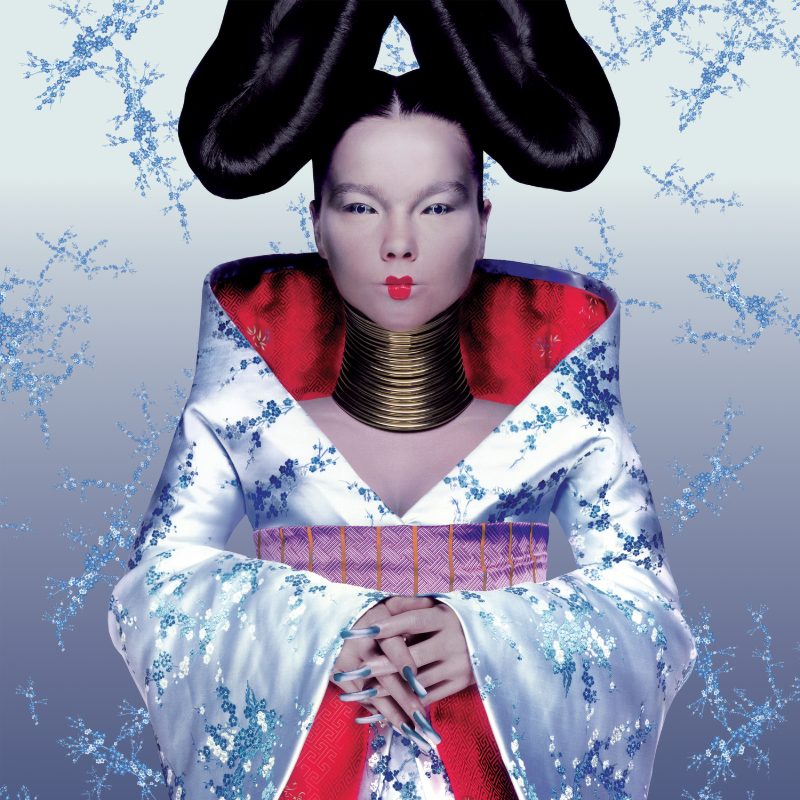
Björk's third album, begun in a London home studio and made in southern Spain with Mark Bell and an Icelandic string octet. One idea, carried all the way, is its triumph and its cost.
- Released
- 22 September 1997 (UK, One Little Indian)
- Label
- One Little Indian (UK: TPLP71 LP, TPLP71CD CD); Elektra (US, 62061-2 CD); Mother Records elsewhere
- Producer(s)
- Björk · Mark Bell · Guy Sigsworth · Howie B
- Runtime
- 43:35 (10 tracks)
- Chart peak (US)
- #28 (Billboard 200)
- Chart peak (UK)
- #4 (Official Albums Chart, week of 28 September 1997)
- Certifications
- BPI Gold (16 October 1997); Music Canada Gold (12 June 1998); RIAA Gold (31 August 2001)
- Awards & honours
- Grammy nomination, Best Alternative Music Performance (1998), lost to OK Computer; #9 in the Village Voice Pazz & Jop poll for 1997; #202 on Rolling Stone's 500 Greatest Albums (2020)
Björk asked for one flavour and got it: strings and beats treated as a single material, which is the record's great achievement. The price is a soft middle, where the weaker songs dissolve, and an influence narrower than its legend.
Markus Dravs, who engineered Homogenic, remembers the brief Björk gave him. She wanted beats like rough volcanoes covered in soft moss. That's his memory, as Pitchfork's Philip Sherburne retold it in 2017, but the album's working title says the same thing more bluntly. It was going to be called Homogenous. She told Spin she wanted one flavour, one state of mind. She'd compared Debut and Post to Tintin books, each a trip somewhere new. This one, she said, was going home. Most albums ask for a mood. This one asked for a substance: something hard and something soft that couldn't be pulled apart.
That's the right way to hear it, and it's where both the record's greatness and its flaw live. Homogenic is a producer's album in the best sense. Its strings and its programmed beats aren't laid next to each other. They're treated as one material, so thoroughly that Sherburne wrote you can't tell where the strings end and the silicon begins. Nothing Björk had made before sounds this sure of itself. But one flavour has a cost. When every track is built from the same stuff, a weaker song has nowhere to hide. Three of them sit between the fifth and eighth tracks.
It started at home. After the long tour for Post, Björk began work in her own studio in Maida Vale, in London, with Dravs. Then, in September 1996, a stranger turned her life into a news story. Ricardo López, who lived in Hollywood, Florida, had kept video diaries about her for about 9 months. He posted a sulphuric-acid device, hidden in a hollowed-out book, to her London home. Hours later he shot himself, with the camera running. Police found his body on 16 September. Given the address by Florida police, Scotland Yard found the parcel at a sorting office in South London, and it was detonated.
It's tempting to hear the whole album through that week. Sherburne argues that you don't need the biography, and he's right about the songs. None of them is about López. Where he shows up is on the map. In Mark Pytlik's biography, the press attention stopped the London sessions. Trevor Morais, her tour drummer, offered his studio in Spain so she could work in private. She meant to stay briefly and ended up making the album there. That's how López reached the record. He changed its address.
Spain gave her Mark Bell. She'd wanted the LFO producer since Debut, Bell said in 2002, and this time he came out and stayed for 5 months. He remembered mornings when Morais ran a drum school for him, Dravs, Björk and her assistant. Björk told Oor magazine in September 1997 what she was after. She wanted Icelandic techno, with electronic beats as the heartbeat and strings as the old-fashioned colour. Years later she called it her summer album, perhaps, she said, because she'd made it in Spain. That's the album's quiet joke. A record about Iceland was built in the sun, in a drummer's studio in Málaga province.
The strings tell you whose record it is. The sleeve credits the Icelandic String Octet on 4 tracks: 'Hunter', 'Jóga', '5 Years' and 'Pluto'. A separate London section plays 'Bachelorette'. Eumir Deodato arranged 'Hunter' and 'Pluto'. On the other three he orchestrated and transcribed arrangements Björk had written herself. So three of the five string arrangements are hers. By MusicTech's account, she worked out string parts on a small Casio keyboard. Her first idea was stranger still. She wanted the strings in the left channel, the beats in the right and her voice in the middle. She dropped it. From then on, the strings and the beats weren't two sides of anything.
You can hear the decision from the first track. 'Hunter' runs 25 seconds before Björk sings. Pitchfork hears the song bobbing on fluttering kicks and snares and a reversed accordion, and the sleeve puts the Octet on it too. 'Jóga' is the clearest case. Sherburne hears churning breakbeats and slowly bowed strings in it, and from 2:25 the voice drops out for half a minute, the song's only long break. If his line about not telling the strings from the silicon holds anywhere, it holds there. 'Jóga' is also one of the three tracks Björk arranged herself, which is the best answer to anyone who thinks the hired arranger made this record.
'Bachelorette' is the most orchestral thing here. It has the London strings, harp, horns, timpani and a military snare. It's also the one track Björk produced alone. Bell recalled that Coba, the accordionist, played with three fingers on each hand to sound like an enthusiastic amateur. That small joke matters, because it roughens a song that could have turned grand. Björk called it the third part of a trilogy with 'Human Behaviour' and 'Isobel'. Sherburne found it and 'Jóga' short of room to breathe, even in a 10-out-of-10 review, and he has a point. Both are dense from bar to bar. They thrill on the first play and tire on the tenth.
The two quietest songs show how far the method stretches. 'Unravel' was written with Guy Sigsworth, and the two of them produced it. No strings are credited on it, yet Pitchfork heard slow string harmonies, which says a lot about how this record treats sound. It's the song that won over Radiohead. Thom Yorke said in 2006 that it was one of the most beautiful songs he'd heard, and Radiohead recorded their own version the next year. 'All Is Full of Love' closes the album, produced and mixed by Howie B. Pitchfork calls it beatless. Björk later called it the first Vespertine song. So a record about one flavour ends by tasting the next one, and that's an honest way to finish.
The weakness is in the middle. 'All Neon Like' is the longest track, at 5:53, and it repeats a texture more than it builds a song. 'Immature' is the shortest, at 3:06, and it's pleasant and slight. It's one of two tracks Björk didn't produce, and the only one Bell produced alone. 'Alarm Call' has what Sherburne calls the album's least frictional beat. It sounds like a single, and it became one, a UK #33 in late 1998. Writing at the time, the A.V. Club's Stephen Thompson complained that the songs rarely assert themselves, and that '5 Years' gets lost in the noise. He went too far. But the method that makes 'Jóga' feel like weather makes 'Immature' feel like weather too, and weather is hard to remember.
'Pluto' is where the critics split, and the split is revealing. NME's 1997 review called the album Björk's weirdest and her best, but heard 'Pluto' as the one place its elements clash. Thompson, who disliked most of the record, singled 'Pluto' out for praise. Both were hearing the same thing. It's the one track where the single flavour turns sour on purpose. Sherburne calls its beat a buzzing stomp, and the Octet is in there too, on an arrangement by Deodato. It's also Bell's one writing credit, which suits a track that sounds like his half of the record winning an argument. After the middle stretch, it's the jolt the album needs.
Its reputation has moved the other way from its sales. Homogenic entered the UK chart at #4, behind Oasis, Ocean Colour Scene and Finley Quaye. Debut had reached #3 and Post #2. In America it had sold 501,000 copies by 2007, against 810,000 for Post and 918,000 for Debut. 'Jóga', the lead single, didn't make the UK Top 100 at all. Critics were warmer from the start. It was #9 in the Village Voice's Pazz & Jop poll for 1997. Pitchfork gave it 9.9 that year and 10 in 2017. In 2020 Rolling Stone ranked it #202 among the 500 greatest albums. Each Björk album to that point had sold less in America than the one before. Homogenic is still the best of the three.
Its influence is real, and narrower than the legend. The documented line runs through Radiohead. Yorke's praise for 'Unravel' is on the record, and the band went on to record the song. The Arca line is a critics' reading. Sherburne hears Homogenic in Arca's music, and Rolling Stone named Yorke and Arca in 2020 as artists the album enraptured. Arca later co-produced Björk's Vulnicura, but we found no statement from Arca about this album. Sam Walton argued in Loud and Quiet that Kid A follows its shape, which is also a critic's reading. The bigger claim, that art-pop since 1997 runs on Homogenic, has no artist statement behind it that we could find. Its clearest heir is Björk herself. Vespertine grew out of its last song, and Sherburne hears the dropped left-and-right plan coming back on Vulnicura Strings.
Homogenic is a great record with a soft middle. Its production is as sure as anything Björk has made, with strings and beats that sound grown together rather than joined. 'Unravel' is one of the best songs she's written, and 'All Is Full of Love' is a perfect last page. 'Jóga' and 'Bachelorette' are the peaks, though the density that thrills on the first play still wears on the tenth. The songwriting doesn't always keep up with the sound. On 'All Neon Like', 'Immature' and 'Alarm Call', one flavour tastes thin. That's the reservation, and it's a real one. What's left is the sound of an artist who knew exactly what she wanted, and mostly got it.
Pressing guide — the one to own
The original to own is the 1997 UK LP, One Little Indian TPLP71, which the catalogue lists as the first pressing. It has a top-opening single sleeve, a printed card inner sleeve and, in some copies, a folded poster. Nilesh Patel cut the lacquers at The Exchange, and the etched runouts read 'TPLP-71 A-1 EW NILZ - THE EXCHANGE' and 'TPLP 71 B-1 EW NILZ - THE EXCHANGE'. The catalogue number and barcode don't prove it, because the 2000, 2015 black and 2022 LPs carry both on the sleeve. The 2023 LP carries the same barcode. The 2000 repress is the close one. It's 180 g, was sold sealed with a Tplp71H sticker, and its runouts end in a full stop as the catalogue transcribes them. The 2015 green vinyl adds GZ job numbers, and the 2015 black LP has Optimal runouts.