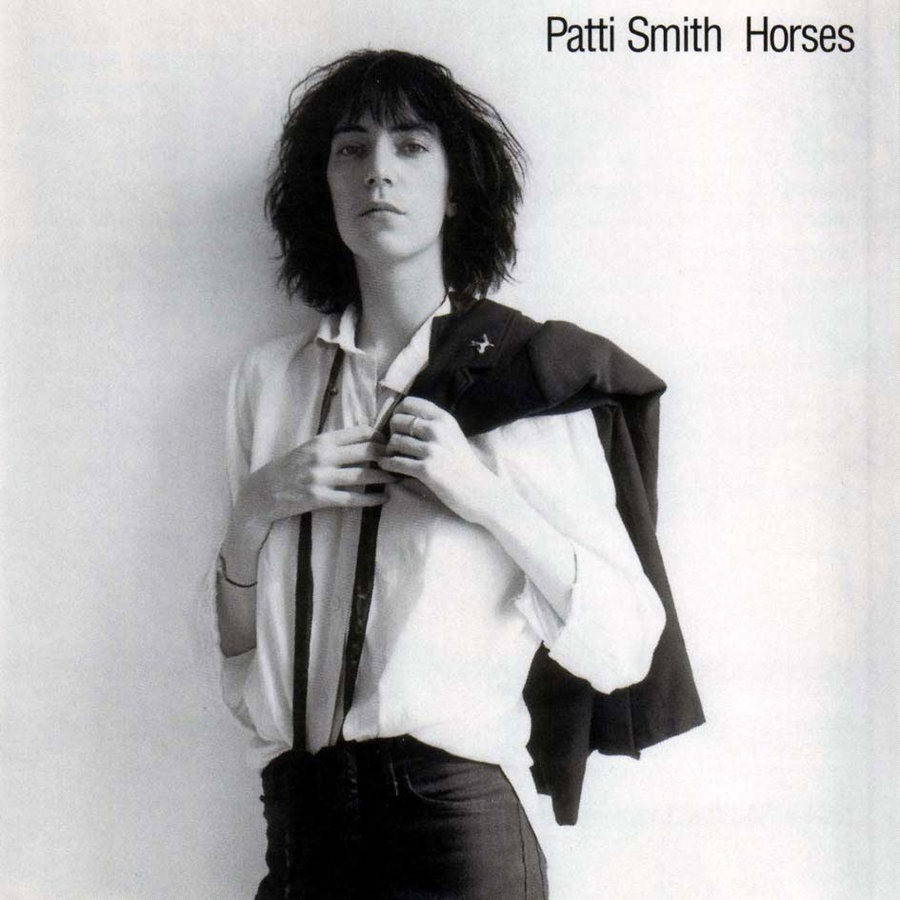
Patti Smith's debut, recorded at Electric Lady in September 1975 with John Cale producing: a poet calling rock's dead heroes back, over a band that improvised its two longest pieces.
- Released
- 10 November 1975 (US, Arista)
- Label
- Arista (US AL 4066; UK ARTY 122; Japan IES-80454)
- Producer(s)
- John Cale
- Runtime
- 43:10 (8 tracks)
- Chart peak (US)
- #47 (Billboard 200, chart dated 7 February 1976), 17 weeks on the chart
- Chart peak (UK)
- #83 (Official Albums Chart, chart dated 19 October 2025, with the 50th-anniversary edition); no chart run in 1975–76
- Certifications
- BPI Gold (22 July 2013); ARIA Gold (24 April 2017). No RIAA certification
- Awards & honours
- National Recording Registry (2009); Grammy Hall of Fame (2021); #26 on Rolling Stone's 500 Greatest Albums (2020); #2 in the Village Voice's 1975 Pazz & Jop poll
Horses is filed as the first punk album, though apart from 'Gloria' it barely sounds like punk. Its peaks are 'Birdland' and 'Land', two 9-minute improvisations. The shorter songs, left plain and exposed, are where it falls short.
Patti Smith wanted Horses in the shops on 20 October 1975, Arthur Rimbaud's birthday. A vinyl shortage pushed it back to 10 November, the anniversary of his death. She told Rolling Stone in 2014 that she found the delay magical, and you can see why. The record she'd made is full of the dead. 'Elegie' was recorded on 18 September 1975, 5 years to the day after Jimi Hendrix died. It was made at Electric Lady, the studio Hendrix built. 'Break It Up' began as a dream about Jim Morrison. Even 'Land', Smith told Simon Reynolds of the Observer in 2005, is a tribute to Hendrix.
Horses is usually filed as the first punk album. In that 2005 piece, Reynolds noted that it's generally considered the spark of the punk explosion. It also beat the Ramones' debut into the shops by 5 months. Then he pointed out that, apart from 'Gloria', it doesn't sound very punk. He's right, and the gap matters. This is a record that looks back. Smith told him that by the early 1970s rock's greatest voices had been snuffed out: Dylan had retreated, and Hendrix and Morrison were dead. Lenny Kaye, her guitarist, said in 2015 that they were as much a Sixties band as anything. Horses is their attempt to bring that music back, led by a poet who plays no instrument on it. Its punk reputation comes from what it set off. What makes it great is the singing, and two long pieces nobody else could have made.
She came to it from print. Between 1971 and 1973 she published three books of poetry, and she still wrote the odd piece of rock criticism. Jane Friedman, who managed her, and Allen Lanier of Blue Öyster Cult pushed her to sing. Her first single, 'Hey Joe' backed with 'Piss Factory', came out in 1974 on Mer. By Dave Marsh's account in Rolling Stone, Kaye, Robert Mapplethorpe and Friedman's company set the label up to release it. In February 1975 Stephen Holden of RCA recorded a demo with the band. John Rockwell wrote about it in the New York Times, and then Clive Davis called. Davis said Lou Reed had tipped him off. That spring the group played a two-month residency at CBGB with Television, still without a drummer. By May, Smith had signed to Davis's new label, Arista. She was 28 when the sessions began.
Her first choice of producer was Tom Dowd, but he was tied to Atlantic, whose boss was against her. So she picked John Cale. Reynolds writes that she chose him less for the Velvet Underground than for the raw sound of solo records such as Fear. She told Marsh she'd been looking for a technical person and got a 'total maniac artist'. Cale once asked her why she'd chosen him. When she said his records sounded good, he joked that she should have hired his engineer. Both have described a fight. Cale told the Independent in 1996 that it was 'a lot like an immutable force meeting an immovable object'. His clashes with Lanier, he said, escalated until they got a little frightening. Smith admitted she'd been suspicious and hard to work with.
Her suspicion had a reason. Rock was becoming over-produced, she told the Independent, and she was trying to fight against that. Jenn Pelly of Pitchfork writes that Smith wanted the band captured live in the room, without overdubs. Cale's question was how to contain her energy on a record. She'd bring several poems to a session and want three words from one and two lines from another, a cut-up in the manner of William Burroughs. The sessions ran at Electric Lady through September 1975. Holly Williams, writing in the Independent in 2015, says Cale pushed the band to keep improvising. Smith said he left the band's 'adolescent and honest flaws' in, and let them fly. Rockwell, reviewing it for Rolling Stone, still heard the studio in places, naming the overdubs on 'Redondo Beach'.
The opening track shows the method. It's split in two: 'In Excelsis Deo', credited to Smith, and 'Gloria (Version)', credited to Van Morrison. The first words come from her own poem, 'Oath'. She half speaks them over piano chords, and at 1:49 she reaches Morrison's first verse. A 1964 single by his band Them becomes the carrier for her poem. What changes is who's in charge. Just after 3:00 she's spelling out the title like a crowd chant, and the band behind her has stopped sounding like a covers act. That's how Smith used old songs: as raw material for her own.
The two long pieces are where the record earns its place, and Reynolds called them its two peaks. 'Birdland' runs 9:16. The sleeve says it was inspired by Peter Reich and Huey Smith. Reich's childhood memoir, as Smith told it, has a boy convinced his dead father is coming for him in a spaceship. Smith told Reynolds the track was totally improvised, and her greatest experience as a performer on the album. You can hear the risk. She comes in at 0:25, then four times falls silent for 19 to 28 seconds while the band holds on, first at 1:48. Nobody sounds sure what happens next, and that's the thrill. 'Land' does the same over 9:36, with more structure under it. By 1:11 the story she's telling has turned into 'Land of a Thousand Dances'. At points her voice multiplies: Rockwell heard 'two and three vocal tracks' on it. Here, more than anywhere, the studio adds something a stage couldn't.
The flaw is in the sound, and it shows on the shorter songs. Jonh Ingham, reviewing it for Sounds in November 1975, heard Cale's production as stark and austere. The music was skeletal, he wrote, built on Richard Sohl's piano and Kaye's guitar. Rockwell heard 'three-chord, four-man rock & roll basics' on most of it. Reynolds traces the album's 'naked and exposed' sound to the band playing live together in the studio, with hardly any overdubs. Both men loved the record, and on the long pieces that plainness is a strength. On the 4-minute rock songs it leaves a limited band exposed. 'Redondo Beach' gets away with it, because its jaunty reggae backing, as Reynolds heard it, clashes with a song about a sister who'd disappeared. 'Break It Up' doesn't. It has Tom Verlaine on guitar and one good hook, which comes back more than 20 times before 30 seconds of instrumental close it out. 'Free Money' builds to a chorus at 2:09 that has little weight behind it when it lands.
There's a quieter loss too. Robert Christgau gave the album an A in the Village Voice, but said it loses her humour. Rockwell missed something similar: the between-song patter of her club dates, and the quirky humour that came with it. For 43 minutes Smith is deadly serious. That's part of why the long pieces hit so hard. It's also why 'Elegie', a 2:42 goodbye, closes the album on a hush instead of a release. Charlie Kaplan, hearing it for the first time for NPR in 2011, found it hard to enjoy and still called it great despite its weaknesses. Both halves of that verdict are fair.
Critics heard it at once. Ingham, in Sounds, called it 'record of the year'. In the Village Voice's Pazz & Jop poll for 1975 it came second with 240 points, behind The Basement Tapes and one point ahead of Born to Run. The public was slower. It entered the Billboard 200 at #183 on 13 December 1975 and peaked at #47 on 7 February 1976, with 17 weeks on the chart. The RIAA has never certified it. In Britain it didn't chart at all until the 50th-anniversary edition spent one week at #83 in October 2025. Its two Gold awards came decades late: the BPI's in 2013, and ARIA's in Australia in 2017.
The musicians are the evidence. Viv Albertine of the Slits told the Independent in 2015 that Horses absolutely and completely changed her life. Girls like her, she said, had no role models. Michael Stipe heard it at 15, Reynolds reported, and decided then and there to be in a band. KT Tunstall said in 2016 that its cover was the seed of her song 'Suddenly I See'. Morrissey took 'Redondo Beach' to #11 in Britain in April 2005. Kaye gives the best account of what passed on. Not many of the bands that claim it sound like his, he said in 2015. What they took was the inspiration and the sense of possibility.
Its standing has only grown. The Library of Congress added it to the National Recording Registry with its 2009 class, and the Grammy Hall of Fame inducted it in 2021. Rolling Stone ranked it #26 among the 500 greatest albums in 2020. Pitchfork gave it 10 out of 10 in November 2025. Of all the reasons to hear it, the 'first punk album' tag is the weakest. What still sounds new is narrower and better than that. A poem takes over a garage-rock song at 1:49. A band improvises for 9 minutes and holds together on the strength of one voice.
Horses is a great record, and its flaw grows from the same root as its greatness. Smith wanted the band caught as it played, and Cale left its rough edges in. On 'Birdland' that was exactly right, and 'Gloria' shows the same method working at speed. 'Land' adds the studio's layered voices to that freedom. On 'Break It Up' and 'Free Money' the same plainness leaves too little under the hook. Put it on for the long pieces, and for a voice that carries everything around it. Forgive the two short songs that sag. 50 years on, it isn't the founding text of punk. It's a poet dragging the music she loved back to life, and at its best you can still hear it working.
Pressing guide — the one to own
The original to own is the 1975 US Arista AL 4066. The proof is in the runouts: side A carries STERLING RL and the etched MOM+DAD, side B STERLING RL and DADDY FRANK LINDA+TODD. Linda and Todd are Smith's sister and brother. The first jackets are glossy, with the title in white, and later ones print it in black. Labels are light blue with a white Arista logo.