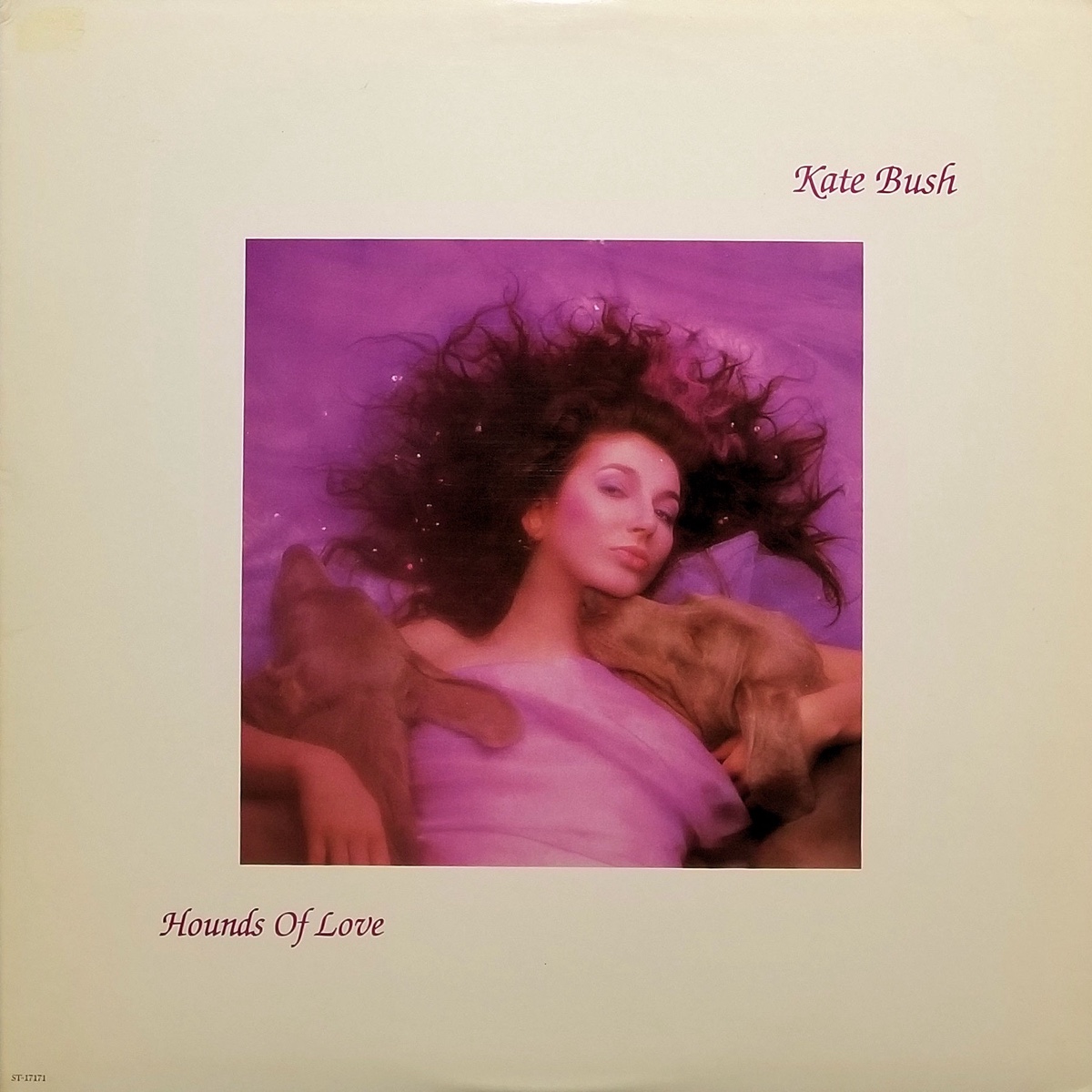
Kate Bush built her own 48-track studio, turned her demos into the masters, and made one side of five songs, four of them singles, and one 26-minute night at sea.
- Released
- 16 September 1985 (UK, EMI); US on EMI America
- Label
- EMI (UK); EMI America (US)
- Producer(s)
- Kate Bush
- Runtime
- 47:24 on CD: side one, Hounds of Love, 21:03; side two, The Ninth Wave, 26:21
- Chart peak (US)
- #30 (Billboard 200, December 1985); #12 on the chart dated 18 June 2022
- Chart peak (UK)
- #1 (Official Albums Chart), 3 weeks at the top in two spells, and 68 weeks in the top 100
- Certifications
- BPI 2× Platinum (23 December 1986, when that meant 600,000 units); Music Canada Platinum (6 December 1985)
- Awards & honours
- Nominated for British Album, British Female and British Single at the 1986 Brit Awards. In 2022 'Running Up That Hill' became the UK #1 that took longest to get there: 37 years
Hounds of Love sounds alive because Bush didn't start again. Its demos became its masters, so the first idea of each song is still on the tape. That patience is what lets the strange second side work.
'Running Up That Hill' started with a sound. Kate Bush found a Fairlight sample she liked for the riff, and she wanted a military drone around it. She sang a drum part to Del Palmer, who set it up on the LinnDrum. The first verse came straight away. She put all of it down on the 8-track in her music room at home. That recording was never thrown out. When the song moved to her new studio, the original Fairlight part stayed on the tape, doubled because the sample was noisy. Stuart Elliott added a snare to shore up the Linn's, and some dramatic fills for the ending. The demo had become the master.
That was the method for the whole record, and Bush said so twice. In December 1984 she told her fan club that “the current album is the demos”. In October 1985 she told International Musician & Recording World that every track was a demo turned into a master. Hounds of Love took almost 2 years, yet it still sounds like the first afternoon of each song. That's what makes it great. Bush built a studio where she could keep her first ideas and go on working on them, with no clock running. The famous structure stands on that method: five songs on one side, four of them singles, and a 26-minute night at sea on the other.
The pressure behind it is easy to state. The Dreaming, her first album as sole producer, reached #3 in 1982. It lasted only 10 weeks on the chart and was certified Silver, where her first two albums had gone Platinum. Barry Walters wrote in Pitchfork in 2016 that EMI nearly sent The Dreaming back for lacking singles. In December 1984 a fan-club questioner told Bush that reviewers had called it weird and over-produced. She said the first word didn't bother her, but the second did. The composer Michael Berkeley later remembered the assumption, in 1985, that the next album would be a final fling for a waning career.
It's tempting to hear Hounds of Love as her reply to that second word. Her own accounts don't say so, and the record is hardly bare. But it's built the opposite way to an over-produced album. The plan, Bush wrote, was to keep as many of the demos' Linn drums, Fairlights and voices as they could. The session players went on top. The upright piano from the demos wasn't good enough to keep, so a grand replaced it.
The studio was more modest than its legend. Tony Horkins interviewed Bush and Palmer there for International Musician in 1985. He wrote that it was put together on a budget, so an SSL desk was out. They chose a Soundcraft desk and recorder, then added a Studer and slaved the Soundcraft to it for 48 tracks. Horkins called the building a converted cottage. Pitchfork's 2016 review calls it the family barn. Either way it was hers, and no clock was running. Bush told Horkins about hunting for the right kind of sea for side two. Sound-effects records were too noisy, or had the wrong kind. She'd just bought a Nagra, a portable tape recorder, and side two needed a lot of effects. She was never alone in there, though. Paul Hardiman engineered the drums, Haydn Bendall the Fairlight work and James Guthrie the strings.
Side one shows the method at work. Under 'Running Up That Hill' sits a three- or four-note Fairlight chord, frozen in a Quantec room simulator to make the drone. The pulse never lets up, and the song gives you nowhere to rest. Paddy Bush adds balalaika to the choruses. The title track opens on a line of dialogue from the 1957 film Night of the Demon. Its cello is played by Jonathan Williams, the only cellist named on the sleeve. Bush told Horkins she'd written the cello parts for one song on an Emulator sampler, then hired a player “because a good musician makes something of them”. 'Cloudbusting' began with Fairlight strings. Bush had them written out for six real players, arranged by Dave Lawson. She asked James Guthrie to record them because she admired his work on Pink Floyd's The Wall. Real strings, she told Horkins, can't be beaten, and it would be a joke to pretend otherwise. For strings and cello, the machine was where a part began, not where it ended.
Side two is The Ninth Wave. The back sleeve lists it as seven titles under one heading, and the tracks run into each other for 26 minutes. The heading comes from Tennyson, whose lines from 'The Coming of Arthur' are printed on the back cover. The story is easy to follow. A woman is in the sea at night, fighting sleep. She dreams of ice. Voices try to wake her, and she's put on trial as a witch. As a ghost, she visits the people she loves. Her future self argues her into living. Then comes 'Hello Earth', and then morning. Only 'Hello Earth' runs past 5 minutes. That brevity is why the suite moves like a dream rather than a lecture.
The playing changes as the story does. Bush wanted a delicate piano for songs she thought of as empty and sad, and Hardiman gave her a very live sound that she compared to Satie. On 'Under Ice' her last sung line comes at 1:47, and the track runs on for more than half a minute after it. On 'Watching You Without Me', Danny Thompson's double bass was recorded live enough to catch his fingers on the strings. That's the right sound for a song about a ghost in the room. 'Waking the Witch' includes a helicopter, used by permission from Pink Floyd's The Wall.
The two boldest passages bring in musicians from well outside pop. 'Jig of Life' was cut at Windmill Lane in Dublin in 1984, with Bill Whelan arranging. Bush says it was built around John Sheahan, the fiddler from The Dubliners, and that she finished writing it the day before at Whelan's piano. A tape Paddy Bush had made of a Greek ceremony set it off. She wrote that they danced and whooped in the control room as the Irish players worked. Her brother John Carder Bush reads the closing passage. For 'Hello Earth', Michael Berkeley arranged a male choir from the Richard Hickox Singers. He says Bush's brief pointed him to the music from the title sequence of Nosferatu, which she hadn't managed to identify. Berkeley suggested they invent a language for the words, and she was thrilled. The sleeve also credits elements of 'Tsintskaro', a Georgian traditional song.
Not every critic heard it this way. In Rolling Stone in February 1986, Rob Tannenbaum wrote that the album “both dazzles and bores”. He said Bush “overdecorates her songs with exotica”, and that the album needed a lyric sheet and a footnote appendix. He pointed to the suite on side two and to the Reich references in 'Cloudbusting'. The suite needs neither, because its story is easy to follow. His charge of over-decoration fits one song on side one far better. 'The Big Sky' is the album's least settled song. It was the lowest-charting of the four singles, at #37, and it was left out of the 2014 concerts. Since 2018 her own label's LP reissues have used its single mix in place of the album mix. It's hard not to hear an artist who had doubts of her own. 'Mother Stands for Comfort' is cold by design, a song Bush said was about a mother shielding a son who has killed. It works, but there's little in it to go back for.
Britain took to it at once. It went to #1 in its first week, replacing Madonna's Like a Virgin. Madonna took the top spot back for a week in October, then Bush returned to it, for 3 weeks at #1 in all. It spent 68 weeks in the top 100. In America it stopped at #30. Then, on 27 May 2022, the fourth season of Stranger Things arrived, with 'Running Up That Hill' in several episodes. On 17 June the song went to #1 in Britain, 37 years after release. No single had waited longer, and the 44-year gap since 'Wuthering Heights' was the longest between #1s by any artist. At 63, Bush became the oldest woman to top the chart. In America the album climbed to #12 and gave her a first Billboard #1, on Top Alternative Albums.
What the album changed is harder to pin down than its fame suggests. The documented line runs through single songs, not the album as a whole. The Futureheads took 'Hounds of Love' to #8 in 2005, 10 places higher than Bush's own single. Walters notes Utah Saints sampling the album for a UK top-10 hit. He also hears Coldplay's 'Speed of Sound' borrowing the rhythm, chords and climax of 'Running Up That Hill', though that's a critic's ear, not the band's word. Even 2022 was a song's revival more than an album's. In Britain the single went to #1, but the album got no higher than #80. The reputation, meanwhile, has only grown. American reviews were mixed in 1985 and 1986. By 2016 Pitchfork was giving it 10 out of 10, and in 2020 Rolling Stone ranked it #68 of all time.
Hounds of Love is one of the best records of its kind, and the case doesn't need 2022. It rests on the method. Bush kept the first idea of each song and spent almost 2 years making it sound finished without making it sound worked over. Side one has three great singles in 'Running Up That Hill', the title track and 'Cloudbusting'. It also has 'The Big Sky', which never settled. Side two is the bolder achievement: a story told clearly in 26 minutes, with real players carrying each scene. The influence is real but narrower than the fame, and most of it runs through the singles. That doesn't touch the record. Play it straight through, and it still sounds like first ideas, kept and made whole.
Pressing guide — the one to own
The object is the 1985 UK original on EMI KAB1, also marked EJ 24 0384 1 on the rear sleeve and spine. It comes in a single sleeve with a printed inner carrying the lyrics, credits and photographs. Many copies have TOWNHOUSE etched in the runouts, from Ian Cooper's cutting at The Town House, but some genuine 1985 UK copies don't. One KAB1 sleeve holds a French pressing from Pathé Marconi. The European 1C 062-24 0384 1 issue is a 1985 contemporary, not a later press. The in-print Fish People LPs are easy to find, but they carry a different mix of 'The Big Sky'.