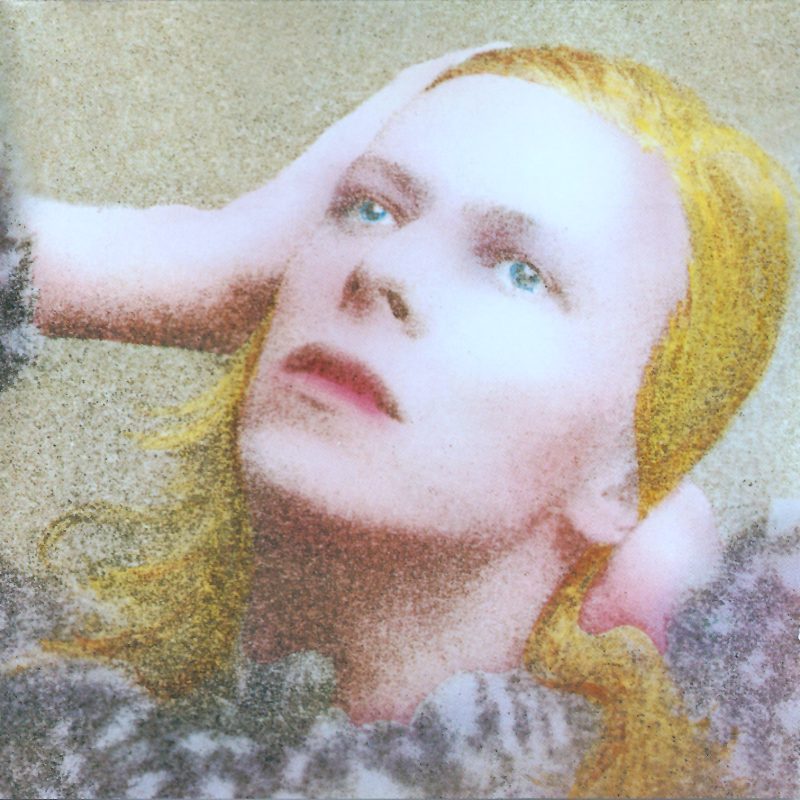
David Bowie's fourth album: piano songs made in the summer of 1971 with no label behind it, then used to win one. Side one holds four of the best songs he wrote.
- Released
- 17 December 1971 (UK); the US LP was reviewed as a new release by Billboard on 4 December 1971
- Label
- RCA Victor (UK SF 8244; US LSP-4623). A GEM Production
- Producer(s)
- Ken Scott and David Bowie (sleeve: 'Produced by Ken Scott (assisted by the actor)')
- Runtime
- 41:04 (11 tracks, by the 1971 UK label timings; digital editions run about 41:30)
- Chart peak (US)
- #57 (Billboard 200, 30 January 2016); first entered the chart on 15 April 1972
- Chart peak (UK)
- #3 (UK Albums Chart, 18 August and 1 September 1973); first entered at #44 on 23 September 1972
- Certifications
- BPI Platinum (Silver, Gold and Platinum all awarded on 25 January 1982). No RIAA certification
- Awards & honours
- #88 on Rolling Stone's 500 Greatest Albums (2020), up from #107 in 2003; 18th in the Village Voice's Pazz & Jop poll for 1971
Hunky Dory was used to sell Bowie as a songwriter, and it plays like a pitch: the best set of songs he'd yet written, laid out to show range. That's why side one still astonishes, and why the record never quite holds together.
On 9 September 1971, RCA signed David Bowie to a three-album deal, with an advance of $37,500. RCA's Dennis Katz signed him after Bowie's manager, Tony Defries, played him the finished songs. That order matters. Hunky Dory wasn't made for a record company. It was made with no label behind it. The plan, as Bill DeMain tells it, was for Defries to use the finished album to win a new deal. Gem Productions was the company through which Defries had paid off Bowie's debts to Mercury, and the sleeve calls the album 'A Gem Production'. In late July, before recording had even finished, mixes were being made for a Gem promotional record. The album was a sales pitch before it was a release.
Hear it as a pitch and the record makes sense, flaws included. A pitch has one job: to show what a writer can do. Hunky Dory does that brilliantly. 'Changes', 'Oh! You Pretty Things', 'Life on Mars?' and 'Quicksand' are among the best songs Bowie wrote, and all four sit on side one. But a pitch is built to show range, not to hold together. Side two opens with a cover and then runs three tributes in a row. Some of the sound is borrowed too, from good sources and in plain sight. This is a great songbook that falls short of being a great album, and the gap between the two is what's most worth hearing.
Bowie needed a pitch. The Man Who Sold the World had come out in America in November 1970 and sold poorly. Tony Visconti, Mick Ronson and the drummer Mick Woodmansey had all left him in August 1970. A single, 'Holy Holy', flopped in January 1971. Mercury wanted to keep him anyway. Defries didn't, and in May 1971 he forced the label to let Bowie go by threatening to deliver a poor album. What Bowie still had was a publishing deal with Chrysalis, where Bob Grace booked Radio Luxembourg's studio for his demos. A publisher sells songs, and one had just sold. Peter Noone's 'Oh You Pretty Thing', with Bowie on piano, reached #12 in June 1971. Noone told the NME that Bowie was the best writer in Britain at the moment, and certainly the best since Lennon and McCartney.
Two changes in Bowie's life show up in the songs. The first was an instrument. Angie Bowie said he'd switched from guitar to piano at Haddon Hall, where he wrote the songs, and that it opened them up. The second was a country. Mercury had sent him on a promotional radio tour of America early in 1971. Three songs came out of it, about Andy Warhol, Bob Dylan and, in 'Queen Bitch', the Velvet Underground. Bowie said in 1997 that the new continent changed the way he wrote. He also described what he was after: Little Richard and Jacques Brel, with the Velvet Underground backing them. That's a recipe more than a sound. It promised a set of very different songs, and that's what he delivered.
It was recorded at Trident, in Soho. Kevin Cann's session log puts the first session on 8 June 1971 and the last on 6 August. DeMain's account is shorter: 2 weeks of recording and 2 of mixing. The hours were 2pm to midnight, Monday to Saturday. It was Ken Scott's first record as a producer. He'd engineered for the Beatles and on George Harrison's All Things Must Pass, and he borrowed some of that album's acoustic sounds. The sleeve reads 'Produced by Ken Scott (assisted by the actor)', and the actor is Bowie. Scott remembered almost everything going down in one take, and almost all of Bowie's lead vocals. Woodmansey recalled most tracks taking one to three takes, usually two.
The record's centre is a piano. Trident's was a Bechstein, by Nicholas Pegg's account the 1898 instrument heard on 'Hey Jude'. Rick Wakeman, then a member of the Strawbs, played it on most of the album. Wakeman says Bowie told him to treat the songs as piano pieces, and that he'd build everything else around them. That's the method you hear. On 'Changes' the piano is the frame, and Pegg calls Wakeman's playing on it superb. When the chorus arrives at 0:53, it's sung by a crowd of overdubbed Bowies. That's how John Mendelsohn heard it, reviewing the album for Rolling Stone in January 1972. A guitar band would have made a riff the hook. Here the hook is a voice, multiplied, against a keyboard.
'Life on Mars?' was the last thing recorded, on 6 August. It was Mick Ronson's first string arrangement, played by members of the BBC Symphony Orchestra. Woodmansey remembered no rapport between them and the band, and none of that shows. Scott liked the way Ronson's arrangements would drop to one or two violins and bring the rest in slowly. Listen from the title line at 1:17, which ends the first chorus, to the next verse at 1:40. No new line is sung in between, and the arrangement carries the song on its own. The song's debts are on the record too. Pegg notes that its opening bars share the chord sequence of 'My Way'. Bowie had written an English lyric for 'Comme d'habitude' in 1968, which lost out to Paul Anka's 'My Way'. His sleeve note for 'Life on Mars?' reads 'Inspired by Frankie'. He later said there was a sense of revenge in it.
'Quicksand' is the album's deepest song and the best proof of Scott's ear. He insisted on stacked acoustic guitars, and Ronson arranged the strings. The released take is the last of four, cut on 14 July. Pegg traces references in it to Aleister Crowley, the Golden Dawn, Nietzsche and the bardo. The music carries all that lightly, and after the last line at 4:26 it keeps going for more than half a minute. 'The Bewlay Brothers' closes the album and is the one track that doesn't sound like a pitch. Pegg says it was a late addition and the only song on the album that wasn't demoed. It was recorded on 30 July with 'Changes'. Scott says Bowie told him it was for the American market, with words that made no sense on purpose. In 1977 Bowie said it was about his half-brother, Terry. Both accounts can stand, and the song is stranger for it.
Side two is where the pitch shows its seams. 'Fill Your Heart', by Biff Rose and Paul Williams, replaced Bowie's own 'Bombers' late on. Then come the three tributes. 'Andy Warhol' opens with ARP tones, then Scott announcing the take and Bowie correcting his pronunciation, at 0:21. It's a charming moment, and the song never tops it. Bowie wrote it before he'd met Warhol. When he played it to him at the Factory in September 1971, Warhol disliked it and walked away. 'Song for Bob Dylan' parodies the title of Dylan's 'Song to Woody' and borrows two Velvet Underground titles for its chorus. David Buckley calls it probably the weakest track, and he's right. Mendelsohn found both songs self-indulgent in 1972. Only 'Queen Bitch' turns homage into a song of its own.
That's the deeper limit, and it runs through the good songs too. Much of the material is borrowed, and openly. 'Life on Mars?' answers 'My Way'. Cann hears 'Kooks' as a Neil Young pastiche, and Bowie got the news of his son's birth at home while playing a Neil Young record. The 'Andy Warhol' riff resembles the opening of Ron Davies's 'Silent Song Through the Land'. Scott borrowed some of the acoustic sounds of Harrison's All Things Must Pass. None of that counts against the songs, which change what they take. But it's why the record sounds less new than Ziggy Stardust, which the same band was already recording when Hunky Dory came out. Buckley argues that its near easy-listening surface has hidden what the lyrics are doing. Christopher Sandford put its sound on a line with Elton John and Phil Collins. That's unfair to the songs and fair to the surface.
Critics heard the songwriter at once. Billboard called it a 'heavy debut for RCA' in its issue of 4 December 1971. Robert Christgau gave it an A− in the Village Voice, and it came 18th in that paper's poll of 1971. Buyers took longer. It sold about 5,000 copies in its first quarter, by Sandford's count, and RCA did little to promote it. In America it entered the Billboard 200 in April 1972, two months before Ziggy. In Britain it didn't chart until 23 September 1972, entering at #44. It peaked at #3 in August 1973, 20 months after release. So the story that Hunky Dory was overlooked is half wrong. The critics mostly loved it. British buyers waited for Ziggy.
Its standing is secure. Rolling Stone ranked it #107 in 2003 and #88 in 2020. Musicians say the same. Boy George called it the record that changed his life. KT Tunstall named it her favourite album, and Guy Garvey the album that influenced him most. Trevor Bolder told DeMain it was his favourite Bowie album, and that many musicians he met said so too. Dave Stewart said in 1999 that he still used its sound as a reference point. Billboard's Joe Lynch went further in 2016, hearing it as the blueprint for 25 years of lo-fi indie pop. That's a critic's reading, and a stretch. Its influence is real, but it's the influence of a favourite record, not of a method anyone could copy.
So what is it worth now? Side one is as strong as any side Bowie made, and its four big songs would carry a career on their own. But a verdict has to cover the whole record, and the whole record is uneven. The tributes on side two are sketches. Some of the sound, lovely as it is, was borrowed from Harrison's record. It has the songs of a great album and the shape of an audition, and it hangs together less well than Ziggy did six months later. Admire it rather than revere it. It's a very good record, and the clearest evidence of how good a songwriter Bowie was before he became a character. Play side one, then 'Queen Bitch' and 'The Bewlay Brothers'. 'Song for Bob Dylan' can wait.
Pressing guide — the one to own
The original is the 1971 UK RCA Victor SF 8244, with the US number LSP 4623 in brackets on the sleeve and labels. It's a single sleeve, laminated on the front and spine, with an unlaminated back. First sleeves have a strong green tinge on the front and no GEM logo on the back; the logo was restored on the next printing. Inside are a sepia-printed lyric liner and a rice-paper inner with blue text and 'Made In England'. The runouts read APRS 5947 and APRS 5948, stamped '3T', with the cutters' names Bobil and Rasputin etched beside them.