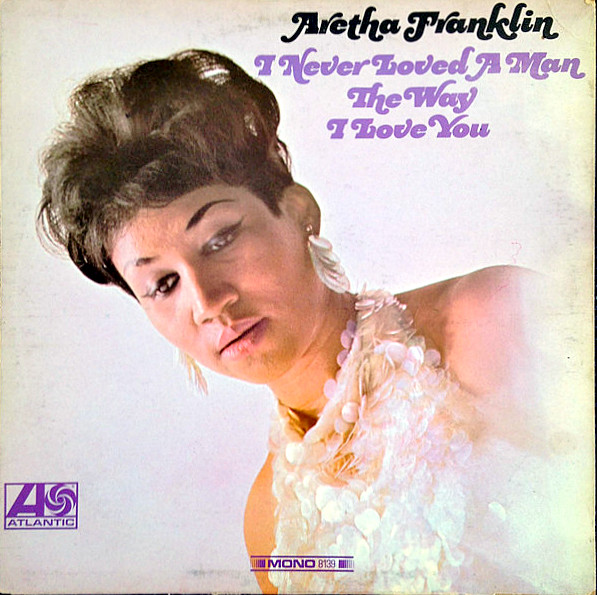
Aretha Franklin's first Atlantic album, started in Alabama and mostly made in New York over three February days. The legend credits the studio. Wexler, who produced it, credited her.
- Released
- 10 March 1967 (US, Atlantic), in mono and stereo
- Label
- Atlantic (US: 8139 mono, SD 8139 stereo); Atlantic 587066 (UK, made by Polydor)
- Producer(s)
- Jerry Wexler
- Runtime
- 32:06 (11 tracks, label timings)
- Chart peak (US)
- #2 (Billboard Top LP's, charts of 27 May, 3 June and 10 June 1967, behind More of the Monkees); #1 (Billboard R&B LPs, 14 weeks at the top)
- Chart peak (UK)
- #36 (UK albums chart, 12 August 1967; 2 weeks)
- Certifications
- RIAA Gold (13 June 1967); nothing higher listed
- Awards & honours
- Grammy Hall of Fame (2009); #13 on Rolling Stone's 500 Greatest Albums (2020). 'Respect' won two Grammys in 1968 and was added to the National Recording Registry in 2002
The story usually told is a fistfight in Muscle Shoals and a Southern band that made her. The record says otherwise: a great, uneven album made mostly in Manhattan, built on her piano and on a 'Respect' she'd reworked before she reached the studio.
On 24 January 1967, at FAME Recording Studios in Muscle Shoals, Alabama, the title song wasn't working. Rick Hall, who owned the studio, later said he'd never heard of Aretha Franklin. He thought the song sounded like a waltz. David Hood, who played trombone that day, says nothing worked until Spooner Oldham found a small lick on the electric piano. The horn parts followed within minutes. Franklin played the piano as she sang. By the next morning there was a sign on the studio door saying the session was cancelled.
That day has become the album's legend: a Southern studio, a fight and a star made in a single session. As late as 2018, Rolling Stone described the record as made at FAME. The sleeve says otherwise: only two tracks were recorded in Muscle Shoals. Hall's own account adds that only one was finished there. The other nine were cut at Atlantic's studio in New York over three days in February. What made this record was a singer who arrived with 'Respect' already reworked, and who was finally put at the piano. That's why it's great. Its flaw comes from the same place. The voice is everything here, and the songs don't always deserve it.
She was hardly new. John Hammond had signed her to Columbia in 1960, when she was 18, and Columbia put out eight studio albums in six years. Jon Dolan of Rolling Stone calls them 'somewhat supper-clubby'. Carl Wilson, in Slate, says Franklin and her husband and manager, Ted White, wanted her to sing everything, against Hammond's judgement. Her Columbia contract ended in November 1966, and Atlantic signed her that month. Jerry Wexler, her new producer, booked her into Hall's studio. Rolling Stone quoted his summary of the plan in 2018. 'I took her to church, sat her down at the piano, and let her be herself.' It's still the best description of the album.
It nearly ended on the first day. In Hall's account, White drank vodka through the session and shared it with the horn players. By about 2pm, Hall said, White was getting drunk. Then he demanded that Hall fire a trumpet player he said was making passes at Franklin. The player was sent home, and later a tenor player was fired. Wexler stopped the session partway through 'Do Right Woman'. Hall went to the hotel to make peace, and he and White came to blows. Hall later called it a terrible mistake. Slate calls the fight racially charged, which Hall's version leaves out. Either way, Wexler then spent about 10 days unable to find his new singer.
When she resurfaced, the work moved to Atlantic in New York. Dan Penn has said one reason was that Atlantic had an eight-track machine. Wexler took the FAME players with him. He later told Ritz he'd shipped the rhythm section up from Alabama, naming Jimmy Johnson, Tommy Cogbill and Roger Hawkins. Cogbill was in fact a Memphis player, like the guitarist Chips Moman. Wexler had added both to the FAME men. Oldham came too. The 1995 CD insert dates the nine New York tracks to three days: 'Save Me' on 8 February, five songs on the 14th and three on the 15th. It gives no date for the New York work on 'Do Right Woman', and Slate says the sessions began with that song. White, by Slate's account, wasn't there. So the famous Muscle Shoals record is mostly a Manhattan record. That changes how you hear it. What travelled north was a handful of players and a singer who knew what she wanted. The sound went with them.
'Respect' is the clearest proof of whose record this is. Otis Redding wrote it and recorded it in 1965. Franklin had already been singing it on stage. She'd worked out the switch to a woman's point of view with her sisters, and she showed the band the stop-start rhythm. Wexler told David Ritz the rhythm was her invention, and that the backing singers' wordplay was made up on the spot. The sleeve credits the arranging to Tom Dowd, so on this song the accounts and the paperwork part company. Carolyn and Erma Franklin sing behind her. King Curtis takes the tenor solo, playing over the chords of Sam & Dave's 'When Something Is Wrong with My Baby'. The spelled-out section arrives a verse later. Tom Dowd credited the spelling to Carolyn. The parts of this record that people sing along to came from the Franklins. Redding said as much. At Monterey on 17 June 1967, he introduced 'Respect' as the song a girl had taken from him.
The title song is the best thing here. Ronnie Shannon wrote it, and Franklin brought it with her to Alabama. On the record you hear what that session found: Oldham's figure, her piano and the horns Hood saw take shape in minutes. The singing starts 3 seconds in and runs to 2:35 with no instrumental break. Dolan calls it the album's high point, and he hears her voice distort. Pitchfork's Marc Hogan hears a song about toxic codependency. He's right, and that's why the track still unsettles. Hall heard a waltz. She sings it like a confession she'd rather not be making. Nothing else on the record is this exposed.
Her own song holds up beside it. 'Dr. Feelgood', credited on the original label to 'Aretha White' and Ted White, is a slow blues on her own piano. Hogan singles it out for her writing, and he's right to. 'Do Right Woman' is stranger, because it was made in two cities. The backing track was started at FAME on 24 January. In Dan Penn's account, only the bass drum, snare, bass and perhaps the guitar survived from Alabama. Franklin added piano in New York, and her sisters sang. Matt Dobkin's book on the album says the two layers sit slightly out of tune. It's a patch job, held together by one of her calmest vocals.
The weaker half of the album is the borrowed half. Five of its 11 songs are covers of familiar records. 'Drown in My Own Tears' was an Atlantic single for Ray Charles in 1956. 'Good Times' and 'A Change Is Gonna Come' are Sam Cooke's, both from 1964. 'Soul Serenade' comes from a King Curtis record of the same year. Franklin sings them all well, and only 'Respect' becomes hers. 'A Change Is Gonna Come' comes closest. Hogan thinks she reimagines it as boldly as 'Respect', and notes that she changes one pronoun in the refrain to claim it. That's too generous. One pronoun doesn't move the song out of Cooke's shadow. Robert Christgau gave the album an A, but he wrote that not every track sounds inspired. Of the five songs he named as the ones that carry it, 'Respect' is the only cover.
Jon Landau, reviewing it for Rolling Stone in November 1967, blamed the band rather than the songs. In substance, he found the drums too soft, the guitar weak and the production short of polish. He was wrong. The restraint he heard as weakness is what gives her room, and the plain recording lets her lead every track. The fairer charge is one Landau didn't make. Little here was new. Wexler had already taken Wilson Pickett to FAME the year before, and five of the songs had been records already. What was new was the singer's command of all of it.
Its success came quickly and lasted. The album entered Billboard's chart on 8 April 1967 and stayed for 79 weeks. It spent 14 weeks at #1 on the R&B LP chart. On the pop chart it reached #2 for 3 weeks from 27 May, behind More of the Monkees. The RIAA certified it Gold on 13 June. 'Respect' went to #1 on 3 June and later won two Grammys. NPR put its meaning plainly in a 2017 headline: the song wasn't a feminist anthem until Franklin made it one. Wexler told Ritz it became a kind of national anthem. The fight had a long tail too. Hall and Wexler fell out, and Wexler used Hall's players elsewhere. He later set them up as Hall's rivals, in a building across town that became Muscle Shoals Sound.
Its reputation has climbed since. Rolling Stone ranked it #83 among the 500 greatest albums in 2003 and #13 in 2020. Pitchfork put it at #10 of the 1960s in 2017. It entered the Grammy Hall of Fame in 2009. 'Respect' outgrew it, and in Slate Wilson reads Beyoncé's Lemonade as an album-long elaboration of the song. The rise is deserved. But it's a rise for a voice as much as for an album, and most of the case for the record rests on five or six tracks.
Little of it has dated, and what has is the frame around her. The Cooke and Charles covers sound like what they were in 1967: a new signing proving her range on familiar songs. Her own performances don't sound tied to a year. At 32 minutes the album ends before the weaker tracks can drag, and 'Dr. Feelgood' and 'Do Right Woman' on side two stand with the opening of side one. Reissue labels have kept faith with the original. Rhino in 2013 and Atlantic in 2018 both chose the mono mix for vinyl, and a 2025 audiophile set went back to the master tape.
So the legend has the place wrong and the person right. This is the first record on which Aretha Franklin was allowed to make her own music, and every bar she sings shows it. The title song, 'Respect', 'Dr. Feelgood', 'Do Right Woman' and 'Don't Let Me Lose This Dream' are the reasons to own it. Around them sit covers that a lesser singer would have made dull, and that she makes merely pleasant. That soft middle keeps it from being perfect. It doesn't keep it from being great. Play it for the voice, which never falters, and forgive the songs that can't keep up with it.
Pressing guide — the one to own
The original is Atlantic 8139 in mono or SD 8139 in stereo, issued together in March 1967 in a single sleeve with Jerry Schatzberg's photograph. Mono labels are red and plum, stereo labels green and blue, both with the black fan logo. The identified US plants are Monarch, Presswell, Columbia's Pitman plant and Columbia's Terre Haute plant. Lacquers cut at Atlantic Studios carry 'AT' in the runout. Barber's three dots over the 'W' mark his stereo cut, and Columbia-pressed copies often carry 'CL', for a Columbia or Customatrix cut.