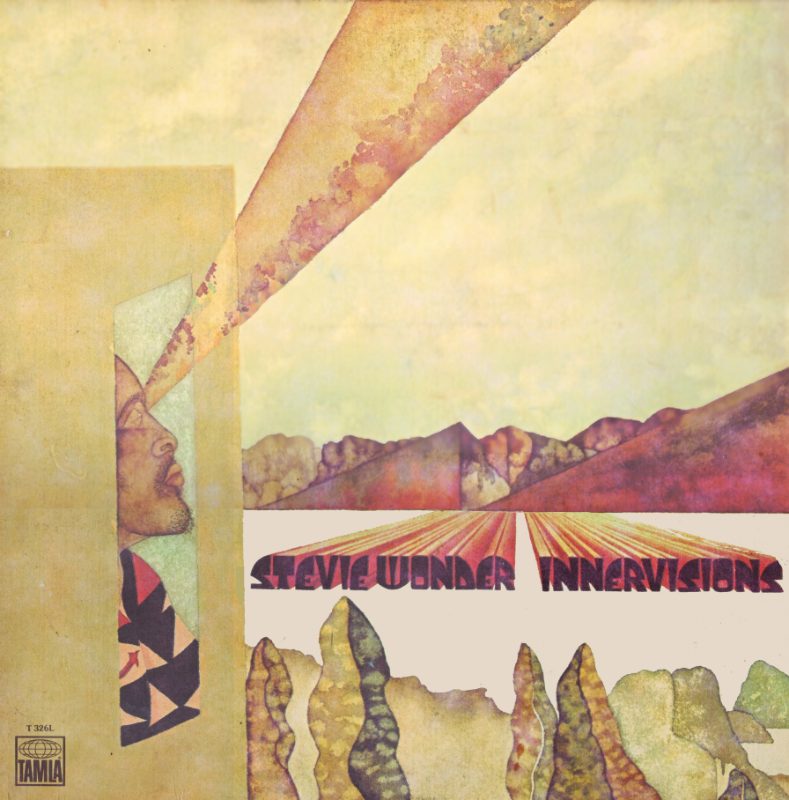
Stevie Wonder's 1973 album, played mostly by Wonder with two engineers and a synthesizer the size of a room. It came out before the crash, not after, and it's better without the myth.
- Released
- 3 August 1973 (US, Tamla T 326L); 9 August 1973 (UK, Tamla Motown STMA 8011, BPI date)
- Label
- Tamla (US); Tamla Motown (UK and elsewhere)
- Producer(s)
- Stevie Wonder (associate producers: Malcolm Cecil, Robert Margouleff)
- Runtime
- 44:15
- Chart peak (US)
- #4 (Billboard Top LPs & Tape, chart dated 22 September 1973) · #1 (Billboard Soul LPs, 2 weeks)
- Chart peak (UK)
- #8 (Official Albums Chart, chart dated 27 April 1974), 55 weeks on the chart
- Certifications
- BPI Gold (30 April 1974); Music Canada Gold (1 April 1978). The RIAA database lists no certification
- Awards & honours
- Grammy for Album of the Year, 1974. Grammy for Best Engineered Recording, Non-Classical, to Malcolm Cecil and Robert Margouleff, 1974. Grammy Hall of Fame, 1999
Innervisions is sold on two stories: a one-man band, and a car crash. Both need correcting. What's left is better than the legend: 13 months of sessions, the finest playing of Wonder's career, and one soft patch on side one.
At about 4am one morning, Robert Margouleff took a Nagra tape recorder out onto 57th Street in New York. He taped a diesel heating-oil truck. Its engine is the city that greets the young man halfway through 'Living for the City'. Wonder's brother, Calvin Hardaway, plays the young man. Johanan Vigoda, Wonder's lawyer, plays the judge who sends him down. The sleeve thanks them both for their help. The scene sounds like a documentary. It was made by an engineer, a brother and a lawyer.
That's worth holding on to, because Innervisions is usually sold on two stories. In one, Wonder makes it alone. In the other, a car crash turns it into a record about surviving. Neither survives the paperwork. The sleeve credits other players and singers on six of the nine songs. Two associate producers built the synthesizer at the centre of it. And the record was in American shops before the crash. Take both stories away and what's left is better than the legend: the finest playing of Wonder's career, on songs he'd been building for 13 months.
It began with a birthday. Wonder turned 21 on 13 May 1971 and let his Motown contract lapse. That May, Ronnie Blanco introduced him to Malcolm Cecil, who'd built a synthesizer called TONTO with Robert Margouleff. Wonder had heard their album Zero Time. Over Memorial Day weekend he came to Media Sound in New York to see the machine, and the three of them recorded 17 songs in a weekend. Then he signed a new deal with Motown, in July 1971 by one account, at a 14% royalty. Cecil later said Wonder got about $100,000 of the money Motown owed him, and lived on it while they made Music of My Mind and Talking Book. Innervisions was the third of the four albums the three men made together between 1972 and 1974.
TONTO stood for The Original New Timbral Orchestra. Cecil and Margouleff had started it in 1968, and it grew into a semicircle of cabinets about 20 feet across. On the sleeve they're associate producers. They're credited with programming the ARP and Moog synthesizers and with engineering the electronic music. Wax Poetics describes a clear division of labour. Wonder looked after his vocals, and the two engineers looked after the instrumental layers and TONTO. During vocal takes, Cecil read each line of the lyric to Wonder just ahead of him. Call it a workshop with one star rather than a one-man band.
The one-man reputation isn't false, only rounded up. The sleeve credits Wonder with every instrument on three tracks, and with every other instrument on four more. Billboard's review in August 1973 called it a one-man-band record that works. But the guests matter. Lani Groves, Tasha Thomas and Jim Gilstrap sing behind him on 'Too High'. Willie Weeks plays the bass on 'He's Misstra Know-It-All', and Scott Edwards plays it on 'All in Love Is Fair'. 'Visions' has no drummer credited at all. It's Wonder's Rhodes, two guitars and Cecil on upright bass. The help makes the solo work sound better, not worse.
It wasn't made in a burst, either. The vocal on 'Too High' was cut on 17 April 1972, weeks after Music of My Mind came out. 'Golden Lady' was begun that August and finished the following April. 'Living for the City' was built between 5 and 8 December 1972. 'Higher Ground' was recorded on 12 May 1973, and the latest date in Cecil's session log is 25 May. So Innervisions is a selection from a year of work, cut to 44 minutes. Jon Tiven complained in Circus that it was too even, with no standout song. That's hard to square with a record that gave Wonder two US top-10 singles.
'Living for the City' is where the method pays off most, and Margouleff has described how it was built. The Rhodes was heavily processed and panned. The bass line was all TONTO. Each TONTO sound was a single voice, and the Rhodes was the only instrument on the track that could play chords. Wonder sang into an Electro-Voice RE20, close up, for the extra bass that comes from singing near a microphone. For the last verse, Margouleff and Cecil kept stopping him and starting again, on purpose, until the voice came out hoarse and angry. You can hear the difference between the first verse and the last. The fury was coaxed out in a control room. It's still the most convincing thing on the record.
'Higher Ground' shows the other side of the method, which is speed. A 2003 account in Mojo says it was written and recorded in about three hours. The sleeve credits Wonder with every instrument on it. His clavinet runs through a Mu-Tron III envelope filter, and a Moog plays the bass. At 3:42 it's the tightest song on the album. 'Visions' is its opposite. The basic track was played live on 17 January 1973, with David T. Walker on electric guitar and Dean Parks on acoustic. Nothing in it hurries. Playboy's reviewer picked it as the key song in 1973, and that judgement has held up. It's the one place where Wonder lets a question hang in the air.
Side two is the stronger half. 'Jesus Children of America' is another track the sleeve credits entirely to Wonder, recorded between 28 March and 3 April 1973. 'Don't You Worry 'Bout a Thing' opens on a Latin piano introduction and rides on the percussion of Yusuf Roahman and Sheila Wilkerson. Its basic track dates from August 1972, and more vocals were added on 25 May 1973, the latest date in Cecil's log. 'He's Misstra Know-It-All' closes the record, with Willie Weeks on bass. Cecil says it came together in three days, 5, 6 and 8 April 1973, before the Watergate hearings opened. The Recording Academy has called it commentary on Nixon. We haven't found Wonder saying so, and the song works without the label.
The record has a soft patch, and it's at the end of side one. 'Golden Lady' is a warm love song, with Clarence Bell on Hammond organ and Larry Latimer on congas. It also sings its title 24 times in 5 minutes. Coming straight after the 7-minute drama of 'Living for the City', it sounds slight. Robert Christgau gave the album an A but called 'Golden Lady' its worst track. He was right. 'All in Love Is Fair', on side two, has a smaller problem. It's a good song, but to our ears it belongs to an older singer than Wonder at 23. Lenny Kaye heard Johnny Mathis in it, writing in Rolling Stone. Barbra Streisand's version reached #10 on the adult contemporary chart in 1974.
Then came the crash. On 6 August 1973, 3 days after the American release, Wonder was hurt on Interstate 85 near Salisbury, North Carolina. His driver was John Wesley Harris. A flatbed farm truck was involved. Early reports said it carried logs; its driver said the bed was empty. Wonder went to Rowan Memorial Hospital and then to North Carolina Baptist in Winston-Salem. One biography says he was in a coma for 4 days. Reports at the time, the Salisbury Post found, had him partly conscious within a day. In a story the Salisbury Post says is often repeated, his publicist, Ira Tucker, sang 'Higher Ground' to him, and his fingers moved in time. On 20 August he left North Carolina Baptist to convalesce at the UCLA Medical Center. The story has grown in the retelling, and so has its claim on the album.
The crash didn't make the record, but it did shape how people heard it. Wonder later told the New York Times he'd written 'Higher Ground' before the accident. The reviews had mostly been warm. Clayton Riley in the same paper praised him as producer, composer, arranger, singer and player at once. On 2 March 1974, Innervisions won Album of the Year at the Grammys. The Recording Academy says that made Wonder the first Black artist to win it. At the same ceremony, Cecil and Margouleff won Best Engineered Recording. We read that award as an answer to the one-man myth. Rolling Stone placed it at #23 in its 500 greatest albums in 2003, and at #34 in 2020. It has slipped a little, from a great height.
Its influence is harder to pin down than its reputation. The documented line runs through covers. Ray Charles won a Grammy in 1976 for his 'Living for the City'. The Red Hot Chili Peppers took 'Higher Ground' to #55 in Britain in 1990. Incognito's 'Don't You Worry 'Bout a Thing' reached #19 there in 1992. Critics have made larger claims. John Diliberto argued in Keyboard in 1984 that Wonder's work with TONTO did for Black pop what Sgt Pepper did for rock. That's a fair case, but it's an argument, not a documented line. We found no statement from the artists usually named as the album's heirs saying they learned from it.
Innervisions is one of the best soul albums ever made, and it doesn't need either legend to earn the title. Its strength is the playing. Simon Raymonde of Cocteau Twins, naming it among his favourite albums, singled out the drumming. Wonder's voice and keyboards carry all nine songs, and three of them are entirely his own playing. Its weakness is the sag at the end of side one, where 'Golden Lady' coasts after the best track on the record. Its influence is real but thinner than the claims made for it. Hear it as what it was: a record made by a 23-year-old, two engineers and a handful of friends, and in the shops before anything happened to him. That story is harder to tell than the myth, and much more impressive.
Pressing guide — the one to own
The original to own is the 1973 US Tamla LP, catalogue T 326L on the cover, spine and labels, in a gatefold sleeve with the lyrics printed inside. The label matrices are C5RS-7576-1 and C5RS-7577-2 on all four US originals listed here. What changes is where the copy was made. RCA's Hollywood plant stamps an 'H' in the runouts. The catalogue identifies Superior copies, from Somerdale, New Jersey, by a small 'TVC A' etching from the Tracy-Val plating works next door, read with the press-ring shape. Kendun-cut lacquers carry a stamped 'KENDUN'. The catalogue lists no Braille or 'first state' variant among the album's 306 versions.