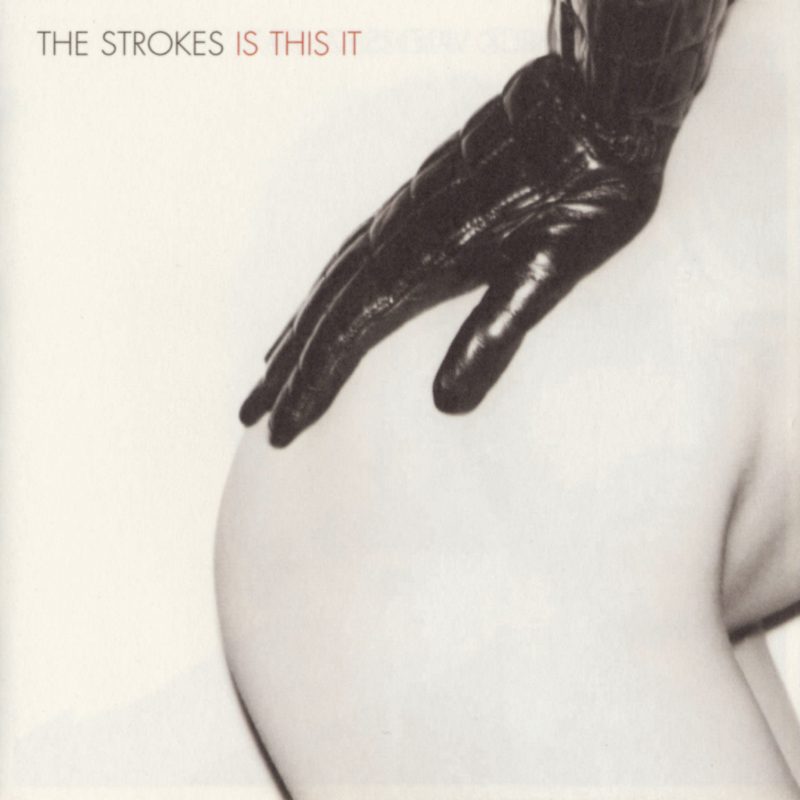
The Strokes' 2001 debut: 11 songs by Julian Casablancas in 36 minutes, made in an East Village basement. A record of brilliant editing, built mostly from borrowed parts.
- Released
- 27 August 2001 (UK, Rough Trade); 11 September 2001 (US LP) and 9 October 2001 (US CD), RCA. First released in Australia on 30 July 2001
- Label
- Rough Trade (UK: LP RTRADELP 030, CD RTRADECD030); RCA (US and Europe)
- Producer(s)
- Gordon Raphael
- Runtime
- 36:28 (11 tracks, original CD)
- Chart peak (US)
- #33 (Billboard 200, chart dated 9 February 2002)
- Chart peak (UK)
- #2 (Official Albums Chart, 2–8 September 2001), behind Slipknot's Iowa
- Certifications
- BPI 3× Platinum (August 2026); RIAA Platinum (February 2011)
- Awards & honours
- Brit Award for Best International Newcomer and three NME Awards, including Best Album (2002). #2 on the Guardian's 100 best albums of the 21st century (2019); #114 on Rolling Stone's 500 Greatest Albums (2020)
Is This It sounds like five friends caught live in a basement. It's a digital record, built and trimmed with great care, and its greatness lies in the editing. Its flaw is that so little of it is new.
In April 2001 RCA had doubts about the Strokes. The label hadn't liked the sound of their first EP, and it worried the album wouldn't sound professional enough. By the producer Gordon Raphael's account, Julian Casablancas answered with a boombox in a waiting room, playing RCA's A&R man the new recordings. The man smiled and said 'Good job'. Raphael could still feel the label wondering how to fix it. It's the right story to start with, because Is This It is an argument about what professional means. It sounds like five friends caught live in a basement on cheap gear. That's the effect, and it was worked for.
It's a digital recording, made on Pro Tools and Logic, and no song on it uses more than 11 audio tracks. Raphael mixed as he went. Nearly every choice on it was a choice to take something out. That's the album's real achievement: 11 songs in 36 minutes, each cut down to what it needs. Its weakness sits in the same place. The parts that survive the cutting are mostly borrowed. The Strokes didn't invent a sound in 2001. They edited an old one better than anyone had in years, and that's both the praise and the limit.
Casablancas wrote it all. Every song on the 2001 sleeves is credited to him alone. Albert Hammond Jr has described him bringing in 'The Modern Age' and showing the others the chords, down to how they held them. Hammond had known Casablancas since boarding school in Switzerland. He was the last to join, in 1998, when the other four were already playing together. You can hear that history. These are one writer's songs, played by four people who learned them from him, and the album never sounds like a committee.
In August 2000 Raphael saw them at the Luna Lounge and offered to make a cheap demo. He was a keyboard player who'd grown up in Seattle and moved to New York in 1998, and by his own account he'd never sold a record. They cut three songs in three days, for about $600. Rough Trade put the demo out in Britain as The Modern Age EP in January 2001, and NME made it single of the week. Then came a detour. The band tried a session with Gil Norton, the producer of the Pixies and the Foo Fighters. Who wanted Norton is disputed. In 2002 Raphael said Rough Trade had suggested Norton for a second EP. By 2015 he remembered the label wanting Norton for the album, and NME's 2021 history says RCA wanted an established producer.
About a week after the Norton session, Casablancas phoned Raphael. He was afraid, Raphael recalled, that they'd lost their sound. The band booked every day of Raphael's April. He has described their brief several times since. Paraphrased, they wanted to sound like a band from the past that had travelled forward in time to make its record. The room helped. Transporterraum was a brick-and-concrete basement in the East Village, about 25 feet square, under a methadone clinic. Raphael was under threat of eviction from it while they worked.
Most of the songs were cut as live band takes to a click track, with the vocals added afterwards. Moretti asked for no drift in tempo. Guitar and bass spilled into the drum room's microphone, and on Moretti's advice Raphael kept the spill. But a few were built the other way, and Raphael names 'Hard to Explain' and 'Soma' as the clearest cases. They were made track by track, and he processed Moretti's drums to sound like a drum machine. No drum machine was used. For 'Hard to Explain', Moretti moved his hi-hat about 4 feet from the snare microphone to keep it out.
That's the album's secret. Its looseness is partly a performance of looseness, assembled one layer at a time. Put on 'Hard to Explain' and listen to the drums under Casablancas's entrance at 0:33. They're real, and they're meant to sound programmed. Then put on 'Last Nite', which Raphael doesn't name among the layered songs. For 26 seconds the band play before he sings, and it sounds like a group in a room. The gap between those two openings is the gap between a trick and a band, or at least the sound of one. The record needs both, and it rarely lets you see the join.
The guitars were placed with the same care. Hammond played a white Stratocaster and Valensi a semi-hollow Gibson with a P90 pickup. Each went through a Fender DeVille amp, on opposite sides of the room, with no EQ on the way in. Then there's the voice. Casablancas sometimes sang through his small Peavey practice amp, with a microphone in front of it. Raphael recalls him wanting it worn in like a favourite pair of jeans, not wrecked. Visitors from the label, Raphael has said, accused him of ruining Julian's voice. They were wrong. That voice is the sound of the record.
The length is the point. The album runs 36:28, and no song is shorter than 2:35 or longer than 3:58. Alexis Petridis noted in the Guardian in August 2001 that these 11 songs were the band's whole live set. The album is the set, edited. In NME's 20th-anniversary feature in 2021, Matt Wilkinson called its shortness a corrective to the long records of the Oasis years. He's right, and it's why the record still plays straight through. 'Someday' reaches its title by 0:23. 'Take It or Leave It' closes with the longest mid-song break on the album, 39 seconds without a sung line from 1:59. Raphael singled that song out for its din.
Not every song earns its place in the run. Three nearly complete versions of 'Alone, Together' were scrapped before this one: one played live, one begun with the drums alone, one on a drum machine. The fourth is fine, and it still sounds like a song that took four tries to match the others. 'Trying Your Luck', late on, shares the pace and mood of what came before without adding to it. Jon Monks argued in Stylus in 2003 that some of these songs sound like the same song written twice. On these two he has a point. By October 2026 they were two of the three least-played songs on the album on Spotify.
The bigger flaw is how little of it is new. Petridis loved the album and still called it derivative. He heard the Velvet Underground, the Stooges and Iggy Pop in it, and read the yelp that opens 'New York City Cops' as an Iggy impression. Tom Petty went further. He told Rolling Stone in 2006 that the Strokes had taken 'American Girl' for 'Last Nite'. He added that he'd seen them admit it in an interview, and that it didn't bother him. He was generous, and he could afford to be. But the album's most-streamed song owes something to another man's song, and that man said so.
None of that slowed it down in Britain. It came out there on 27 August 2001, a month after an Australian release, and entered the chart at #2, behind Slipknot's Iowa. America was different. The US vinyl came out on 11 September 2001, with 'New York City Cops' on it. Ten days later the band pulled the song from the CD. Their statement said they stood by it, but after seeing the NYPD's response, the timing was wrong. 'When It Started' replaced it. The American editions also swapped the glove for a CERN bubble-chamber photograph. RCA and the band's manager both called that the band's own decision. The CD arrived on 9 October. It debuted at #74 on the Billboard 200 and didn't peak until the chart of 9 February 2002, when it jumped from #63 to #33. The American CD is the lesser version. 'When It Started' is a decent song, but it's no match for 'New York City Cops', the rowdiest and funniest thing on the record.
The band's first prizes came from Britain: a Brit Award and three NME Awards in February 2002. Prizes date, though. The influence is the legacy worth counting, and it's on the record. The Guardian's 1000 Albums guide in 2007 called the album the chief spark for Arctic Monkeys, and Brandon Flowers of the Killers said in 2026 that it hit him hard. A record that sends other people off to start bands keeps being heard through them. Monks argued in 2003 that it was too shallow to call a classic. He was wrong about the verdict and right about the surface. There's no hidden depth to find on the 50th listen, only the same pleasure, still working.
So Is This It is a great record with a real flaw. Its sound wasn't an accident. It was designed, take by take, by a band and a producer who knew what to leave out. That's why it still sounds quick and alive. What it lacks is invention. Its parts came from records the band loved, and its biggest song owes a debt its owner noticed. Few debuts are this well edited, and few have so little in them that's new. Play it for 'Last Nite', for 'Someday' and for 36 minutes that waste almost nothing. Don't play it to hear something that didn't exist before 2001.
Pressing guide — the one to own
The one to own is the original UK LP, Rough Trade RTRADELP 030, released on 27 August 2001. It was pressed by MPO from lacquers Ray Janos cut at Sterling Sound. The runouts read 'MPO 07863-68045-1A RJ STERLING RTRADE LP 030 A' and the matching 1B / B on side two, with 'STERLING' stamped and the rest etched. The sleeve is textured matte card with a red spine, and the vinyl is black. The runouts alone aren't proof: an unofficial red-vinyl copy reproduces them.