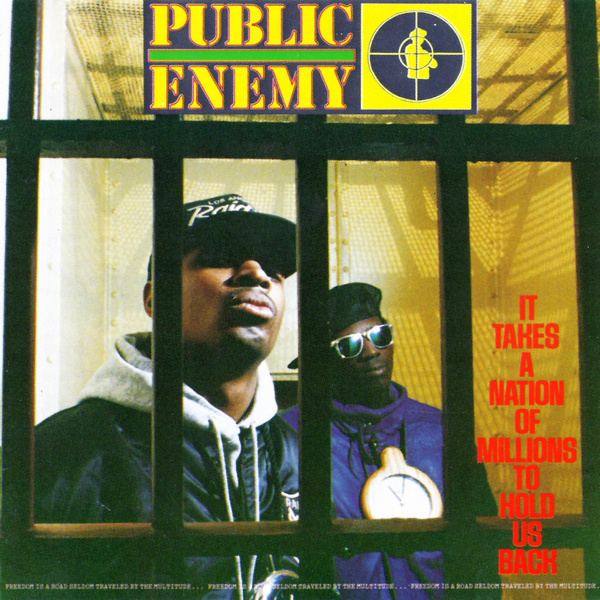
Public Enemy's second album, released in June 1988: the Bomb Squad's dense collage of samples and live turntables, with a sound that has outlasted its politics.
- Released
- 28 June 1988 (US)
- Label
- Def Jam Recordings, distributed by CBS/Columbia (US); CBS (UK and Europe)
- Producer(s)
- Hank Shocklee and Carl Ryder (Chuck D); Eric Sadler, assistant producer; Bill Stephney, production supervisor; Rick Rubin, executive producer
- Runtime
- About 58 minutes, 16 tracks (US CD 57:58; the LP labels add up to 58:06)
- Chart peak (US)
- #42 (Billboard Top Pop Albums, charts dated 13 and 20 August 1988) · #1 (Top Black Albums, 24 September 1988)
- Chart peak (UK)
- #8 (Official Albums Chart, new entry in the week of 24 July 1988), 9 weeks on chart
- Certifications
- RIAA Platinum (22 August 1989); BPI Silver (8 August 1988) and Gold (22 July 2013)
- Awards & honours
- #1 in the Village Voice Pazz & Jop critics' poll for 1988 (1,011 points); NME's album of the year for 1988; #15 on Rolling Stone's 500 Greatest Albums (2020)
The Bomb Squad made noise the argument, and preferred a rough edge to a clean one. It's the best-produced hip-hop album of its decade. The words are weaker than the music, and the running order sags.
The first sound on It Takes a Nation of Millions to Hold Us Back isn't a beat. It's a crowd in London. The sleeve says the live segments were taped there on 3 November 1987, with thanks to Dave Pearce and BBC Radio London. It wasn't always meant to start that way. Russell Myrie's authorised history of the group says the sides ran the other way round until just before mastering, with 'Show 'Em Whatcha Got' first. Hank Shocklee flipped them. The record is dedicated to the cities of Philadelphia and London. Those are the two places where, Myrie writes, strong shows persuaded the group that the new music had to be faster than the debut.
That's the right way in, because this is a record about volume as much as words. Shocklee told Rolling Stone in 1989 that people had called rap noise, so the group set out to show them what noise was. The result is the best-produced hip-hop album of the 1980s. Jon Pareles saw where its strength lay in the New York Times a month after release. Chuck D's ego-tripping and rhetoric, he predicted, would matter less than the group's sound and stance. He meant it partly as a complaint, and the complaint still holds. The music here is smarter than most of what's said over it. That gap is the album's real flaw, and it's why the noise is what lasts.
Public Enemy's debut, Yo! Bum Rush the Show, came out in March 1987. Pitchfork's Craig Jenkins later put its sales at around 400,000, a modest showing beside the Beastie Boys' Licensed to Ill. Chuck D has said the group was already recording the second album on the day the first was released. The group set out to make a hip-hop equivalent of Marvin Gaye's What's Going On, Myrie writes, and a way past the 'Cold Gettin' Dumb' style of rap. Three songs were finished before planning for the album began: 'Rebel Without a Pause', 'Bring the Noise' and 'Don't Believe the Hype'. While Chuck D and Flavor Flav toured, Shocklee and Eric Sadler stayed in the studio.
What those songs are angry about is narrower than their reputation. In his 1988 review, Pareles described radio stations keeping rap in separate shows, away from the rest of their output. That fight, and the critics, are the targets of 'Bring the Noise', 'Rebel Without a Pause' and 'Don't Believe the Hype'. So a good part of a famously political album is about the group's own reception: its airplay, its press and, on 'Caught, Can We Get a Witness?', its samples. Pareles noticed. Most of Chuck D's anger, he wrote, was aimed at whatever stood in the way of his own fame and record sales. He also credited the record with imagining rap's listeners as a community. But the complaint was a fair hit, and it explains why the record's force doesn't sit mainly in its arguments.
It sits in how the record was built. Shocklee has described the order of work to Stay Free! magazine. The beat came first, a rhythm skeleton with fragments of samples already in it. Chuck D wrote to that, and the team then added whatever the lyric needed. Shocklee wanted no conventional R&B bass lines, melodies or chords. He told the New York Daily News in 2005 that they wanted music that could stand up to Chuck D's voice. The sleeve credits production to Shocklee and Carl Ryder, a name Chuck D used, with Sadler as assistant producer and programmer. Shocklee calls Sadler, a guitarist, the only one of them with a 'cultured musical trade': he didn't read music, but he played. Chuck D's own summary, as Brian Coleman reports it, was that 'Eric was the musician, Hank was the antimusician.'
The DJ was part of the arrangement, not an extra. Shocklee says he wanted the DJ inside the instrumentation on all the group's records, so parts are cut in live from Terminator X's turntables rather than sampled. 'Don't Believe the Hype' went further. Shocklee says it was played on a turntable, transformed, and only then sampled. The mixing was physical too. Dan Charnas reported in Scratch magazine in 2005 that there was no automation, so the mixes were done by hand. The sleeve names Rod Hui as the album's mixer at Greene Street, with Steve Ett mixing two tracks at Chung King. Listen to the record as a performance by machines and hands together, because that's how it was made.
The best idea on the record is a taste for flaws. 'Rebel Without a Pause' is built on a saxophone squeal from the J.B.'s 1970 track 'The Grunt', as the scholar Ron Eglash notes. Shocklee caught it for the demo on his Ensoniq Mirage, which he remembers holding only 3 seconds of sound. In the studio, an Akai S900 could loop it smoothly, and Shocklee found the smooth version weak. What he missed was the split second of delay before the Mirage loop came round again. That, he told the Red Bull Music Academy in 2008, was 'the funkiest part'. He doesn't say in so many words which take is on the record, but the preference is the point: rough over clean. Myrie adds that Flavor Flav played the beat live on a drum machine for the length of the track. Myrie also credits Terminator X with a transformer scratch near the end. The single came out on 28 July 1987, 11 months before the album.
'Bring the Noise' shows the same taste, and here the mistake is documented. Charnas reported that its breakdown, where the 'Funky Drummer' kick plays alone, began as a sequencing error on an E-mu SP-1200. Shocklee kept it and had Chuck D rewrite his part to fit. Elsewhere the borrowing reaches well outside funk. 'She Watch Channel Zero?!' runs on the riff from Slayer's 'Angel of Death'. 'Night of the Living Baseheads' has ESG's 'UFO' and David Bowie's 'Fame' inside it, as Pitchfork's Craig Jenkins noted in 2014. Robert Christgau compared the album's dissonance to Ornette Coleman's and John Coltrane's, driven by relentless momentum. Pareles heard the principle in 1988: 'there's always some irritant at the center.' That line is the whole method. Nothing is allowed to settle, and the friction is the hook.
The weaknesses are real, and they're in the running order and the writing rather than the sound. Four of the 16 tracks run under 2 minutes. Two of them, 'Mind Terrorist' and 'Security of the First World', are interludes that hold the momentum without adding to it. 'She Watch Channel Zero?!' is the weakest song: a great riff under what Pareles summed up as a put-down of a woman for watching television. Even the record's champions saw the gap between words and music. Christgau gave it an A in the Village Voice in 1988, later raising it to A+, while writing that Chuck D's raps hadn't yet lived up to the music. He also dismissed the closing track's claims about racial origins in a single clause. Mark Jenkins put it more bluntly in the Washington Post on 6 July 1988: the sound thrilled him, but the ideas were borrowed.
The politics around the record dated faster than the record did. Professor Griff, credited on the sleeve as Minister of Information, had made homophobic and antisemitic remarks in interviews in London shortly before the album came out. Then the Washington Times published an interview with him on 22 May 1989, 11 months after release. His dismissal was announced on 21 June. Within days Def Jam said the group had disbanded. By August it was back, with Griff rehired in a new role. Christgau's 1988 review had already attacked the politics of both Chuck D and Griff. That's still the sensible way to hear it: take the music whole and the ideology in pieces.
Its reputation was made at once. It topped the Village Voice's Pazz & Jop critics' poll for 1988 with 1,011 points, and NME named it the album of the year. Sales came more slowly. It peaked at #42 on Billboard's pop albums chart in August 1988, and reached #1 on its Black albums chart in September. In Britain it entered at #8 and spent 9 weeks on the chart. The RIAA certified it Platinum on 22 August 1989, 14 months after release. Its influence is easier to trace than to measure. Chuck D sent early copies west to Dr. Dre and Ice Cube. Ice Cube then hired the Bomb Squad to produce AmeriKKKa's Most Wanted, released in 1990. Pitchfork's Craig Jenkins later read Paul's Boutique and De La Soul's 3 Feet High and Rising, both from 1989, as records that followed its sample-dense lead. That's a critic's reading, but a fair one.
The usual story is that the law then made records like this impossible. It's half right. Shocklee told Stay Free! that the samples were cleared after release. Asked whether a record like it could be made now, he said it wouldn't be impossible, just 'very, very costly'. Copyright caught up with the group around Fear of a Black Planet, he said, once hip-hop artists started getting sued. By 1990 publishers and their lawyers were making moves, and record companies began policing releases. Chuck D said Public Enemy had to change its whole style by 1991, because sample claims had become too expensive to defend. The Grand Upright case, decided on 17 December 1991, concerned Biz Markie's 'Alone Again', not Public Enemy. So the law never banned this sound. It made it too expensive to risk, and for this group that was enough.
So where does it stand now? Pitchfork gave the 2014 reissue 10/10. Rolling Stone moved it from #48 on its list of the 500 greatest albums in 2003 to #15 in 2020, and that's the right direction of travel. It's one of the best hip-hop albums ever made, and few records of 1988 in any genre sound as dense or as deliberate. Its ideas haven't aged as well as its noise, and its running order needed a sharper edit. Skip the interludes if you like, and argue with 'She Watch Channel Zero?!'. Then play 'Rebel Without a Pause' loud and listen to the squeal come round. Shocklee's preference for the rough loop over the clean one is the whole record in one choice.
Pressing guide — the one to own
The original to own is a 1988 US LP, and there are two kinds. Copies with BFW 44303 on the labels carry the catalogue number the New York Times and Billboard printed in 1988. Copies with C 44303 labels and FC 44303 on the spine add the Columbia logo around the label rim. Both were mastered at Masterdisk, with 'MASTERDISK DMM' in the runout, and pressed at Columbia's plant in Carrollton, Georgia. Some Columbia-numbered copies show a crossed-out BFW number in the runout, and some BFW sleeves wear an FC 44303 sticker. So no source settles which came first. Either is an original; it comes in a single sleeve with a printed lyric inner sleeve.