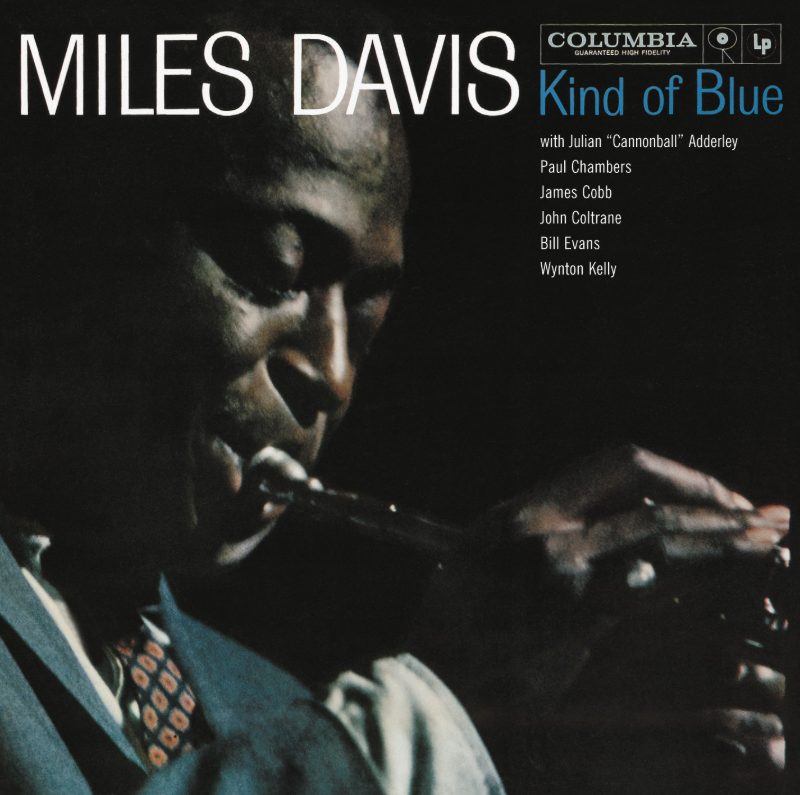
Miles Davis's 1959 Columbia album: five pieces, seven musicians and two sessions in a former church in Manhattan, heard here for the playing rather than the legend.
- Released
- 17 August 1959 (US, Columbia CL 1355 mono and CS 8163 stereo)
- Label
- Columbia
- Producer(s)
- Irving Townsend, credited from the 1997 reissue (the 1959 LP credits no producer)
- Runtime
- 45:44 by the printed timings; the 1997 CD adds the first complete take of 'Flamenco Sketches' (9:32)
- Chart peak (US)
- #2 (Billboard Traditional Jazz Albums, 15 February 2020); #3 (Billboard Vinyl Albums, 31 January 2015)
- Chart peak (UK)
- #63 (Official Albums Chart, 7 July 2001); #1 (Official Jazz & Blues Albums Chart, 69 weeks at #1)
- Certifications
- RIAA 5× Platinum (18 November 2019); BPI 2× Platinum (18 November 2016)
- Awards & honours
- Grammy Hall of Fame (1992); National Recording Registry (2002, its first year); #1 in a BBC poll of the 50 greatest jazz albums (2016)
The legend is a band catching a few new sketches in first takes, but the documents show a year of groundwork, some retakes and a tape machine running slow. The playing is the miracle, and the writing is thinner than its fame.
In 1959 Columbia ran four tape machines at once for its sessions at the 30th Street studio in New York. Two recorded in mono and two on three-track tape, each pair a prime and a backup. On 2 March 1959 the prime three-track deck was running slow. Played back at the right speed, everything taped on it that day came out slightly sharp. That meant 'Freddie Freeloader', 'So What' and 'Blue in Green', the whole of side one. The fault wasn't caught until 1992. Then Sony's engineer Mark Wilder found it, went to the backup tapes, which had never been played, and put side one out at its true pitch.
It's a fitting way into Kind of Blue, because the record and its legend have never quite matched. The legend says Davis handed his band a few sketches they'd never seen, and they caught the music in first takes. Ashley Kahn, who wrote the standard book on the sessions, says the single-pass story isn't true. The documents describe something better. These were pieces that had been gathering for a year, played by a band that made them sound brand new. Kind of Blue is one of the great performances in recorded jazz. As writing, it's thinner than its reputation.
Davis wanted fewer chords. In 1958 he told Nat Hentoff of the Jazz Review that fewer chords would give a soloist more freedom and more room for melody. He'd already tried it. The title track of Milestones, recorded early that year, was his first piece built on modes. Those are scales a soloist can stay on for bars at a time, instead of a run of changes. The theory was in the air. George Russell had set it out in his Lydian Chromatic Concept in 1953, and both Davis and Bill Evans knew it. Evans had studied and recorded with Russell. The Miles Davis estate says ideas from Davis's 1958 soundtrack for Ascenseur pour l'échafaud fed this record too. And a performance by Les Ballets Africains drew him towards slow music over a harmony that barely moves.
The other reason was Bill Evans. He'd joined the band in 1958 and left in November, when Wynton Kelly replaced him. Davis brought him back for these sessions. Evans had introduced Davis to Ravel and Bartók. A year before the sessions, Davis gave him a slip of paper with two chords on it, G minor and A augmented. Evans built 'Blue in Green' from it. In December 1958 he recorded 'Peace Piece', and Stereophile's John Marks says 'Flamenco Sketches' owes much to it. Kelly got one track, a blues, and it was recorded first. Kahn thinks Kelly may not have been happy to see Evans back in his old seat. He suggests the blues was Davis's way of soothing him.
Davis wanted spontaneity, and he called no rehearsals. Evans's sleeve note says Davis conceived the settings only hours before each date. It compares the playing to a Japanese art in which nothing can be erased. It's a beautiful note, but the band knew more than it lets on. Jimmy Cobb later recalled playing 'So What' live before the session. 'All Blues' had been growing on stage for at least 6 months, with help from Gil Evans. 'Blue in Green' was the fifth take, after four breakdowns. 'Flamenco Sketches' was played through twice, and the second take was issued. What does hold is that nothing was edited inside a take. The edits only removed the chatter between them.
The tape of the first session opens with the producer, Irving Townsend, telling the room the machine is running. 'Freddie Freeloader' came first, then 'So What', then 'Blue in Green'. The band came back 7 weeks later, on 22 April, which was Paul Chambers's 24th birthday. Kelly wasn't there. They did 'Flamenco Sketches' first and 'All Blues' last, logged as 'African'. The room was a former Presbyterian church, about 97 by 55 feet, with a 50-foot ceiling. Only the track carrying Davis and Chambers was sent to the echo chamber in the building's basement. Marks notes that the other instruments leaked onto that track. He thinks that may help explain the record's natural sense of space.
'So What' shows the method at its plainest. Evans's note gives the shape: 16 bars on one scale, 8 on a second, then 8 on the first again. Here that's D Dorian, then E-flat Dorian, a half-step up. Chambers states the theme on bass and the band answers him. The introduction before that was most likely written by Gil Evans, not Bill. Once the solos start, there's almost nothing to steer by, and that was Davis's point. On two scales, a soloist can't hide behind the changes. Davis plays few notes and leaves long gaps, and the gaps carry the solo.
On a stereo copy the band is set out like a stage. Davis and Chambers share the middle. On side one Coltrane is on the left and Cannonball Adderley on the right, and on side two they swap. That makes the two saxophones easy to tell apart, and the record runs on the difference between them. 'Blue in Green' leaves Adderley out. It's a 10-bar form that circles back on itself after a 4-bar introduction. Kahn describes the solos as a palindrome: Davis, Evans, Coltrane, Evans, Davis. Davis plays muted, and the piece ends over bowed bass. At 5:37 it's the shortest track and the best one.
'All Blues' is a 12-bar blues in 6/8, and it's the one tune that sounds lived in, which it was. In Kahn's account Evans opens with a tremolo, the saxophones set up the vamp, and Chambers holds the bass figure throughout. 'Flamenco Sketches' goes furthest. Evans's note describes five scales, each played for as long as the soloist wants. There's no chorus length to count, only players listening for each other.
The case against is about the writing. 'Freddie Freeloader' is a B-flat blues with one twist, an A-flat seventh in the last two bars. NPR's Jazz Profiles called Kelly's playing happy and swinging, and it is. But as a composition it could sit on almost any hard-bop record of 1958. For 9:46 the writing asks nothing new of the players. Each of the other four pieces does. Who wrote what is still argued, too. The 1959 labels credit all five pieces to Davis. Evans said on Marian McPartland's radio show, broadcast on 27 May 1979, that he wrote 'Blue in Green' and Davis got the royalties. The 1997 CD credits him as co-writer of that and 'Flamenco Sketches'. A record this famous for its ideas is oddly vague about whose they were. The sound has a gap of its own. The mono tapes are lost, so the 2013 mono LP had to be cut from a re-creation.
Accounts of how it first landed differ. NPR's Jazz Profiles says the jazz community quickly recognised it as a classic. Kahn's account is cooler. He writes that Ornette Coleman's arrival in New York late that year muted its first impact, and that this irritated Davis. Coleman had recorded The Shape of Jazz to Come in Hollywood in May. It came out in November, and on 17 November he opened at the Five Spot. Next to that, Kind of Blue sounded like the calmer answer to the same question. Both accounts can be true: musicians heard it at once, while the noise late in 1959 was about Coleman.
Its influence is easier to document than its first reception. John Coltrane's 'Impressions' uses the structure of 'So What'. Pink Floyd's Richard Wright said the album's chord progressions shaped the opening chords of 'Breathe'. Duane Allman said that for a couple of years he'd barely listened to anything but Kind of Blue. In 2014 the band Mostly Other People Do the Killing recreated the whole album note for note, as Blue. In the US the RIAA certified it 5× Platinum on 18 November 2019. On the UK's jazz and blues chart it has spent 69 weeks at #1. Davis didn't invent modal jazz. What Kind of Blue did was make it something people bought and kept.
Its maker was less sure. In his 1989 autobiography Davis called it a failed experiment, because it didn't fully catch the sound in his head. In 1986 he told Ben Sidran the modal material was done: right for its day, and not something he felt any more. Critics still rank it high: it topped a BBC poll of the 50 greatest jazz albums in 2016. But Rolling Stone, which had it at #12 among the 500 greatest albums in 2003 and 2012, moved it to #31 in 2020. In August 2026 Craft Recordings announced that A Charlie Brown Christmas had been certified 6× Platinum. That's one level above Kind of Blue's 5×, and Craft now bills it as the best-selling jazz album. None of that touches the music. It does take some shine off the story.
Kind of Blue is one of the best jazz records ever made, and it earns that on the playing. Seven musicians, never more than six on a track, take almost bare frames as an invitation to say less. Coltrane and Adderley pull the same tunes in two directions while Evans, Chambers and Cobb keep the ground still. Its weaknesses are real. One of its five pieces is an ordinary blues, and for 33 years its first side played at the wrong pitch. Hear a corrected copy, start with 'Blue in Green', and the reputation holds.
Pressing guide — the one to own
The original to own is the 1959 US mono, Columbia CL 1355, on six-eye deep-groove labels with no 'CBS' at the top. The matrices begin XLP47324 and XLP47325, and the catalogue lists at least 13 stamper combinations without ranking any as first. Copies whose side-two label lists the tracks in reverse, with 'Adderly' on the cover, also lack 'CBS', and the catalogue treats them as earlier than CBS-label copies. The catalogued first-year US sleeves list side two in the wrong order on the back, so that error proves nothing. Stereo copies from 1959 play side one slightly sharp. Whether the mono does is unsettled.