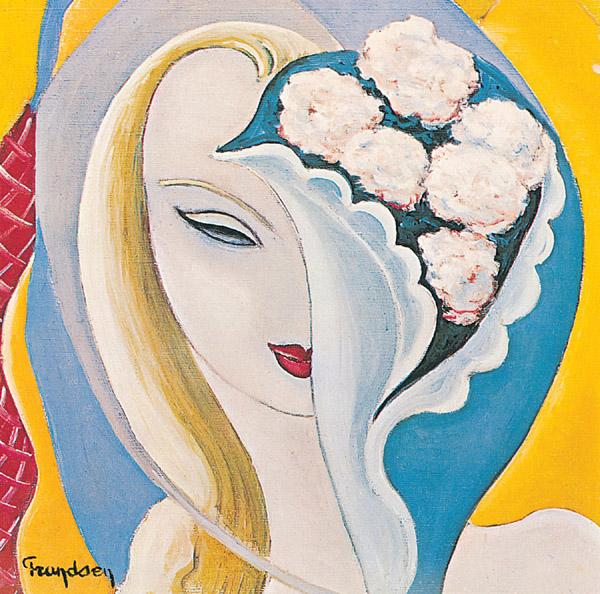
The only studio album by Derek and the Dominos, cut in Miami in 1970 with Duane Allman as a guest. Its playing is extraordinary; its four sides hold more than its best songs need.
- Released
- 9 November 1970 (US, Atco); December 1970 (UK, Polydor)
- Label
- Atco SD 2-704 (US); Polydor 2625 005 (UK)
- Producer(s)
- Derek and the Dominos (sleeve credit); Tom Dowd, executive producer
- Runtime
- About 77 minutes; 14 tracks on 2 LPs
- Chart peak (US)
- #16 (Billboard Top LPs)
- Chart peak (UK)
- #68 (Official Albums Chart, 2 April 2011, its only week on the chart); the single 'Layla' reached #7 in 1972
- Certifications
- RIAA Gold (26 August 1971)
- Awards & honours
- Grammy Hall of Fame (album 2000; the single 'Layla' 1998). Rolling Stone's 500 Greatest Albums: #117 (2003), #226 (2020)
The legend is a love affair and a guitar duel. The tapes tell a plainer story: a band playing for hours with the machine running, and a double album nobody stopped to edit. The playing earns the reputation. The shape doesn't.
On Wednesday 9 September 1970, at Criteria Studios in Miami, Derek and the Dominos recorded 'Little Wing' and 'Layla'. The date comes from the session log printed in The Layla Sessions, the box set issued in 1990. Jimi Hendrix, who wrote 'Little Wing', died in London 9 days later. It's the kind of fact a legend is built from, and this album's legend has grown for more than half a century. In the legend, it's Eric Clapton's confession of love for George Harrison's wife. It's also the record Duane Allman is supposed to have transformed. Both stories hold some truth. Neither is the best reason to play it.
What the tapes hold, first of all, is a band playing. In the 7 minutes of 'Layla', the singing is over by 2:16. Everything after that is instrumental. Across four sides the playing is rarely less than superb, and the shaping is often careless. Layla is one of the great performance records of its time, and a less complete album than its reputation says. The legend is about feeling. The real strength is musicianship, and the real weakness is the edit nobody made.
Clapton wanted to escape the hype of a supergroup. After Cream and Blind Faith, he toured as a sideman with Delaney & Bonnie and Friends from November 1969 to March 1970. Bobby Whitlock, Carl Radle and Jim Gordon all came from that band. Whitlock joined Clapton in Surrey around April 1970, and the two began writing songs. Radle and Gordon came to London to play on Harrison's All Things Must Pass. The band played its first show at the Lyceum in London on 14 June 1970, with Dave Mason as a fifth member. Mason soon left, and the four carried on. In August they toured British clubs for 3 weeks, under contracts that barred promoters from using Clapton's name to draw a crowd. The band name was a disguise, and on the record Clapton often sounds glad of it.
The songs had a subject. Clapton had fallen for Pattie Boyd, who was married to Harrison. Ian Dallas gave him Nizami's Layla and Majnun, a 12th-century poem built on a 7th-century Arabic story. Clapton later told Rolling Stone that the song was about a woman who'd turned him down. 'I Am Yours' goes further, and lists Nizami as its co-writer. Drugs were part of the picture too. Whitlock's memoir describes a cocaine binge with Clapton and Allman between sessions in Miami. He later blamed the band's end on too many drugs and too much alcohol. None of the love story is hidden, and none of it needs decoding. The titles spell it out. For all its fame, it's the least interesting thing about the record.
Allman arrived by way of a concert. The Allman Brothers Band played the Miami Beach Convention Center on 26 August 1970. Clapton went to the show and invited Allman to the studio. Tom Dowd and Whitlock both remembered everyone going back to Criteria that night to jam. The session log first credits Allman the next day, on a run of jams. His first album track, 'Tell the Truth', is dated 28 August. He plays on 11 of the 14 songs, and the sleeve says he appears courtesy of his label, Capricorn. Clapton asked him to join the band. He declined.
He isn't on the first three songs: 'I Looked Away', 'Bell Bottom Blues' and 'Keep On Growing'. Two accounts, Whitlock's and the one Sound On Sound drew from Tom Dowd and his engineers, say three songs were cut before Allman arrived. The log has no album track before 28 August, and it dates the three songs without him to 1 and 2 September. Memory and paper disagree, and the music can't settle it. What it does settle is simpler. Those three songs, nearly 15 minutes of music, are the Dominos on their own, and they're among the album's best. 'Bell Bottom Blues' needs no help at all. It's Clapton's plainest plea on the record.
Sound On Sound's 2006 account of the sessions, from interviews with Dowd and the engineers Ron and Howard Albert, describes the room. It was Criteria's Studio B, with a custom MCI console and an MCI 16-track tape machine. Clapton and Allman sat side by side, their backs to a 9-foot Baldwin grand. Small Fender Champ amps sat on its closed lid. The tape ran all the time. Songs were played for hours before a take was chosen, and there were rarely more than three or four formal takes. Ron Albert says some tracks kept only the rhythm guitar and drums from that take, and others weren't touched at all. Whitlock says 'Little Wing' and 'Have You Ever Loved a Woman' went down live, vocals included. Sound On Sound singles out 'Layla'. Clapton overdubbed its lead vocal over several nights, and the engineers pieced it together from many takes. The playing has the ease of a band that never stopped. The singing is less even, and it's the part critics have picked at ever since.
'Layla' itself was built in pieces. Clapton wrote it as a ballad, and by his account it was Allman's riff that made it a rock song. Where that riff came from is disputed. Sound On Sound traced it to a T-Bone Walker vocal line, and Whitlock pointed to Albert King's 'As the Years Go Passing By'. The first movement is the band at full stretch, with the vocal gone by 2:16. Then comes the piano coda, which Jim Gordon came up with after the song was finished. Sound On Sound says the track was put together in three parts. First came the band, then the piano, then the band again, brought back in over the end of the piano to smooth the join. Gordon shares the writing credit. Whitlock said Gordon took its melody from Rita Coolidge's song 'Time', and Coolidge's 2016 memoir says the same. Whitlock also doubted that the coda belonged in the song. He had a point. The join is the record's most famous moment, and it's two good ideas laid end to end.
The smaller songs show the band best. 'Keep On Growing' started as an instrumental, and Whitlock says he wrote its words quickly because it needed some. You can hear the order of events: the singing stops at 4:17, and the band plays on for 2 more minutes. 'Little Wing' is the cover that earns its place. Whitlock learned the words and sang it live on the take, with them laid out on top of his organ. 'Thorn Tree in the Garden', Whitlock's own song, closes the album. It was done in one take, with the band sitting in a circle round a single microphone. After 7 minutes of 'Layla', that's the album's best decision. It lets a loud record end quietly.
The weakness is length, and critics found it early. Four sides run to about 77 minutes. Five of the 14 songs are covers, and three of those are blues. 'Key to the Highway' alone runs 9:47, and it fades in because the tape was already rolling. Dowd said the band started playing it after hearing Sam Samudio cut the song in another room. Whitlock remembered Dowd out of the room with the faders down. Either way, it's a jam caught by chance and kept whole. 'Have You Ever Loved a Woman' drops its vocal at 2:24 and doesn't bring it back for 3½ minutes. Ed Leimbacher, reviewing it for Rolling Stone in December 1970, expected filler from a double album and listed five weak cuts. Yet he praised 'Key to the Highway', and his weak cuts included 'Bell Bottom Blues' and 'Thorn Tree in the Garden'. On a record this long, every listener's filler is different. Robert Hilburn, reviewing the 1990 box in the Los Angeles Times, allowed that some of the songs and vocals felt hurried and unfinished, and found the musicianship frequently inspired.
Robert Christgau saw the risk and argued past it. In the Village Voice in January 1971, he granted that it looked like a slapdash studio session, but thought it might be Clapton's most consistent record. He later raised his grade from A to A+. The public was slower. In Britain the album didn't chart at all in the 1970s. Its only week on the Official Albums Chart came on 2 April 2011, at #68. In America it reached #16 and went Gold on 26 August 1971, under 10 months after release. Edited to 2:43, 'Layla' stalled at #51 as a US single in 1971. Reissued in 1972, it went to #10 in America and #7 in Britain. So the flop story is half true: a modest American hit, and an album the British chart ignored for 40 years.
The story kept growing after the music stopped. The band fell apart in London in spring 1971, during sessions for a second album. Allman died on 29 October 1971, aged 24, after a motorcycle accident in Macon. Radle died in 1980. Gordon killed his mother in 1983, and died at a prison medical facility in 2023. Whitlock died on 10 August 2025, which leaves Clapton as the last of the four who made the album. The deaths turned the record into a legend. They also make it harder to hear plainly, and Gordon's coda now carries his crime with it.
Its influence runs through the title song more than through other records. 'Layla' was a British hit twice, at #7 in 1972 and #4 in 1982. Clapton has played it ever since, from Live Aid to the acoustic version that won a Grammy in 1993. We found no later artist on record naming the album as the model for their own. The rest of what's documented is close to home. Clapton said that playing with Derek Trucks made him feel he was back in the Dominos, and his 2006–07 shows opened with a run of its songs. The Allman Brothers Band began playing 'Layla' in 2003, for Duane and for Dowd. The Tedeschi Trucks Band played the whole album at the LOCKN' festival on 24 August 2019. The album's critical ranking has gone the other way, down. On Rolling Stone's list of the greatest albums it was #117 in 2003, and #226 in 2020. The drop seems about right.
So the legend has the subject right and the strength wrong. Layla isn't great because Clapton was in love, or because Allman rescued it. It's great in stretches because four players and a guest were caught at full power with the tape running. That's also why it isn't great all the way through. Nobody shaped the four sides, and the record found little that was new: it played the blues and its cousins with unusual heat. Hear 'Bell Bottom Blues', 'Little Wing', 'Layla' and 'Thorn Tree in the Garden', and you'll understand the reputation. Sit through 'Key to the Highway' and you'll understand its limits. It's a very good record, rightly admired, and loved a little more than it deserves.
Pressing guide — the one to own
The original to own is the 1970 US Atco double LP, SD 2-704, in an un-laminated gatefold. First pressings have yellow Atco labels with '1841 Broadway' in the rim text. The plant code in the runouts says where a copy was pressed: 'PR' for Presswell or 'MO' for Monarch. Many copies also carry 'aB', the mark of Al Brown, who cut the lacquers at Atlantic Studios. The UK original is Polydor 2625 005, with the two discs numbered 2335 009 and 2335 010.