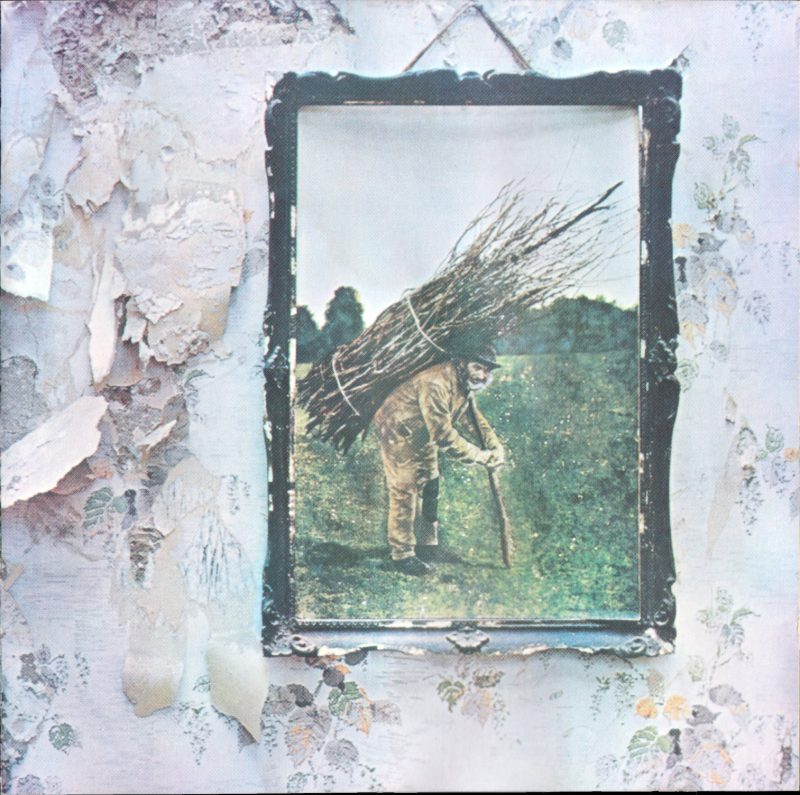
Led Zeppelin's untitled fourth album, made mostly in a cold Hampshire house over the winter of 1970–71. Their best-played record, and the one that hangs together least.
- Released
- 8 November 1971 (UK, Atlantic 2401012; US, Atlantic SD 7208)
- Label
- Atlantic (UK: marketed by Polydor, pressed by Phonodisc; US: Atlantic)
- Producer(s)
- Jimmy Page; executive producer Peter Grant; engineer Andy Johns
- Runtime
- 42:31 (8 tracks)
- Chart peak (US)
- #2 (Billboard 200), 4 weeks at #2 from the chart dated 18 December 1971
- Chart peak (UK)
- #1 (Official Albums Chart), 2 weeks at the top, 4 and 11 December 1971
- Certifications
- RIAA 2× Diamond (8 November 2021); BPI 6× Platinum (23 November 2007); Music Canada 2× Diamond (28 June 1995)
- Awards & honours
- Grammy Hall of Fame (the album in 1999, 'Stairway to Heaven' in 2003); 'Stairway to Heaven' added to the National Recording Registry (2023); #58 on Rolling Stone's 500 Greatest Albums (2020)
The sleeve swapped the band's name for four symbols, one for each member, and the music works the same way. Each player gets room at the height of his powers. What the eight songs don't do is join up.
The man on the front of Led Zeppelin's fourth album went without a name for 52 years. He's an old countryman bent under a bundle of sticks, in a framed, hand-coloured photograph. The frame hangs on the papered wall of a partly demolished house. There's no title and no band name, front or back. In November 2023 it was traced to an 1892 photograph, which a part-signature links to Ernest Howard Farmer. The sitter was probably Lot Long, a thatcher from Mere in Wiltshire. Robert Plant had bought it in an antique shop in Berkshire.
Leaving the band off the sleeve was the point. Jimmy Page wanted a release with no information on it at all, and at first a single symbol in place of a name. The band settled on four, one for each of them. So the record that took Led Zeppelin's name off the cover put four signatures inside it. That's the best way to hear the music, too. This is the band's best-played and best-recorded album, and its strength is four players each given room. Lenny Kaye, reviewing it for Rolling Stone in December 1971, called it their "most consistently good" record. He praised its variety, with no cut getting in another's way. He's right about the quality. But that variety is also why this is the least unified of their great records.
The blank sleeve was an answer to the reviews. Led Zeppelin III came out on 5 October 1970 to a lukewarm press. Page told Trouser Press in 1977 that Melody Maker had put its acoustic songs down to a visit from Crosby, Stills & Nash. He said that criticism was much of the reason the next sleeve carried no information. An agent told the band that after a year without a record or a tour, it was professional suicide. Atlantic objected too. By Dave Lewis's account, the band held on to the master tapes until the label gave way. The message was simple: judge the music.
Most of that music was made in a cold house in Hampshire. Andy Johns, the engineer, had used the Rolling Stones' mobile truck on Sticky Fingers. He suggested Mick Jagger's house, Stargroves. Page wouldn't pay Jagger £1,000 a week, and found Headley Grange instead. It was built in 1795 as a workhouse, and Page later said the heating didn't work. The sessions began at Island's studio in Basing Street in December 1970 and ran into February 1971. Much of the album came together on the spot. Page said 'Misty Mountain Hop' arrived that way. Page and Plant made up 'The Battle of Evermore' on John Paul Jones's mandolin, an instrument Page had never played.
The house is the sound of 'When the Levee Breaks', and Johns has told that story himself. One night he sent the others to the pub and moved John Bonham's kit out into the lobby. He put two Beyerdynamic M160 microphones up the first flight of stairs. Both went through limiters, and Page's Binson Echorec went on top. The song opens on Bonham alone, and Plant doesn't sing until 1:23. Johns said the song's tempo gave the limiters time to breathe. He said the 'Ga Gack' sound came from the Echorec, not from Bonham's playing. It's the record's one real invention, and it came from an engineer in a hallway.
Page takes credit for the track's other ideas: phased vocals, a harmonica solo with backwards echo, and something new every 12 bars. The harmonica is Plant's. Robert Christgau thought the track the album's triumph, and Lenny Kaye picked it as a standout in Rolling Stone in 1971. Keith Shadwick disagreed, arguing it adds too few ideas as the minutes pass. He has a point about the length. But a one-chord drone that builds for 7 minutes is the idea, and the drums carry it. The song itself is a 1929 record by Kansas Joe McCoy and Memphis Minnie. The label credits Memphis Minnie next to all four members, and leaves McCoy off.
'Stairway to Heaven' is built the same way, by addition. Page worked out the changes with Jones the night before the band ran it down at Headley Grange. Plant pencilled most of the lyric on the spot. The take itself was cut upstairs at Island, with drums, Page's acoustic guitar and Jones on a Hohner electric piano. Johns recorded Page's 12-string Rickenbacker straight into the desk, compressed for a bell-like tone. Listen for who arrives when. Plant comes in at 0:52, and the drums don't enter until about 4:18, past the halfway mark. Page's solo starts at 5:34, and Johns says it took seven or eight takes. Each player arrives as an event. It's the four-symbol idea as an arrangement.
The two openers make the same case at full volume. 'Black Dog' is Jones's riff, and he has named Howlin' Wolf's 'Smokestack Lightning' as its model. The stop-start shape, Plant alone and then the band answering, came from Fleetwood Mac's 'Oh Well'. Johns triple-tracked Page's Les Paul through limiters, so the riff lands like a section, not a guitar. 'Rock and Roll' began as a jam when 'Four Sticks' stalled. Bonham played a Little Richard intro with the tape running. Page joined in, and Plant sang over it straight away. In his 1981 guide Christgau wrote that this was the song that won him round, months after he'd dismissed the album. It sounds like four people finding a song in real time, because it was.
The finish took longer than the playing. In February 1971 Page and Johns took the tapes to Sunset Sound in Los Angeles for about ten days, arriving just after an earthquake. Back in London they played the mixes at Olympic, and they sounded wrong. Only 'When the Levee Breaks' kept its Sunset mix. Page remixed the rest in July, at Island by Johns's account. The release, first planned for April, slipped while that happened. The cover and talk of a double album held it up too. That patience is the producer's half of the record, and it has aged better than anything in the writing. The drums are enormous, yet every part around them stays clear.
The trouble is the album as an album. Side one runs two riffs, a folk duet and an eight-minute suite. Side two runs a groove, a rhythmic puzzle, a ballad and a blues. Every mode the band had tried on their first three records is here, mostly done better. But the joins show, and two tracks sag. 'Four Sticks' is the weaker of them. Bonham played it with two sticks in each hand, through a riff that moves between 5/8 and 6/8, and it took many takes. It's a hard problem solved, not a song. 'The Battle of Evermore' is the other. Sandy Denny sings the answering part, the only outside vocalist on a Led Zeppelin record, and she's the best thing in it. Christgau's complaint that the band's medievalism has its limits bites hardest here. 'Going to California' gets the acoustic mode right, because it doesn't dress up. Page had written it earlier on acoustic guitar, and Dave Lewis says Joni Mitchell inspired the music.
None of that slowed it down. It went to #1 in Britain on 4 December 1971, a week after entering at #10. In America it reached #2 and stayed there for 4 weeks. Above it sat Sly and the Family Stone's There's a Riot Goin' On, then Carole King's Music. By 2021 the RIAA had certified it 2× Diamond, and the press repeats a figure of more than 37 million worldwide. Its influence ran through the drums more than through 'Stairway'. Johns said Page used the same room-mic approach on 'Kashmir'. The Beastie Boys built 'Rhymin' & Stealin'' on the 'Levee' break in 1986. Esquire also lists Eminem, Dr. Dre and Mike Oldfield among its users.
The critics took longer than the buyers. Christgau gave it an A in 1981 and called it "the definitive Led Zeppelin and hence heavy metal album". The Grammy Hall of Fame took the album in 1999 and 'Stairway' in 2003. The Library of Congress added 'Stairway' to its National Recording Registry in 2023. Even the raves now come with a reservation. Mark Richardson made the reissue Pitchfork's Best New Reissue in 2015, and wrote that the band went for perfection and got there. But he called it their least weird album, 'Stairway' aside. He added that classic-rock radio made it feel like the album on shuffle, and that he never needs to hear 'Stairway' again. He's right about the weirdness. Houses of the Holy and Physical Graffiti take more chances, and Physical Graffiti is partly built from these sessions' leftovers. But overfamiliarity is a fact about radio, not about the record. Play 'Rock and Roll' or 'Levee' with fresh ears and the overplay falls away.
Led Zeppelin IV is worth owning for the playing and the recording. 'When the Levee Breaks' alone would justify it. 'Black Dog', 'Rock and Roll' and 'Stairway' are the band at a height they rarely reached again. It isn't their most adventurous album, and it isn't a whole. 'Four Sticks' and 'The Battle of Evermore' are where the sequence sags, and side one plays more like a sampler than a statement. Kaye was right that no song gets in another's way. None of them leads into the next, either. It's a great record with a real flaw: easier to love in parts than as one piece.
Pressing guide — the one to own
The original to own is the 1971 UK Atlantic 2401012 on the plum label, in a gatefold. The first label state prints Plant's feather symbol upside down on side 2, and it's the only one that pairs that error with a visible Peter Grant credit. Nine plum-label states are documented. Eight carry George Peckham's hand-etched 'Pecko Duck' and 'Porky' in the runouts; the last has neither. The 1972 reissue is K 50008.