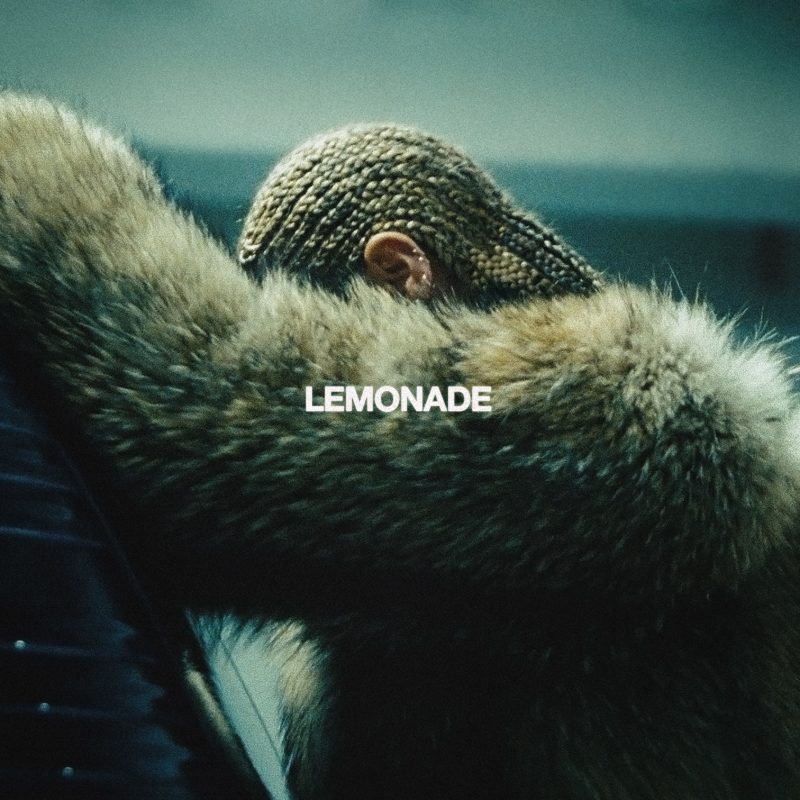
Beyoncé's sixth album, released with an hour-long HBO film in April 2016. About 20 producers and more than twice as many writers, held to one voice by her choices and her engineer's mixing.
- Released
- 23 April 2016 (film on HBO; album on Tidal). Other download stores from 25 April; CD+DVD 6 May 2016
- Label
- Parkwood Entertainment / Columbia (US CD+DVD 88985 33682 2; clean edition 88985 33683 2)
- Producer(s)
- Beyoncé (executive producer; producer on all 12 tracks) · Diplo · Ezra Koenig · Jack White · MeLo-X · Wynter Gordon · Boots · Mike Dean · Just Blaze · Jonny Coffer · Kevin Garrett · Mike Will Made It · and others
- Runtime
- 45:49 (12 tracks, sum of the label's timings)
- Chart peak (US)
- #1 (Billboard 200, chart dated 14 May 2016), 653,000 units in the first week
- Chart peak (UK)
- #1 (Official Albums Chart, week to 5 May 2016), 73,000 chart sales in the first week
- Certifications
- RIAA 4× Platinum (17 December 2024); BPI 2× Platinum (6 February 2026)
- Awards & honours
- Nine Grammy nominations for Beyoncé at the 59th Grammys, including Album of the Year (lost to Adele's 25); won Best Urban Contemporary Album. #1 on Rolling Stone's 250 greatest albums of the 21st century so far (January 2025)
Critics in 2016 heard Lemonade as a confession. The account of its making shows something harder: a crowd of writers and producers pulled into a single voice. That control is the album's triumph. Its flaw is the genre dress-up in the middle.
For 45 days, two rooms in a Paris hotel held identical studios. Each had the same speakers, the same Telefunken microphone and the same Pro Tools rig. In one, Beyoncé worked with her engineer, Stuart White. Next door, Jay-Z worked with a second engineer, Ramon Rivas. White described the set-up to Paul Tingen of AudioTechnology in September 2016. It's the best picture we have of how Lemonade was made. It also undoes the easiest way of hearing it.
The easy way is as a diary. In April 2016, critics heard an album about a husband's alleged infidelity, and that reading has stuck. The Paris rooms tell a longer story. By AudioTechnology's count, about 20 producers and more than twice as many co-writers worked on it. Beyoncé, credited as a producer on all 12 tracks, pulled them into one voice. That's the achievement, and it's a bigger one than confession. It's also where the album's weakness comes from. When the editing runs ahead of the writing, the songs become very good copies of other people's genres.
It's her sixth studio album, and like the five before it, it entered the Billboard 200 at #1. White dates the start to August 2014, at the Record Plant in Los Angeles, after the Mrs Carter Show tour. Every room was booked for a month, and producers were writing in all of them. After Paris, and after New Year, White set up a studio in the home cinema of her Los Angeles house. He lived in a nearby hotel for a year, and sessions sometimes began at 8am. Later work took in Conway, Henson, Pacifique, Capitol and Jungle City in New York. Nothing in that schedule suggests a record dashed off in grief. It reads like a long, patient search for the right version of each song.
The public met it as a film first. HBO showed the 65-minute Lemonade on Saturday 23 April 2016, and it averaged 787,000 viewers. The album went on sale and on stream through Tidal the same day. Other download stores had it from the Monday, and the CD and DVD followed on 6 May. The film runs in 11 chapters, and between the songs Beyoncé speaks poems adapted from Warsan Shire. Her 2013 album had already come with a full set of videos. The new idea was a single hour-long film with a shape of its own. That shape belongs to the film, not to the record, and it matters later.
What the songs are about was, in 2016, a critic's reading. Alexis Petridis reviewed it in the Guardian on 24 April. He set it beside Marvin Gaye's Here, My Dear rather than What's Going On: personal, not political. He was right about the centre and wrong about the edges. 'Freedom' samples two Alan Lomax field recordings, one of them made at Parchman prison in 1947. Kendrick Lamar is featured on it. That isn't a song about a marriage. The album carries both subjects, and its craft shows in how little it strains to hold them.
How it was held together is in White's account. Producers sent material in, and he started mixing it as soon as it arrived. Sometimes he copied a Pro Tools session five times to try five arrangements. Changes ran up to the delivery deadline, and he added a new intro to 'Sorry' two days before the end. The credits name him as a recording engineer on all 12 tracks, with others alongside him on some. He worked on a laptop he carried from room to room, and he says it was the first project he'd mixed entirely in the computer. He mixed 8½ of the 12 songs, Tony Maserati mixed three at Mirrorball, and Jaycen Joshua shared 'Formation'. Dave Kutch mastered 11 tracks at Pacifique in North Hollywood and 'Formation' in New York. That's why 20 producers sound like one album. The constant is an engineer who worked on every track, sessions that travelled on his laptop, and a singer who kept choosing.
Listen to 'Don't Hurt Yourself' with that in mind. Jack White's parts arrived on 8-track tape, with plenty of spill between the instruments and the effects taken off. Patrick Keeler plays drums and Jack White plays bass. The track also samples John Bonham's drums from Led Zeppelin's 'When the Levee Breaks', and Stuart White added more drum samples on top. Beyoncé sang through a distorted SM58 with the speakers loud. Her voice arrives 14 seconds in. It's the one song here that sounds like a band in a room, and it was assembled from tape, samples and a laptop. A pop star visiting a rock band usually sounds polite. This doesn't.
'Hold Up' is the same trick in a lighter key. It credits 15 writers, among them Ezra Koenig of Vampire Weekend and Josh Tillman, who records as Father John Misty. It draws on Andy Williams, the Yeah Yeah Yeahs' 'Maps' and Soulja Boy. In 2025 Rolling Stone heard a reggae lilt in it. The title comes in the first sung line, 23 seconds in, and nothing about it sounds like a committee. 'Forward' is the opposite case, with two writers. James Blake sang it on Beyoncé's own microphone chain at Conway, then played the piano. It lasts 1:19, and its last sung line begins at 0:50. It sits at the album's hinge, between the grievance and the repair.
Then 'Freedom' turns outward. Jonny Coffer, Just Blaze and Beyoncé produced it. Marcus Miller plays bass, and Kaleidoscope's 'Let Me Try' is sampled alongside the Lomax recordings. Petridis heard a dense swirl that ran from field recordings to 1960s psychedelia. It's the best song on the record. 'Formation' closes the album, and in the film it plays over the end credits, outside the 11 chapters. It doesn't sing its own title until 1:27. The song the world heard first holds back its name for nearly a minute and a half. Petridis found it tacked on after 'All Night', which he heard as a grand finale. It makes more sense as an epilogue.
The middle is where it gives ground. Petridis heard a lull at the centre, just as the mood turns towards forgiveness. He found 'Daddy Lessons' uncomfortably close to pastiche, and 'Sandcastles' commonplace beside 'Freedom'. Jill Mapes, in Pitchfork, found 'Daddy Lessons' the least interesting chapter in sound. She suspected its sounds were less forward-thinking than the 2013 album's, though she heard a reason behind every one. They were right about the songs. 'Daddy Lessons' has Dixieland horns and a harmonica, and it wears country like a costume. 'Sandcastles' has a fine vocal and a tune that rarely surprises. 'Love Drought' is pleasant and slightly anonymous. The running order carries these songs. On their own, they're the weakest writing on her best album.
The other reservation is about what's missing. The poems that carry the story in the film aren't on the album. On record, the turn towards forgiveness arrives without the words the film gives it. bell hooks raised a harder objection on 9 May 2016. She called the album a product made to sell to every consumer. She read its scenes of female rage as a celebration that undercut the album's own message that violence hurts. And she argued that, for all its images of black womanhood, it stayed inside a frame that casts the black woman as a victim. The first charge is true of almost any major-label record. The last still deserves an answer. A story that turns towards forgiveness has chosen that turn, and it's fair to ask why.
Her essay came after the first-week numbers, and they were enormous. In its first American week, to 28 April, it moved 653,000 units, and its 115.2 million streams were the biggest streaming week any album had had. All 12 tracks entered the Hot 100 at once. The IFPI named it the world's best-selling album of 2016. It still lost Album of the Year to Adele's 25, and Adele said from the stage that she couldn't possibly accept the award. Since then the reputation has only climbed. In January 2025 Rolling Stone put it at #1 on its list of the century's best albums so far.
What it changed is harder to pin down than where it ranks. She'd already paired an album with a full set of videos in 2013, and the claims that later visual albums copied this one are thinly documented. The clearest line runs through 'Daddy Lessons'. On 2 November 2016 she sang it with the Dixie Chicks at the CMA Awards. The CMA then deleted its promotional posts, and its chief executive said her team hadn't approved the footage. Rolling Stone, ranking the album in 2025, tied that treatment to Cowboy Carter eight years later. So the song Petridis and Mapes marked down has had the most surprising afterlife. So far its influence runs mostly through her own catalogue.
Lemonade is Beyoncé's best album and one of the best of its decade. Control is what earns it that. About 20 producers, a crowd of writers and two hotel rooms in Paris went into it, and it comes out sounding like one person. 'Don't Hurt Yourself', 'Hold Up' and 'Freedom' are as good as anything she's made. The middle sags, 'Daddy Lessons' is dress-up, and the album leans on a film it doesn't contain. Rolling Stone's #1 of the century overstates it. A great record with a soft centre is still a great record, and this one is great.
Pressing guide — the one to own
There's no 2016 vinyl. Lemonade came out on Tidal and HBO in April 2016, and on CD+DVD (US 88985 33682 2) on 6 May. The first official LP is the 180g yellow 2×LP, 88985446751. It comes in a gatefold with a 12-inch booklet and a download card for the album and the film. It first appeared inside the numbered How To Make Lemonade box (88985446681) on 18 August 2017, then on its own on 15 September 2017. US copies were pressed by MPO, which is etched in the runouts, and Dave Kutch is credited with the mastering.