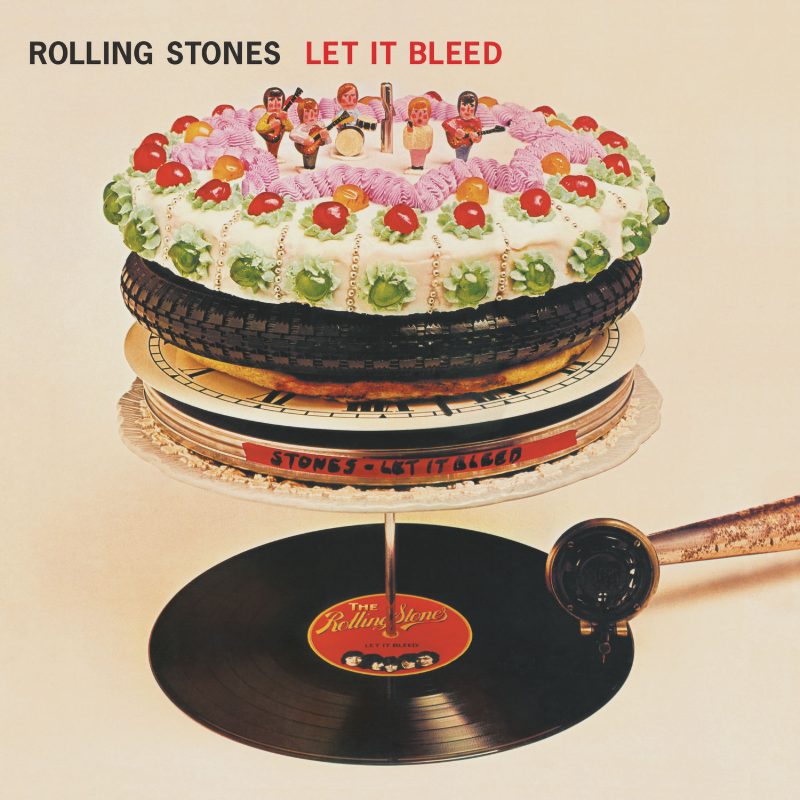
The Rolling Stones' last studio album of the 1960s, released in Britain a day before Altamont. Keith Richards is the only credited guitarist on seven of nine tracks, and outsiders take over its two bookends.
- Released
- 28 November 1969 (US, London Records); 5 December 1969 (UK, Decca)
- Label
- Decca (UK); London Records (US)
- Producer(s)
- Jimmy Miller
- Runtime
- 42:20
- Chart peak (US)
- #3 (Billboard Top LPs, charts dated 27 December 1969 and 3 January 1970)
- Chart peak (UK)
- #1 (chart of 14–20 December 1969), 1 week at the top
- Certifications
- RIAA 2× Platinum (20 October 1989); BPI Platinum (1 July 1999)
- Awards & honours
- Grammy Hall of Fame (2005). #41 on Rolling Stone's 500 Greatest Albums (2020), and #32 in 2003 and 2012
Let It Bleed is heard through Altamont and Brian Jones's death, though it was recorded before Altamont and mostly before Jones died. What makes it great is Merry Clayton and a London choir at its two ends. The middle is the Stones repeating Beggars Banquet, very well.
Merry Clayton was in bed when the phone rang, somewhere between half past eleven and midnight. It was the arranger Jack Nitzsche, she told Terry Gross in 2013, and some English musicians needed a singer. She was heavily pregnant. She'd just come off the road with Ray Charles and didn't know who the Rolling Stones were. Her husband told her to go. At the studio in Los Angeles, Keith Richards showed her the part. She asked what one violent line meant and had it explained. Because of the pregnancy, she sat on a stool to sing. She sang it three times and went home.
Those three passes carry more of this album's reputation than anything the band played. Let It Bleed is remembered as a record about an ending. Brian Jones left the Stones in June 1969 and was dead within a month, and Mick Taylor took his place. Then the decade seemed to die at Altamont, the day after the album came out in Britain. Very little of that story is on the record. Taylor is credited on two tracks, and so is Jones. On seven of the nine, Richards is the only credited guitarist. What lifts Let It Bleed happens at its two ends, where the Stones let other voices in. Between them sits a very good band doing what it did on Beggars Banquet, only heavier.
Richards described it that way himself. In July 1969 he called the new record a progression from Beggars Banquet, only heavier. Work started at Olympic in Barnes on 16 and 17 November 1968, with the basic track of 'You Can't Always Get What You Want'. It began in earnest the following February. In June 1969 Mick Jagger said they had almost two LPs' worth of material and expected a September release. Jagger and Richards wrote 'Midnight Rambler' and 'Monkey Man' on a stay in Positano, in Italy. 'Gimme Shelter' grew from a riff Richards worked up while Jagger was filming Performance with Anita Pallenberg. In 1995 Jagger tied the album's mood to Vietnam on television and to campus unrest. The darkness was in the songs from the start. It didn't need Altamont.
Jones belongs in this story only as far as you can hear him, and that isn't far. He's credited with percussion on 'Midnight Rambler' and autoharp on 'You Got the Silver', which was recorded on 18 February 1969. Al Kooper remembered him lying on the floor reading during the session for 'You Can't Always Get What You Want'. After two drug convictions, Jones couldn't get an American work permit, and the band wanted to tour the US. Ian Stewart suggested a new guitarist. On 8 June 1969 Jagger, Richards and Charlie Watts told Jones at his house, Cotchford Farm in Sussex. Taylor, aged 20, was announced on 13 June. Jones was found dead on 3 July, aged 27, and the inquest recorded misadventure. By the time he left, the band had been working around him for months.
Taylor's part is smaller than his legend. He plays guitar on 'Live with Me', the first track he worked on, which he said was recorded live in the studio with the band. He plays the slide on 'Country Honk', on a cheap Selmer lap guitar in standard tuning. The Taylor solos that fans know on 'Love in Vain' and 'Gimme Shelter' come from concerts between 1969 and 1973. On the album, the guitars are Richards's. He even plays the bass on 'Live with Me'. Jimmy Miller said in 1979 that what mattered most on the album was how much work Richards put in. That's the real line-up change on this record. A band built on two guitarists leant on one, and he carried it.
'Gimme Shelter' shows what that one guitarist could do. Richards's guitar opens the song, 49 seconds before Jagger's first line. He used an Australian Maton hollowbody here and on 'Midnight Rambler', he told Guitar World in 2002. Nicky Hopkins adds piano, Miller adds percussion and Jagger plays harmonica. The backing track was cut at Olympic in February and March 1969. Clayton came months later, in Los Angeles, where the vocals were done that autumn. The sleeve credits her as a vocalist, and she shares the later verses with Jagger. That's the song's best decision. Her voice answers his, and it's the more frightened of the two. Greil Marcus singled her out in Rolling Stone that December. Clayton miscarried after the session. Original copies spell the title 'Gimmie' and her name 'Mary'.
The other end of the album is stranger, and better for it. 'You Can't Always Get What You Want' was the first song recorded. The London Bach Choir opens it at 0:03, before any band, singing Jack Nitzsche's arrangement. Al Kooper plays French horn, piano and organ. He said he got the call because Nicky Hopkins wasn't around. Charlie Watts isn't on it either. Jagger said Watts couldn't get the groove, so Miller drummed. Watts later said he copied Miller's part, and that Miller made him rethink how he played in the studio. Jagger said he'd wanted a choir, probably a gospel one. When Nitzsche 'or somebody' suggested the London Bach Choir, the band thought it would be a laugh. In March 1969 Jagger had admired the orchestra on the Beatles' 'Hey Jude'. The song runs 7:28, and it earns every minute.
Between those two songs, Marcus heard something else. The first and last tracks, his review said, tell what story the album has. On 'Live with Me', 'Midnight Rambler' and the title track, the Stones play familiar roles with their masks on. He was right about the first two. 'Live with Me' is a tight strut, with Bobby Keys on tenor sax and Leon Russell's horn arrangement. 'Midnight Rambler' runs 6:52, and Richards says its slow middle section is in standard tuning. He also says the title came from a sensational headline, though the song's words allude to the Boston Strangler. 'Monkey Man', which Marcus took separately, has Hopkins on piano and Bill Wyman on vibraphone. Each of these is played with total conviction, and none of them moves past Beggars Banquet. Robert Christgau wrote in 1991 that side two has duff moments, though every song stands up. His own database rates the album A+. This is where the record's lower marks belong. It hangs together less well than its reputation says, and it breaks less new ground than its timing suggests.
Side one holds the album's weakest track and its worst credit. Richards says 'Country Honk' is how he and Jagger first wrote 'Honky Tonk Women', as a country song in the style of Hank Williams or Jimmie Rodgers. Byron Berline's fiddle was added in Los Angeles. But the single had come out in Britain on 4 July 1969 and spent 5 weeks at #1. After the finished hit, the sketch is a let-down, and the band never played it live. 'Love in Vain' is better. Robert Johnson recorded it in Dallas in 1937. Richards said the Stones knew only Johnson's version, and moved it towards country around the time he was playing with Gram Parsons. Ry Cooder adds mandolin. The 1969 labels, though, credit the song to 'Woody Payne', a pseudonym. ABKCO's 2019 single LP names Johnson.
After the bookends, the quieter songs hold up best, and they're why the writing is this record's strongest suit. Marcus called 'Love in Vain' and 'You Got the Silver' "tunes waiting for a listener to catch up with them". Richards wrote 'You Got the Silver' alone. It's his first solo lead vocal on a Stones album, and he's singing by 0:05. Hopkins plays piano and organ, and Jones's autoharp is credited. The title track, recorded at Olympic from March 1969, has Ian Stewart on piano and Wyman on autoharp. Marcus counted it among the poses, and here he was wrong. It and 'You Got the Silver' are as well written as anything on Beggars Banquet, and less effortful than 'Monkey Man' or 'Midnight Rambler'.
Then the calendar took over. The album came out in America on 28 November 1969 and in Britain on 5 December. The next day the Stones played a free concert at Altamont Speedway in California. The Hells Angels were given $500 of beer. Whether that made them the security is disputed: the tour manager, Sam Cutler, said their only job was to guard the generators. About 300,000 people came. During 'Under My Thumb', a Hells Angel stabbed 18-year-old Meredith Hunter to death. A year later the Maysles brothers and Charlotte Zwerin released their documentary and called it Gimme Shelter. In Britain the album went to #1 on the chart of 14–20 December, displacing Abbey Road for a single week. In America it peaked at #3. Stephen Davis wrote in 2001 that no record better captured its era's dread.
That reading has stuck, and it flatters the record in the wrong way. The dread in 'Gimme Shelter' is real, but the backing track was cut in early 1969 and the vocals were done before Altamont too. Treating the album as prophecy gives the Stones credit for foresight and none for craft. Its influence runs more clearly through one voice than through a sound. Clayton recorded her own 'Gimme Shelter' in 1970. The 2013 documentary 20 Feet from Stardom built a sequence around her isolated vocal. In 2023 the producer Andrew Watt said Lady Gaga was almost embodying her on the Stones' 'Sweet Sounds of Heaven'. Rolling Stone placed the album #32 in its 500 greatest albums in 2003 and 2012, and #41 in 2020.
So Let It Bleed is a very good record with clear limits. Its first and last songs are as strong as anything the Stones recorded, and 'You Got the Silver' and the title track aren't far behind. Between them, 'Country Honk' repeats a hit in a smaller voice, and 'Monkey Man' plays a role the band already owned. Jones is barely on it, and Taylor plays on two songs. It's Richards's guitar record, with Clayton and a London choir at either end doing what the band couldn't do alone. Admire it, play the bookends often, and leave the prophecy to the film.
Pressing guide — the one to own
The UK first pressings come in mono, Decca LK 5025 with red labels, and stereo, SKL 5025 with blue. Both are laminated sleeves, not gatefolds, with a poster and an indicator hole on the back that shows the inner's colour. The mono's front carries a 'Poster included' sticker. The documented signs of an early copy are unboxed Decca labels and a printed inner that credits the London Bach Choir, a line later blacked out or dropped.