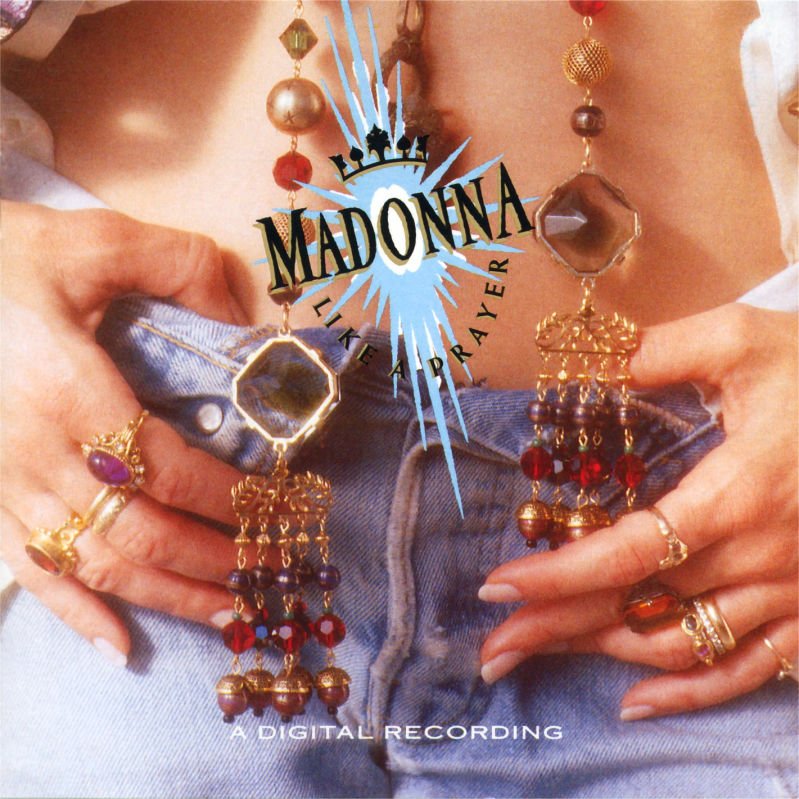
Madonna's fourth album was made in five months in Burbank and is remembered for a cancelled Pepsi ad. It's the first record on which she seems to be singing about her own life.
- Released
- 20 March 1989 (UK and Europe); 21 March 1989 (US); 9 April 1989 (Japan)
- Label
- Sire / Warner Bros. (US LP 9 25844-1; UK WX 239; Japan 21P1-2650)
- Producer(s)
- Madonna with Patrick Leonard; Stephen Bray ('Express Yourself', 'Keep It Together'); Prince ('Love Song'); 'Act of Contrition' credited to The Powers That Be on the European sleeve
- Runtime
- 50:57 (11 tracks)
- Chart peak (US)
- #1 (Billboard 200, 6 weeks from 22 April 1989)
- Chart peak (UK)
- #1 (Official Albums Chart, 2 weeks from 1 April 1989)
- Certifications
- RIAA 4× Platinum (16 July 1997); BPI 4× Platinum (1 February 1995)
- Awards & honours
- MTV Video Music Award, Viewer's Choice, for 'Like a Prayer' (6 September 1989). #331 in Rolling Stone's 500 Greatest Albums (2020)
The scandal made it news, but the sound is what lasts. Like a Prayer is the best-made record Madonna released in the 1980s. It's also a patchwork of borrowed styles, and a quarter of it falls short.
The first sound on Like a Prayer is a guitar nobody is credited for. It's a burst of distortion, over in seconds, and then a door slams. Patrick Leonard, who co-produced the record, told Billboard in 2014 that the guitar was Prince's. Only then does the album proper begin. That opening is a fair summary of what follows. The record is built from other people's sounds: Prince's guitar, a Los Angeles gospel choir, Sly Stone's funk, a 1966 song by the Association. What makes it Madonna's is what she does with them.
It's famous for a fight with a soft-drinks company. Pepsi paid her more than $5 million, launched an ad on 2 March 1989 and dropped it on 4 April. The video did the damage, with its burning crosses, stigmata and a Black saint. Pepsi said viewers had confused its ad with the video. She kept the fee. At the MTV awards that September she thanked Pepsi for the controversy. That story still crowds out the music. The case for Like a Prayer now rests on something quieter. It's the best-sounding record she made in the 1980s, and the first on which she seems to be singing about herself. The case against it is just as real. Its borrowed styles don't always add up, and three of its 11 tracks are weaker than the rest.
She turned 30 in August 1988, and the sessions began the next month. Her marriage to Sean Penn was ending. She filed for divorce on 5 January 1989, while the album was still being made. Her mother had died of breast cancer in 1963, when Madonna was 5. All of this is in the songs. 'Till Death Do Us Part' is about the marriage, and 'Oh Father' is about her father. Stephen Bray, who co-wrote 'Keep It Together', told the Guardian in 2019 that in it she was working through complications about her family and her success. In his account, True Blue had been about romance. With this record she changed chapters, because things hadn't worked out as she'd thought.
The way it was made explains a lot about how it sounds. Leonard told Billboard that they wrote a song a day and finished the writing in under 2 weeks. He'd write the music in about an hour, and she'd write the words in about the same time. His demos were just him, the machines and her voice. Then the drum machines were replaced by players, and singers and guitarists came in. Many of her vocals are first takes. She told Interview in May 1989 that they meant to redo them, then decided the flaws were emotion too. This is a record that kept its rough edges on purpose, and it's better for them.
The main room was Johnny Yuma Recording in Burbank, though the sleeve also credits Saturn Sound, Ocean Way and Prince's Paisley Park. Leonard kept a gym there and started work at 7 or 8 in the morning. Madonna arrived around 11 and was usually gone by mid-afternoon. It wasn't calm. Leonard told the Guardian that they argued a lot. The fiercest rows stopped, he said, once she held up the True Blue sleeve and asked whose picture was on it. He has said they called it the divorce album. She kept breaking down, he said, so everything took several times longer.
The title track is where all of that pays off. The Andraé Crouch Choir was recorded on its own and added afterwards. At the mix Bill Bottrell took out bongos and Latin percussion that clashed with it. What's left is a pop song driven by a gospel choir, with organ underneath. Guy Pratt's bass is the other engine. He improvised it while Madonna kept calling for more, he told the Guardian. By the fade, he said, he'd run out of ideas and gone back to the beginning. Listen for it in the 26 seconds after the last vocal. It went to #1 in the US and the UK, and it's the best thing she'd made.
The personal songs are less comfortable, and mostly better for it. 'Till Death Do Us Part' saves its title for the very end, sung once. Then it closes on a wah-wah guitar and the sound of breaking glass, which is as plain as the album gets. 'Promise to Try' goes the other way. Leonard played piano with Madonna standing at his shoulder, without headphones, and they had it in two takes. Rolling Stone's J.D. Considine heard it as her own grief. Pitchfork heard it as sung to a young girl who has lost her mother. Either way, it's the most exposed she lets herself sound. 'Oh Father' was cut live with the band and her vocal, with one pass by the orchestra afterwards. Classic Pop says Simon & Garfunkel inspired it.
The borrowing is the record's method, and its limit. 'Cherish' nods to the Association's 1966 song of the same name, as Considine and Robert Christgau both noticed. It sings its title 18 times and is pleasant and slight. 'Express Yourself' and 'Keep It Together' owe a debt to Sly and the Family Stone. Pitchfork judged the album 'Express Yourself' far weaker than Shep Pettibone's remix for the single. Classic Pop says that remix is the version she performed at the MTV awards in 1989. Considine defended 'Keep It Together' as an admirable pop song that only seems slight beside the confessional ones. That's generous. Its groove carries it further than the song deserves.
'Love Song' is the clearest failure. Prince co-wrote and co-produced it, and they finished it by sending tapes back and forth. Bray was asked to work on it and turned it down because he was in awe of Prince. He says he regrets that. Lucy O'Brien, writing in the Guardian, counts its pile of guitar parts and overdubs among the album's weaker moments. Chris Willman wrote in the Los Angeles Times in 1989 that Prince's style overwhelms hers. Both are right. It's a duet in which only one of the two seems at home. Its sparse, breathy sound pointed to what she did next, but as a song it never settles.
'Dear Jessie', written for Leonard's daughter, is a strings-and-whimsy pastiche. Willman heard McCartney in it, and Pitchfork heard the Beatles. Christgau's review dismissed its "kiddie psychedelia". It's well made, and it's the one track that could be by somebody else. The closer, 'Act of Contrition', recites a Catholic prayer over the title track's choir played backwards, with distorted guitar. It ends with a comic rant about a restaurant booking. Willman put it beside 'Love Song' as the oddest things on the record. Christgau dismissed both side-closers as forgettable once they've finished. He's right about this one, which is a gesture more than a song. He's wrong about 'Promise to Try', which stays with you long after it ends.
'Spanish Eyes' shows both sides of the method at once. It's one of Leonard's finest arrangements. But nobody agrees what it's about. Writers have read it as a song about AIDS, about a mother losing a son to gang violence, and about a soldier at war. Some European sleeves even print the title as 'Pray For Spanish Eyes'. The album came with an insert, 'The Facts About AIDS', which makes the first reading tempting. Still, the song moves you without ever quite telling you why.
Classic Pop now calls the 1989 acclaim unanimous, and the raves were real. NME gave it 10/10, and Considine, in Rolling Stone, called it "as close to art as pop music gets". But unanimous it wasn't. Willman gave it 3 stars, and Christgau a B+. Buyers were less divided. It entered the UK chart at #1 and stayed in the Top 100 for 73 weeks. In the US it reached #1 in its third week and stayed there for 6 weeks. Four of its US singles made the top 10. On one list it has slipped since. Rolling Stone ranked it #237 among the greatest albums in 2003 and #331 in 2020.
Its influence is easier to claim than to prove. Nick Levine argued in Vice in 2019 that it laid the ground for personal pop blockbusters such as Beyoncé's Lemonade and Ariana Grande's Thank U, Next. It's a fair argument, but it's one critic's. The clearer debts run through Madonna's own work. Classic Pop traces the sparse synth drums and breathy vocal of 'Love Song' into 'Justify My Love' the next year. Critics heard 'Express Yourself' in Lady Gaga's 'Born This Way' in 2011. Madonna later sang the two as a mash-up on her 2012 tour. Leonard came back to co-write and co-produce on Ray of Light in 1998, including 'Frozen'.
Vice called it "Madonna's first masterpiece", and the Guardian has framed it as the record that moved her from pop stardom to art. That overstates it. The scandal made it famous, and the songs are why it lasts, but not all of them. Leave out 'Love Song', 'Dear Jessie' and 'Act of Contrition', and nothing that remains is weak. At its best, in the title track, 'Promise to Try' and 'Oh Father', it's as good as anything she made that decade. The production is the real achievement: Leonard's arrangements, Bottrell's mix, and a choir and a bass player given room. What it doesn't do is invent much. Its best ideas came from Prince, from gospel and from the 1960s, and her gift was to make them sound like confession. It's a very good album with a weak quarter. Admire it, own it, and skip three tracks.
Pressing guide — the one to own
The original to own is the 1989 US Sire LP, 9 25844-1, with 1-25844 on the labels and in the runouts. Look for 'MASTERDISK DMM' in the dead wax. Bob Ludwig's lacquers are on every 1989 Sire and Warner-Pioneer pressing checked, from the US, Europe and Japan. It's a single sleeve with a printed lyric inner and 'The Facts About AIDS' insert. Catalogue notes say first pressings came scented with patchouli. No documented mark tells a scented first state from a later copy.