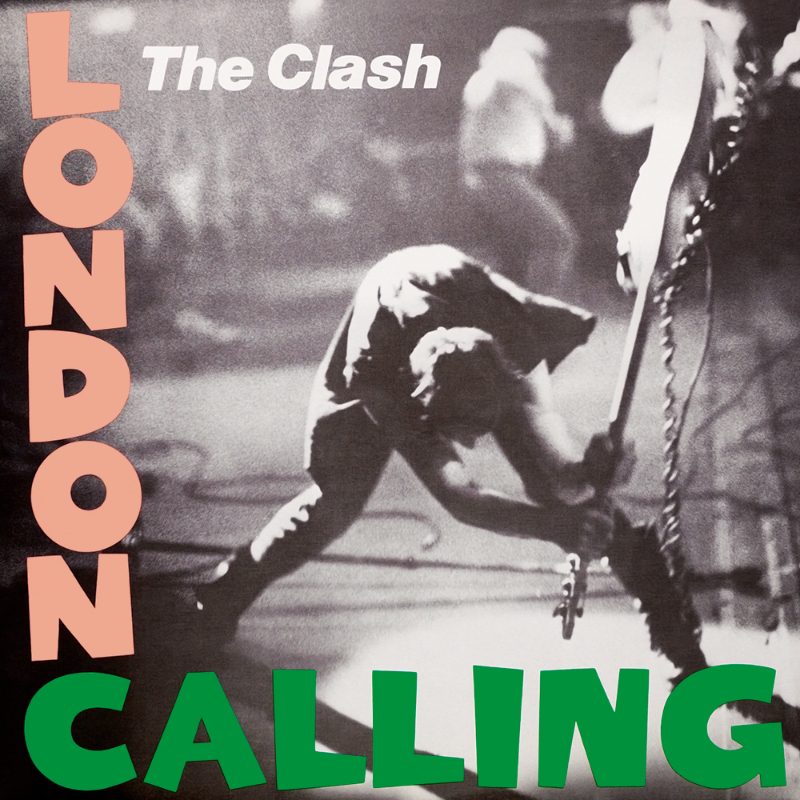
The Clash's third album: a double LP of 19 songs, priced at £5 in Britain in December 1979. Its range is why it has lasted. Its length is the one part that hasn't aged well.
- Released
- 14 December 1979 (UK, CBS); January 1980 (US, Epic)
- Label
- CBS (UK and Europe); Epic (US and Japan)
- Producer(s)
- Guy Stevens (sole credit); chief engineer Bill Price
- Runtime
- About 65 minutes (double LP, 19 tracks)
- Chart peak (US)
- #27 (Billboard 200, 22 March 1980), 33 weeks on the chart
- Chart peak (UK)
- #9 (Official Albums Chart), 20 weeks on the chart
- Certifications
- BPI 2× Platinum (19 December 2025); RIAA Platinum (14 February 1996); Music Canada Gold (1 July 1980)
- Awards & honours
- #1 in the Village Voice Pazz & Jop critics' poll for 1980; Rolling Stone's best album of the 1980s (16 November 1989); Grammy Hall of Fame (2007)
The legend of London Calling is a drunk producer and flying chairs. The truth is a summer of rehearsal and an engineer who mixed it with his assistant. Four sides gave the Clash room for their best songs, and for filler they never had to cut.
In 1979 Maurice Oberstein, the head of CBS in Britain, came to Wessex Studios in north London. There he learned that the Clash's next album would be a double. Guy Stevens, the band's producer, lay down in the drive in front of Oberstein's limousine. He stayed there until the engineer, Bill Price, and his assistant, Jerry Green, carried him back inside. Price told Mix magazine in 2000 that at the time the protest didn't seem to achieve much. Years later he thought it had probably helped persuade CBS. The album did come out as a double. Some British copies went out with a sticker promising 18 tracks for £5.
It's the right place to start, because London Calling is a record whose size had to be argued for. That size is why it has lasted, and it's also where it sags. The legend around it is about chaos: a drunk producer, flying chairs, wine in the piano. The record tells a plainer story. Most of its songs were first worked up, in rough form, in a rehearsal room in Pimlico. An engineer caught the band on tape at Wessex and mixed the album with his assistant. The best of its 19 songs are the best the Clash wrote. But four sides was more than they could shape into one record, and its biggest American hit isn't even listed on the sleeve.
The Clash needed a reset. Epic had refused to release their debut in America, though it sold 100,000 copies there on import, Mix reported. Their second album, Give 'Em Enough Rope, was produced by Sandy Pearlman to sound more commercial. It reached only #128 in America. By early 1979, Record Collector wrote, the band were short of money. Their manager, Bernard Rhodes, had faded from view, and his rehearsal room at Camden Lock was out of bounds. Simonon told the magazine that with their backs against the wall they became a tighter unit. London Calling was made by a band that had lost its manager's backing and its home, and had something to prove.
They found a new room, Vanilla, on Causton Street in Pimlico. Record Collector calls it anonymous, and puts the band there from May to August 1979. The 2004 reissue says June and July, and places the room in Vauxhall. They taped what they played on a TEAC four-track. Those tapes went missing, and Mick Jones found them in 2004. They came out that year as The Vanilla Tapes, with early versions of 15 of the album's 19 songs. Some are only sketches: 'The Guns of Brixton' is there as an instrumental called 'Paul's Tune'. Record Collector heard a band writing the songs on the spot. That's the fact the Stevens legend skips. Most of London Calling had been sketched out before the band walked into Wessex.
The band wanted Jones to produce. The label wanted a name. Strummer found Guy Stevens in a pub on Oxford Street. Stevens, then in his mid-30s, had managed Mott the Hoople, Jones's favourite band, and he drank heavily. Simonon remembered that with Stevens in the room nobody sat down, because a chair or a ladder might come at your head. Price called the method 'direct injection'. Stevens would challenge a singer verbally and physically, even tackle him to the ground, to get more feeling into a take. Price said it worked very well with Strummer. Stevens also poured wine into a piano while Strummer was playing it. Blender's version says beer. Simonon credited him with the album's live feel. The record has, he said, 'the quality of band playing live there and then'.
The man who turned those takes into a record was Bill Price. He was chief engineer and studio manager at Wessex, a former church hall in Highbury with two Cadac desks. The sessions lasted 5 or 6 weeks, and by the end the days ran to 18 hours. For the title track Strummer sang into a Shure SM58. Price passed over a Neumann U47 because of Strummer's bassy voice and his dental work. He built the lead vocal from three passes. Strummer, Jones and Simonon each sang backing parts, and every one of them was doubled. Then the band flew to New York for a tour, and Price mixed the album without them. He flew out and played them the mixes backstage at the Palladium. Tim Young mastered it at CBS Studios in Whitfield Street, and Price recalled that Young reckoned it was the loudest vinyl he ever cut. Writing in The Ringer in 2019, Elizabeth Nelson called Price the album's 'unsung hero'. She's right. Stevens got the performances. Price gave them their shape.
You can hear Price's hand in the title track. Strummer told him he wanted it to 'sound like London'. He described fog coming off the Thames, with gulls circling over it. Price took him at his word. In the instrumental break, which starts at about 1:45, Strummer's seagull cries come back as slow, repeated echoes. Price made them with a Studer A80 tape machine running at a varied speed, and a little of the effect caught the toms. Jones added a backwards guitar part, recorded with the tape turned over. Strummer first drafted the song in a notebook as 'Ice Age'. Rolling Stone counts Three Mile Island and the rise of Margaret Thatcher among the news behind it. The break is where that dread stops being words and becomes a sound. It's the best idea on the record, and it's all production.
The rest of the record gets its range by taking each style seriously. The first song recorded at Wessex was 'Brand New Cadillac', a 1959 Vince Taylor song the band used as a warm-up. Price asked whether 'Jimmy Jazz' could sound like a live recording in a smoky jazz club. 'The Guns of Brixton' was the first Clash song Simonon wrote by himself, and he sings it. Christgau wrote that Simonon had obviously been studying his reggae records. In 1990 Beats International built 'Dub Be Good to Me' on its bassline, and it went to #1 in Britain. 'Spanish Bombs' came after Strummer, driving home from the studio late one night, heard a report of a Basque bombing at a Costa Brava hotel. None of these songs is a costume. Each one sounds like a band that listened hard before it played.
'The Card Cheat', which closes side three, is the biggest production on the album. Piano drives it and horns fill it out, and Nelson calls it probably the most ornate thing the band ever recorded. She hears it as Stevens's attempt at 'River Deep, Mountain High'. 'Lost in the Supermarket' goes the other way. Strummer started its words on the back of a packet of guitar strings, Rolling Stone found, and let Jones sing it. Robert Christgau wrote that the empathy of Jones's vocal lifts it to the head of its kind. In the same review he praised Strummer for making virtuoso use of a four-note range. Nelson puts the point best: the two singers sound nothing alike, and they fit. The record moves between them and never settles into one man's sound. That pairing is the album's best performance.
Four sides is also where it frays, and side four is the weak one. 'Lover's Rock' has a decent tune, but its vocal ends at 2:40 and the band plays on for more than a minute. 'Four Horsemen' and 'I'm Not Down' are good album tracks that a single LP would have dropped. Back on side three, 'Koka Kola' is done in 1:47 and sounds like a sketch. The listed running order then ends on 'Revolution Rock', a cover of a Danny Ray record, at 5:33. Nelson called London Calling 'surgical' beside the sprawl of Sandinista!, the record that followed it. That comparison flatters it. Christgau's A+ and Rolling Stone's decade list also treat the four sides as one achievement. Side four doesn't earn that.
The record's luck makes the point. 'Train in Vain' was written in one night and recorded the next day. It was meant to be given away with the NME, and that plan fell through. By the time it was finished, the artwork had gone to the printers. Price says it was never meant to be a hidden track. On British copies its only listing is a line etched into the run-out groove of side four. Jones wrote most of it, according to Blender, and he sings it. In America it became the band's first Hot 100 entry, peaking at #23 in May 1980. The album's planned ending was a cover. Its real ending is a Mick Jones pop song that arrived too late for the sleeve.
Its standing was settled early, and it has held. It reached #9 in Britain and #27 in America, where it stayed on the chart for 33 weeks. Critics voted it the best album of 1980 in the Village Voice's Pazz & Jop poll, ahead of The River. Christgau rated it the best double album since Exile on Main St. In November 1989 Rolling Stone named it the best album of the 1980s, counting its January 1980 US release. Its influence shows in how other records have used it. Simonon's bassline carried Beats International to #1, and Cypress Hill replayed parts of the song on 'What's Your Number?' in 2004. Garbage built 'Stupid Girl' on a drum loop from 'Train in Vain', and Strummer and Jones share its writing credit. Springsteen opened his 2009 Hyde Park show with the title track. Pennie Smith had rejected the cover photograph as out of focus, and in 2002 a Q special named it the greatest rock'n'roll photograph. Rolling Stone ranked the album #8 in its 2003 list of the greatest albums, and #16 in 2020. That's a small correction, not a fall.
So what is it worth now? The songs hold, and so does the playing. 'London Calling', 'The Guns of Brixton' and 'Train in Vain' would lead any band's best-of. The range was real, and hard won, for a band that started out as one thing. But the album is better in parts than as a whole. Its fourth side is a band that couldn't bear to leave anything off. Four sides gave the Clash room, and they filled it. A sterner producer would have made a better single album, and a smaller record. London Calling is a great album with a slack last quarter, and it's still the Clash at their best.
Pressing guide — the one to own
The first British issue: CBS CLASH 3, two LPs in a single-pocket sleeve. It came with two loose printed 28cm inserts carrying the lyrics and credits, and plain inner sleeves. Later copies swapped those for printed inner sleeves. Some first copies carry the sticker '18 Track Double Album £5 R.R.P.'. Tim Young's TY or 'timtom' in the run-outs marks a British cut, but later British states carry it too, so check the inserts. Don't use the unlisted 'Train in Vain' as a test: every original copy leaves it off the sleeve.