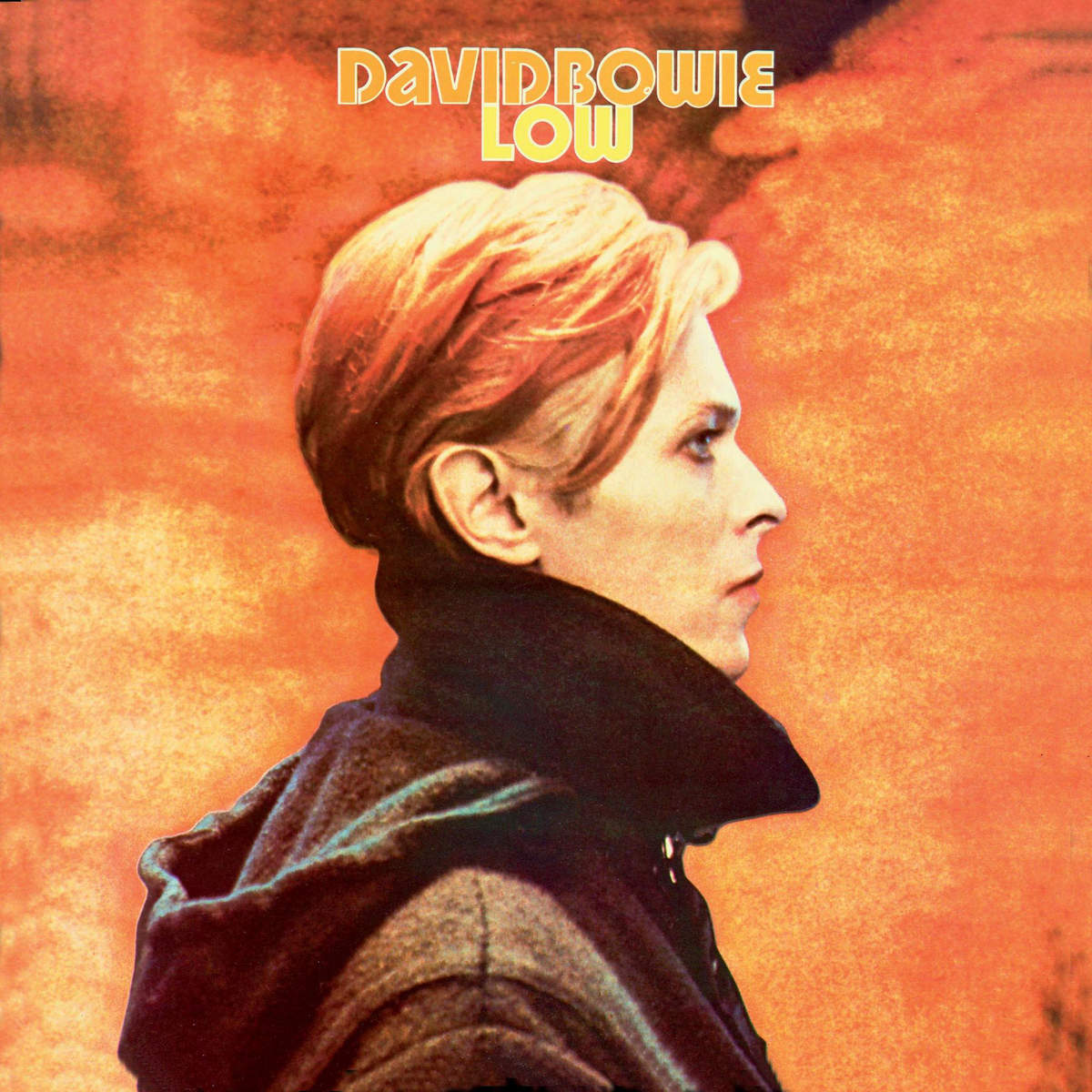
Bowie's 1977 album, made mostly in France with Eno and Visconti: broken songs on one side, slow and mostly wordless pieces on the other. The sound still startles; the songs are his thinnest in years.
- Released
- 14 January 1977
- Label
- RCA Victor (UK PL 12030; US CPL1-2030)
- Producer(s)
- David Bowie and Tony Visconti
- Runtime
- 38:00 (11 tracks, as timed on the 1977 US labels)
- Chart peak (US)
- #11 (Billboard Top LPs & Tape, chart dated 26 February 1977)
- Chart peak (UK)
- #2 (Official Albums Chart, week of 30 January 1977), behind Slim Whitman's Red River Valley
- Certifications
- BPI Gold (21 July 2013); Gold in Canada (1 April 1977). No RIAA award
- Awards & honours
- #206 on Rolling Stone's 500 Greatest Albums of All Time (2020); #1 on Pitchfork's Top 100 Albums of the 1970s (2004)
Low is a producer's record. What makes it great is the treated snare, the split between its two sides and the pieces Eno built while Bowie was away. As songwriting it's slight, and 'Weeping Wall', near the end, marks time.
In September 1976, at the Château d'Hérouville outside Paris, a small boy kept pressing the same three white keys on the studio piano: A, B and C. He was Tony Visconti's son, aged 4. Brian Eno sat down next to him and finished the phrase, and it became the main theme of 'Warszawa'. Bowie wasn't there. He'd gone to Paris for a court case, part of his break with his manager. Before leaving he'd asked Eno for a slow piece with an almost religious feel. When he came back the music was nearly done. He wrote his part in about 10 minutes and sang it in words of no real language.
That's the record in small. Low is the sound of Bowie handing his music to other people and letting them change it. Visconti brought a brand-new machine, an Eventide Harmonizer, and used it to rebuild the drums. Eno brought synthesizers and a taste for chance. On the side-two pieces he and Bowie worked to a metronome click, with every beat numbered on tape. Any number could be the cue for a new part. Carlos Alomar, in Rolling Stone's words, was the musical director. Bowie brought less than usual. He came with chord changes and tempos, and hardly any words. That's why Low still sounds strange, and it's also why it falls just short of the very top of his work.
He needed a clean break. Rolling Stone's 2017 account has him leaving his cocaine years in Los Angeles behind, with Europe offering an escape from fame and a chance to get clean. Laura Snapes, reviewing the album for Pitchfork in 2016, describes a man who could hardly write lyrics after those years. His music for Nicolas Roeg's film The Man Who Fell to Earth never made it into the film. Some of it survives. 'Subterraneans', the album's last track, began in that 1975 score. Bowie later said only a reversed bass part came straight from it.
Two records hang over it. Rolling Stone says Bowie greatly admired Eno's Another Green World, a free-form record of songs and instrumentals from 1975. Chris O'Leary, in his song-by-song Bowie blog, hears its percussion in 'Art Decade'. He also compares Low's running order to Neu! '75, another album split into two very different sides. Bowie's stated aim was to experiment and find a new musical language. He saw divided Berlin as the centre of whatever would happen next in Europe. Eno described side one as seven short, manic disco numbers and side two as soundtrack music. Bowie said 'Subterraneans' was about the people left in East Berlin after the Wall went up.
First came a rehearsal. Bowie had just made Iggy Pop's The Idiot at the same château, and Low began in its wake. 'What in the World' had been meant for Pop's record. For Low the band started with almost nothing written. Alomar, Dennis Davis and George Murray, the rhythm section from Station to Station, jammed through the night for 2 weeks. Roy Young played piano, and Ricky Gardiner arrived about a week in. Bowie gave them chords and tempos, but no lyrics and few melodies. He told Eno that whatever they made didn't have to be released. Most of what you hear was played in France. Hansa, in Snapes's careful phrase, is where the record was mostly finished, not where it was tracked.
Then there's the snare. Visconti fed Davis's drums into the Harmonizer, which repeated each hit an instant later with the pitch dropped. Then he fed that shifted sound back into itself. So the crack of the snare is followed by a thud that keeps deepening instead of dying away. Bowie wasn't sure about it at first. Visconti turned the effect down in the control room and left it up in Davis's headphones, so Davis was playing against his own echo. Visconti's summary of the machine was a profane line about what it did to time. Put on 'Speed of Life' and listen to the drums. This is the record's real lead instrument, and the best thing on it.
Bowie knew whose sound it was. In 1999 he complained that critics gave Kraftwerk too much of the credit. Their percussion, he said, was electronic and rigid. His was a powerful, emotional human drummer, mangled by the treatment, with an R&B band behind him. Visconti called Davis the most original drummer he'd worked with. O'Leary hears Davis inventing the huge gated drums of 1980s pop on these tracks. That's a reading, not a fact, but Rolling Stone made a similar case in 2017, calling the processed drums a major influence on post-punk.
Side one's other ideas are about structure. 'Breaking Glass' runs on two chords, and O'Leary counts 35 words in it. It has no bridge and no ending, only a fade. 'Sound and Vision' goes further. Bowie wrote it with Eno in mind, and Eno suggested the singer shouldn't arrive until the track was well under way. Bowie's lead comes in at about 1:30, close to the halfway mark. Before that you hear the band, then synthetic strings, then Mary Hopkin and Eno's wordless backing line. It went to #3 in Britain all the same, helped by the BBC's use of it in trailers. Holding back the singer was the song's best idea.
This is also where Low is weakest. The songs are sketches, and some of them are thin. John Rockwell reviewed it in the New York Times on the day of release. He noticed how few vocals there were and dismissed most of the words as doggerel, but still found the whole thing "remarkably, alluringly beautiful". Bowie said he'd had no statement to make on it. 'What in the World' plays like the leftover it was. RCA saw 'Be My Wife' as the nearest thing here to a pop song. It's the plainest track, and the plainness doesn't pay off. 'Always Crashing in the Same Car' is the best song on the record. Even that lost a verse. Bowie had sung one as a Bob Dylan impression, and Visconti thought it creepy and, given Dylan's motorcycle accident, in poor taste.
Side two is where the record earns most of its reputation. 'Warszawa' opens on a tolling piano, and the boy's phrase turns up inside it. At 1:17 the phrase returns in a new key and opens the main theme. Eno's synthesizers and the Chamberlin stand in for an orchestra. Bowie's voice comes in near the 4-minute mark, in his usual baritone at first. For the later lines he sang onto tape that Visconti had slowed down, so they play back higher, like a boy's. Where the tune came from is disputed. Rolling Stone says the model was a Bulgarian boys' choir record Bowie bought in Paris. O'Leary thinks it was more likely the records by the Polish folk ensemble Śląsk that Bowie bought in Warsaw. Either way, it's the boldest 6 minutes Bowie had put on a record.
The other side-two pieces are quieter, and not all of them hold. Bowie had given up on 'Art Decade' until Eno revived it, and it's the gentler for Eno's hand. 'Subterraneans' closes the album with two saxophone solos and a vocal in a private language, and it ends on the creak of a studio chair. 'Weeping Wall' is the problem. It's Bowie alone, on vibraphones, xylophones, guitar, pianos, synthesizers and voice. Steve Reich told the Guardian in 2014 that Bowie came to the European premiere of his Music for 18 Musicians in Berlin, and that the piece is somewhat indebted to it. Next to Reich it sounds small. Snapes and O'Leary both hear 'Scarborough Fair' in its melody, and the melody goes round more often than it needs to.
The critics split on side two at the time, and some still do. Robert Christgau gave Low a B+ in 1977 and found most of its movie music banal. Snapes gave it 10/10 in Pitchfork, and still found side two a little ponderous now that so much has copied it. They're right about 'Weeping Wall'. They're wrong about 'Warszawa'. RCA didn't know what to do with any of it. Rolling Stone says the label was terrified, and saw the record as commercial suicide next to his recent hits. In December 1976 Music Week reported that the album, ready in the autumn, was being held until January for Bowie's sleeve design. When it came out, on 14 January 1977, one RCA man told the journalist Wesley Strick that side two needed more work. It entered the UK chart at #37 and went to #2 the next week, behind Slim Whitman's Red River Valley.
What it changed is better documented than most influence claims. Ian Curtis named his punk band, Warsaw, after 'Warszawa'. Robert Smith has said he wanted The Cure's Seventeen Seconds to have "the clear, finished sound" of Low. Trent Reznor told Kerrang! in 1994 that it was probably the record that shaped The Downward Spiral most, in songwriting, mood and structure. A year later Bowie played 'Subterraneans' on stage with Nine Inch Nails. Philip Glass built his 'Low' Symphony, released in 1993, on 'Subterraneans', 'Some Are' and 'Warszawa'. Dave Sitek of TV on the Radio told Rolling Stone that 'Warszawa' was when he knew music was the force that mattered most in his life.
Critics now rank it very high. Rolling Stone placed it #206 among the greatest albums of all time in 2020, and Pitchfork named it the best album of the 1970s in 2004. The reputation is mostly right, and it's worth being precise about why. Low isn't great because Bowie wrote great songs for it. He didn't, quite. It's great because he let a producer, a collaborator and a band finish his thoughts for him, and because 'Warszawa' and that snare still sound new. The songs are slight and 'Weeping Wall' marks time. Even so, it's one of the essential records of its decade, thin in its songs and extraordinary in its sound.
Pressing guide — the one to own
The UK and US first issues were both cut at Sterling Sound. The UK PL 12030 was pressed by RCA at Washington, with a W and STERLING in the runouts. It came with a 12-inch paper credits insert and, on most copies, an orange track-list sticker on the back. Early copies also carried a fan-club pamphlet. The US CPL1-2030 has the black RCA Victor label with Nipper and was pressed at Indianapolis, marked I in the runouts. Side A reads 'STERLING gc.', for Greg Calbi; side B has no gc. It came with a printed credits inner sleeve and a fan-club insert, and some copies had a 20-inch-square poster.