
Deep Dive
Madvillainy
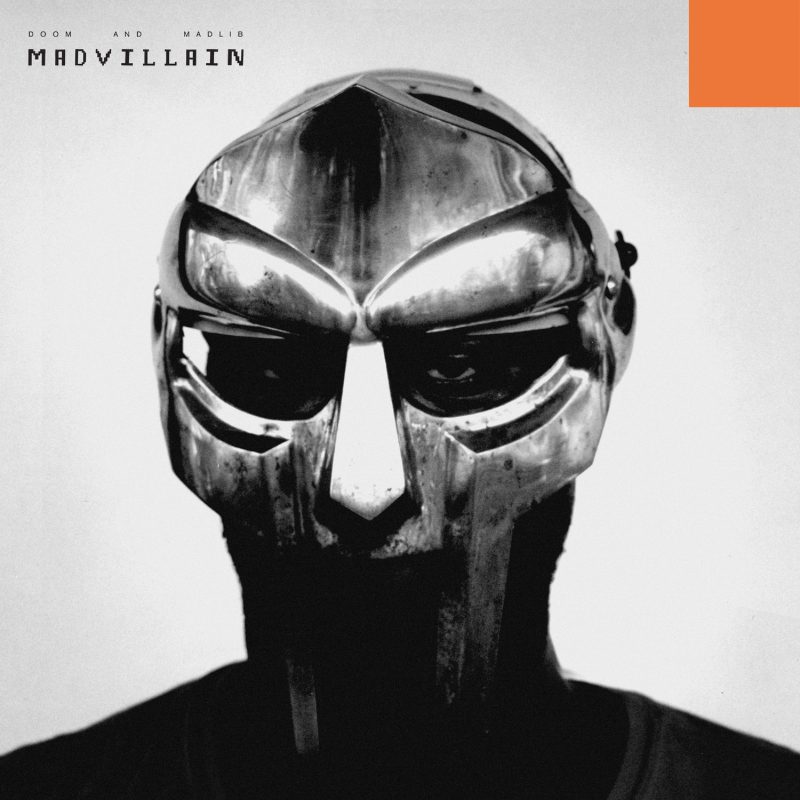
Madvillainy by Madvillain (2004) — what a copy is worth and which pressing to own, in a full Lead-In dossier: MF DOOM and Madlib's only album as Madvillain, made for $13,000 and leaked more than a year before release.
Madvillainy by Madvillain (2004) — what a copy is worth and which pressing to own, in a full Lead-In dossier: MF DOOM and Madlib's only album as Madvillain, made for $13,000 and leaked more than a year before release.
MF DOOM and Madlib's only album as Madvillain: 22 tracks in 46 minutes, made for $13,000. DOOM's writing carries it, and the guest spots are where it sags.
Stones Throw feared the demo leak would sink Madvillainy. It may have done the opposite: DOOM re-recorded every vocal in a calmer voice, and the writing became the best thing on the record. The running order never quite caught up.
Peanut Butter Wolf remembers two versions of DOOM. On the first version of Madvillainy, the Stones Throw founder told Pitchfork in 2014, DOOM rapped in “a really hyper, more enthusiastic voice”. Then he settled on a mellower, more relaxed tone. The first version is the demo that leaked from Madlib's trip to Brazil in late 2002, more than a year before release. When DOOM came back to the record in the autumn of 2003, he re-recorded every vocal. Wolf thinks he wanted the album to sound different from all the other records he put out in those years. Jeff Jank, the label's art director, thought DOOM was perfecting it as an album, keeping each track consistent with the next.
Stones Throw's own history says the leak soured the work for both men, and that it took about a year to coax them back. The argument here is that the delay also made the album better. The Madvillainy released on 23 March 2004 is a second draft by a writer who'd heard his first one in public. Pitchfork's review, two days later, called the new delivery slower, scratchier and better suited to Madlib's low-key, bass-heavy beats. That's still the right call. The writing is what lasts here. The shape lasts less well. A few of its 22 pieces are guest spots and loose ends, and they're weaker than the tracks DOOM carries himself.
The album exists because a small label needed it. Stones Throw was nearly broke, and it depended on Madlib. He'd drifted from rap into jazz as Yesterdays New Quintet, an imaginary band in which he played every instrument. Egon, the label's general manager, tried a reunion of Madlib's first group, Lootpack, and it fizzled. Madlib had told an LA Times reporter that his dream collaborators were J Dilla and MF DOOM. DOOM was the hard one to find. After Operation: Doomsday came out in 1999 and his label, Fondle 'Em, folded in 2001, he was moving between Long Island and Kennesaw, Georgia.
An old college friend of Egon's lived in Kennesaw and knew DOOM slightly, and passed him some Madlib beats. DOOM had never heard of Madlib or Stones Throw, but he wanted in. His manager asked for plane tickets and $1,500 for three songs. The label said yes without having the money. In 2002 Wolf picked DOOM up at the airport in Los Angeles. The whole album was made on a $13,000 budget, scraped together from DJ gigs, delayed royalty payments and an advance from Fat Beats. The contract was written and signed on a paper plate.
Stones Throw says most of it was made in a house. The label's staff lived and worked in a rented place in the Mount Washington hills. Madlib made beats in its basement, an Eisenhower-era bomb shelter with 18-inch concrete walls. DOOM wrote on the back porch and recorded in a bedroom. 'Meat Grinder' and 'Figaro' were done in his first couple of days. Beats did reach DOOM on CD, and the sleeve credits some recording at DOOM's Crib in Atlanta. But DOOM's own memory, from a 2011 interview, is of Madlib handing him another CD while he wrote. “We hardly spoke,” he said. Even so, the record began with the two of them under one roof.
Then Madlib went to Brazil. In November 2002 he was in São Paulo for the Red Bull Music Academy, sharing a hotel suite with Cut Chemist. He said later that he'd never bought so many records, and that two boxes never arrived. In the hotel he made the beats for 'Strange Ways', 'Raid' and 'Rhinestone Cowboy' on a Boss SP-303 sampler, a portable turntable and a borrowed cassette deck. He told Scratch magazine in 2005 that he did most of the album in Brazil. Stones Throw's account gives the trip only a few beats. The two versions don't fit together, and the label's is the more detailed. Somewhere on that trip, a near-finished demo got onto a plane and then onto the internet. Stones Throw dates the leak to November 2002, and Pitchfork's 2004 review to a few months later. Jank says they thought it would ruin sales.
The year off wasn't idle. In 2003 Madlib and J Dilla released Champion Sound as Jaylib, and DOOM put out albums as King Geedorah and as Viktor Vaughn. Madvillain played its first show that year, at a Stones Throw set at Coachella. Jeff Weiss, who wrote the album's history for Pitchfork, says it's unclear why the two went back to it that autumn. When they did, DOOM did more than re-voice it. He changed lines, swapping out a reference to September 11 on 'Meat Grinder'. Weiss says he also wrote what became 'Accordion' and 'Bistro', though an earlier 'Bistro' is among the official demos. Stones Throw says he kept adjusting words and delivery through late 2003. The label asked Madlib to redo a few beats, and he said he'd forgotten where the samples came from. Then Egon realised the record had no proper ending. With less than a week to the distributor's deadline, Weiss writes, the label rented DOOM a studio at $60 an hour, and he cut 'Rhinestone Cowboy' there. Stones Throw adds that its second verse was written more than 6 months after the first.
'Accordion' shows what the second pass bought. It isn't among the demos, and Weiss puts its writing in 2003. Its loop is an accordion taken from Daedelus's 'Experience', the same sound Daedelus used on his 2002 album Invention. The sleeve says it's used courtesy of Plug Research. DOOM comes in at 0:19 and raps almost to the end without a chorus. The title turns up once, at 1:31, in a line that names the instrument he's rapping over. It's a writer's joke about his own beat, dropped in once and left. Weiss noticed the same habit across the record: hooks are practically non-existent, and most song titles come from a single line. Danny Brown told Complex in 2013 that the album showed him you could make a whole record without hooks and have it sound that good.
Madlib's side of the record works as fragments, and the best of them are the shortest. Of the 22 tracks, 12 run under 2 minutes, and the three instrumentals run from 52 seconds to 1:22. Even the vocal tracks leave room for the beat. On 'Raid' the voices drop out at 0:56, and the loop plays alone for 18 seconds. 'Rainbows' does the same thing twice. 'Rhinestone Cowboy' ends with more than a minute of beat after DOOM's last line. Those gaps are where Madlib gets the floor, and they're why a record this dense never feels crowded. 'America's Most Blunted' opens on a sample of Steve Reich's 'Come Out'. Then, as Sasha Frere-Jones put it in the New Yorker, it “stumbles into a swaggering funk pattern”. To Frere-Jones the voices and samples sounded “coated with dust”. Robert Christgau gave it an A minus and described Madlib's “22 bits and pieces in 46 minutes”.
Christgau thought the order was so right that you should “press shuffle at your peril”. That's where this review parts company with him. The record holds together while DOOM or Madlib is in charge. It sags when a guest takes the mic. The 2004 critics mostly heard it the other way. Pitchfork's review called the guest verses extraneous, but said they never disrupt the album's flow. Frere-Jones thought the 22 songs cohere and zip by. Pitchfork's year-end list even praised the evenness: the cuts are so short, it said, that there are almost no high or low points. Weiss is closer to this review. He notes that Wildchild gets a song to himself “for no apparent reason”. That song, 'Hardcore Hustle', is the weakest 81 seconds here. Wildchild is done by 0:53, and the beat runs on alone for the last 28 seconds. On an album this even, one flat track shows.
'Shadows of Tomorrow' is where critics split. Weiss calls it the album's central artery: Quasimoto, Madlib's sped-up alter ego, reworking an incantation from Sun Ra. Frere-Jones found it mildly philosophical and teased it. Frere-Jones has the better of the argument. Sun Ra was Madlib's heaviest debt, Weiss says, and the track pays it off in a way that matters more to its producer than to a listener. Coming 12 tracks in, it's where the sequence starts to feel like a crate of pieces.
None of that held it back. It entered the Billboard 200 at #179 on the chart dated 10 April 2004, and the Independent Albums chart at #10. Weiss writes that EMI, the distributor that had nagged Stones Throw about unsellable records, couldn't keep it in stock. By 2014 it had sold about 150,000 copies, making it the label's best-selling rap album, and it paid for an office in Highland Park. Its influence shows up in what musicians and critics say. Writing in 2012, Weiss reported Earl Sweatshirt comparing Madvillain's effect on his generation with Wu-Tang's on people born in the 1980s. Thom Yorke picked 'Raid' for a compilation. In 2018 Vice called it probably the one shared touchstone of lo-fi hip-hop, the study-music genre that lives on YouTube streams.
DOOM died on 31 October 2020, aged 49. His wife, Jasmine, announced it on 31 December. In January 2021 the album reached its highest Billboard 200 position, #73, and its first Official Albums Chart placing in Britain, at #58. The BPI certified it Gold in 2023, and the RIAA did the same on 25 March 2024. It's tempting to read all that as mourning, and some of it was. Complex counted 183,140 Spotify streams in 2009 and 57.4 million in 2020. Then came a rise of about 150% in 2021, to 143.8 million. Spotify itself kept growing, Complex adds, but in 2023 the album's streams grew faster than Spotify's users did. It had re-entered the Billboard 200 at #117 in September 2014, at 10 years old. The death sped up a climb that was already under way.
Madvillainy deserves most of its reputation, and part of it may be owed to the leak. Even Weiss couldn't say why DOOM and Madlib went back to it. But the delay gave DOOM a second pass, and the second pass is where his writing became the best thing on the record: patient and funny. Madlib's fragments give it the dust and the surprises. What the second pass didn't fix is the running order. Not all 22 pieces pull their weight, and a couple of the guest spots feel like stops on someone else's tape. It's a great record that plays better in stretches than straight through. That's a real flaw, and a forgivable one. In 2014 DOOM told Wolf the sequel was just about done. It never came, so this is the only Madvillain album there is.
The original to own is the 2004 US double LP, Stones Throw STH2065, in a single sleeve, manufactured and distributed by Fat Beats. The runouts are the test. They read STH2065-SA JD MASTERDISK, STH2065-SB JD, STH2065-SC JD MASTERDISK and STH2065-SD JD, from lacquers Jean Dyer cut at Masterdisk. The 2006, 2014 club and 2016 pressings share the catalogue number but carry S-6043x etchings, and later GZ pressings carry 200148 codes. No pressing quantity has been published.
© The Lead-In · an independent, reader-supported music publication.