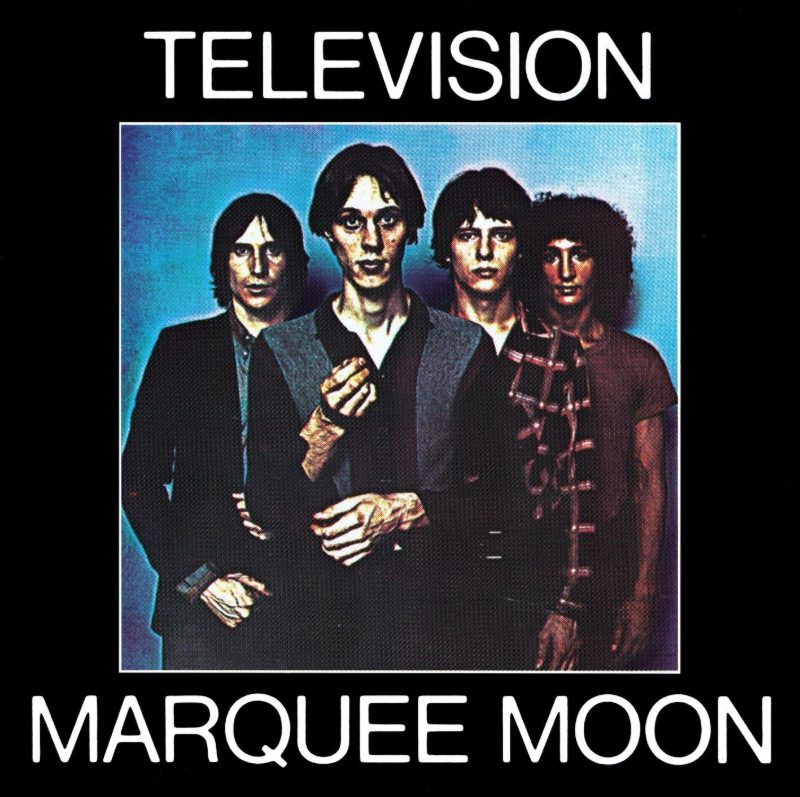
Television's 1977 debut, made in New York with every guitar solo credited on the sleeve. Two players with opposite methods, recorded in a sound the band kept deliberately small.
- Released
- 8 February 1977 (US, Elektra); 4 March 1977 (UK, Elektra)
- Label
- Elektra (US 7E-1098; UK K 52046)
- Producer(s)
- Andy Johns and Tom Verlaine (sleeve: 'Produced by Andy Johns for Maverick Productions Ltd. and Tom Verlaine')
- Runtime
- 45:13 on the 1977 label timings; about 45:55 with the full 10:40 title track, which CDs have carried since Elektra's US issue of 1987
- Chart peak (US)
- Did not enter the Billboard 200
- Chart peak (UK)
- #28 (Official Albums Chart, chart dated 14 May 1977), 13 weeks on the chart
- Certifications
- BPI Silver and Gold, both certified 12 November 2004
- Awards & honours
- #3 in the Village Voice Pazz & Jop critics' poll for 1977, and #5 in NME's albums of the year. #128 in Rolling Stone's 500 Greatest Albums (2003) and #3 in Pitchfork's Top 100 Albums of the 1970s (2004)
Marquee Moon is built on two guitarists with opposite habits: Richard Lloyd could play a solo the same way twice, and Tom Verlaine never did. The playing is as good as rock got in 1977, and the dry sound and cryptic words around it fall short.
The back of the sleeve credits the guitar solos. Richard Lloyd takes the ones on 'See No Evil', 'Elevation' and 'Guiding Light'. Tom Verlaine takes 'Venus', 'Friction', 'Prove It' and 'Torn Curtain'. The title track gets one each, with directions: Lloyd's after the second chorus, Verlaine's after the third. Nobody listening needs to guess who is playing what. It reads like the terms of a partnership, and it was one. Lloyd told Uncut in 2012 that the two had agreed to split the solos evenly, or 60-40 in Verlaine's favour at most. The sleeve is the record of how that deal worked out.
The two men didn't play the same way. In the same interview Lloyd said he could play anything a second time exactly as before, and that Verlaine never played the same solo twice. Greg Kot drew the same line in the Chicago Tribune in 2003, setting Verlaine's spontaneous style against Lloyd's more carefully plotted solos. The eight songs on Marquee Moon are frames for that difference, and the four players fill them as well as any rock band of the decade. That's the case for the record. The case against is narrower. The sound is kept so dry that the record can feel thin, and the words around the guitars rarely add up.
The band was 3 years old when it made the album. Television formed in New York in 1973, with Richard Hell on bass. In 1974 their manager, Terry Ork, talked Hilly Kristal into letting them play CBGB on Sundays, the club's worst night. Later in 1974 they made demos for Island with Brian Eno, and no deal followed. Tyler Wilcox, writing for Pitchfork in 2017, says Verlaine and Lloyd didn't like the sound Eno's team got. Hell left early in 1975, and Fred Smith came over from Blondie to replace him. That October their first single, 'Little Johnny Jewel', came out on Ork's own label. The album is dedicated to him.
Elektra signed them in 1976, after the band had held out for what Lloyd called a reasonable offer. Lloyd says the label wouldn't let them produce themselves. Verlaine, after the Eno sessions, didn't want anyone arriving with ideas of their own. So they hired Andy Johns, an engineer Lloyd remembered for his work with the Rolling Stones and Led Zeppelin. The sleeve credits the production to Johns and Verlaine together, and Ken Tucker's 1977 review called Verlaine the coproducer. It was a shared job. Verlaine had wanted the producer's chair, and he got half of it.
The first day at A&R Studios shows what the band wanted. Lloyd has told the story twice, to Tape Op in 2006 and to Uncut in 2012. Johns turned up late, having set up the drums the night before, and played them a huge drum sound in the John Bonham style. Verlaine told him to take it apart and mic the kit smaller. Johns asked why they'd hired him, then. Lloyd remembers telling him it was for his great guitars and drums, but they wanted the drums smaller and drier, not competing with the guitars. The aim, he said, was 'a record that just sounded like we already sounded'.
That sound had been worked out long before the studio. Lloyd says the songs had been honed for 2 or 3 years and played live hundreds of times. Verlaine claimed most of the credit for it. In 1992 he told Guitarist that at least three quarters of the famous interplay came from him going through the parts note by note in rehearsal. About a third, he said, was written on piano, his part in the left hand and Lloyd's in the right. Lloyd tells it differently. The riff of 'Friction' was his, he says, and so was the line that earned him a co-write on 'Guiding Light'. Both men describe arranged parts. Neither describes arranging the solos, and that's where they parted.
On headphones the partnership is easy to follow. On 'See No Evil' Verlaine is singing by 0:12. At 1:45 the vocal stops for the record's first solo, which the sleeve and Lloyd's own account both give to Lloyd. It's short, and it resolves. Verlaine's solo on 'Venus', from about 1:56, is a different animal. It sounds like a man looking for the end of a sentence. Lloyd also doubled some of his parts, playing them again note for note to make what he called a stereo pair. He started with the chiming part on 'Venus', and Verlaine's response, he says, was to do it to everything.
The title track is where the method pays off. It opens on the stuttering figure Wilcox likened to Morse code, and Verlaine starts singing at 0:32. Lloyd says he took over Verlaine's guitar part so that Verlaine could solo. His own solo, after the second chorus, lasts under 30 seconds from about 2:55. Then, at about 4:22, Verlaine begins the solo that runs to about 9:39. That's more than 5 minutes, half the song, and Lloyd admits it was too good to argue about. The song was old by then. Verlaine told Melody Maker in 1977 that he'd written it about 3 years earlier, with 20 verses, and used to play it on acoustic guitar.
Not everyone loved the long solos. Lester Bangs, talking about the band's CBGB sets, said they reminded him of the Grateful Dead: boring solos, climbing up the scales. Wilcox thinks he meant the title track, which the band was stretching past 10 minutes on stage. Ken Tucker, reviewing the album in Rolling Stone in April 1977, thought Verlaine's solos flirted with formlessness. On the record the risk pays off, because you can hear the band finding the shape as it goes. The 1977 LP fades it at 9:58. Elektra's US CD of 1987 already ran the full 10:40 take, though its disc still said 9:58.
Side two is where the balance tips. 'Elevation' gives Lloyd his longest break, more than a minute from about 2:28, and it's the best argument for planning a solo. He calls it his favourite because it's letter-perfect. He played it twice, note for note, and says the two passes part only in the last bar. 'Prove It' was the nearest thing to a hit, #25 in Britain that August, and Tucker heard a 'sprung-reggae' beat under it. By Lloyd's account it was cut while Johns slept in the producer's chair. 'Guiding Light' is pretty and slight. 'Torn Curtain', named after the Hitchcock film, takes 7 minutes to close the record. It's the only point where the album feels long.
The real weakness is the sound, and it's the other side of the strength. Turning down Johns's big drums kept the two guitars legible. It also leaves the record thin where it needs weight, the long close of 'Torn Curtain' above all. The voice divides people, and Verlaine knew it. When Lloyd told him the record would matter, Lloyd remembers, Verlaine said his vocals were too weird. Robert Christgau, who gave the album an A+, admitted he knew why people complained. The words don't help either. Tucker found them often no more than non sequiturs, phrases that fit the metre but say little. On a record this exact, the lyrics are the one part that isn't.
In 1977 the album sold in Britain, not America. It reached #28 in May, both singles made the Top 30, and it never entered the Billboard 200. Lloyd puts the gap down to the music press. Britain had three weekly papers talking up the New York scene, and America had a monthly Rolling Stone. The tour bore him out, he says, with sold-out 2,000-seat theatres from the Glasgow Apollo on. Critics were mostly won over on both sides. It came #3 in the Village Voice's Pazz & Jop poll for 1977, behind the Sex Pistols and Elvis Costello. The story of a commercial flop is an American one.
Its standing with critics has held. Rolling Stone put it at #128 in its 500 Greatest Albums in 2003, and Pitchfork ranked it #3 of the 1970s the next year. Rolling Stone also files it under post-punk. Verlaine never cared for the comparisons. When the album came out, Verlaine told BOMB in 1992, everyone compared them to Quicksilver Messenger Service, and he thought they sounded 'more like the Ventures, in a psychedelic way'. Speaking to Guitarist that year, he called them pre-punk. The documented influence is musicians saying what it did for them. The Edge told Rolling Stone that hearing 'Elevation' was like a light going on, and that he'd never heard guitar like it. Thurston Moore put it among his 13 favourite records in 2000. What passed on was a way of arranging two guitars, not a genre.
So the reputation is right about the record and wrong about why. It isn't the start of a genre, and it isn't flawless. It's as clear a document as rock has of two guitarists working out a partnership: one who could repeat himself exactly, and one who never would. The playing hasn't aged a day. The dry sound and the words hold it back from the very top. Play the title track twice: once for Lloyd's half-minute, once for Verlaine's 5 minutes. Then decide whether side two needed 'Torn Curtain'. Marquee Moon is a great record with a weak spot you can hear, and the weak spot is never the guitars.
Pressing guide — the one to own
The original US LP, Elektra 7E-1098, was pressed at three plants: Specialty (SP), PRC in Richmond, Indiana, and Columbia's Santa Maria plant (CSM). None is catalogued as the first. All carry hand-etched matrix numbers and a stamped STERLING, often faint, and none listed carries a 'GC' mark. The catalogue entries list a printed paper inner, lyrics on one side and a band photograph on the other, with the Specialty, PRC and promo copies. The UK original is Elektra K 52046, pressed by CBS at Aston Clinton.