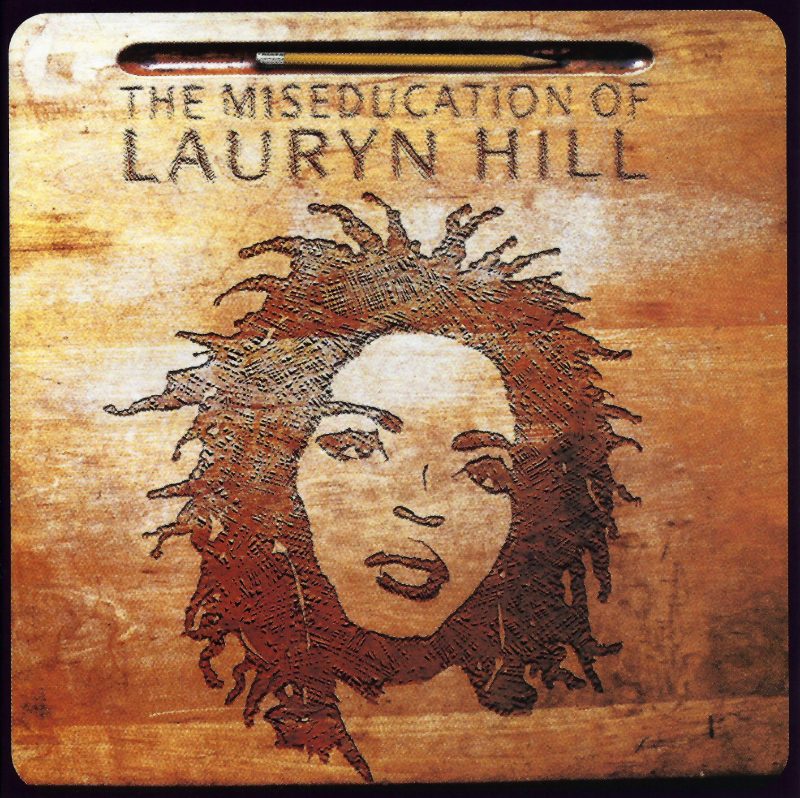
Lauryn Hill's only solo studio album, made in New York, New Jersey and Kingston, and the first hip-hop record to win Album of the Year. The voice holds it together; the frame doesn't.
- Released
- 25 August 1998 (US, Ruffhouse/Columbia); Japan had it first, on 19 August 1998
- Label
- Ruffhouse / Columbia (US); Columbia elsewhere (489843)
- Producer(s)
- Lauryn Hill, with Che Pope as co-producer of 'To Zion' and additional production by Vada Nobles on 'Lost Ones'. The credits were challenged in a 1998 lawsuit, settled in 2001
- Runtime
- 77:39 by the US CD's sleeve timings (77:17 where the title track is timed at 3:55); 16 tracks, the last two unlisted
- Chart peak (US)
- #1 (Billboard 200, chart dated 12 September 1998), with 422,624 copies in its first week, then the biggest opening by a woman in the SoundScan era
- Chart peak (UK)
- #2 (Official Albums Chart), on its debut on 10 October 1998 and again in March 1999; 72 weeks in the Top 75
- Certifications
- RIAA Diamond (16 February 2021), the first for a female rapper; Music Canada 7× Platinum (27 August 1999). Guinness World Records estimates worldwide sales at about 20 million
- Awards & honours
- Five Grammys at the 41st ceremony, on 24 February 1999. They were Album of the Year, Best New Artist and Best R&B Album, plus Best Female R&B Vocal Performance and Best R&B Song for 'Doo Wop (That Thing)'. Added to the National Recording Registry with the class of 2014, announced on 25 March 2015
Hill's insistence on doing it her way gave the album its greatness and its flaw. The voice and the songs hold up. The 77 minutes, and a classroom idea that never takes shape, are what an editor would have fixed.
Commissioner Gordon, who recorded and mixed most of The Miseducation of Lauryn Hill, has described the mix of 'Doo Wop (That Thing)'. It ran to 128 tracks, spread across two 48-track and two 24-track machines locked together at Sony's New York studios. Hill's own aim, as Rolling Stone's 2008 oral history sets it out, pointed the other way. She wanted the integrity of reggae, the knock of hip-hop and the instruments of classic soul, recorded raw and without compressors. Her manager, Jayson Jackson, says she wanted it to sound muddy, like an old record. So this is a record of enormous effort made to sound unbothered. Getting there took a lot of people, and one person in charge.
Everything good here comes from that person's refusal to hand the record over. The sleeve credits Hill as writer, producer and arranger of every original song, with Che Pope as co-producer on one. Her voice carries all of it, rapping and singing, and it's the best thing on the album. The same refusal explains what's wrong with it. It runs 77 minutes and never feels edited. The classroom idea in its title never holds together either. It's a great album in a loose frame, and the frame is where it shows its age.
It began as a grievance. In summer 1996, Jackson says, Hill called him from the road, furious that every other Fugee was getting a solo record and she wasn't. She told him she wanted a whole new crew. The label had other ideas. Gordon says Sony wanted another Fugees album, not a solo one. Rohan Marley, Bob Marley's son and by then Hill's partner, says Sony heard early versions and dismissed them as 'coffee table music'. Columbia talked to RZA about producing, according to the biographer Chris Nickson, and Hill insisted on doing it herself. By Nickson's count she wrote more than 30 songs in the attic studio of her house in South Orange, New Jersey.
Then she was pregnant, and the record found its subject. Hill credited the pregnancy with an urge to write. Rohan Marley says people told her to end it, and Gordon recalls label staff complaining about it. Her son Zion was born in August 1997, and recording began in New York and New Jersey that September. 'To Zion' is her answer to the people who told her to stop. Che Pope says he made the track in one of the 20-minute stretches he could bear in a top-floor room of a Brooklyn brownstone with no air conditioning. Carlos Santana added lead guitar in Miami, and in return Hill made a song for his album Supernatural. The song is the emotional centre of the record, and also the first sign of strain. Carvell Wallace, in a glowing Pitchfork review in 2016, heard her voice stretched to its limits there.
The album's reputation puts it in Jamaica, and the sleeve says otherwise. Marley Music, the credit for Bob Marley's old house and studio at 56 Hope Road in Kingston, appears on five of the 14 listed songs. Chung King, in New York, appears on 11. The move south came after the first New York sessions, when Rohan Marley suggested escaping the people who kept dropping in at Chung King. Gordon remembers the equipment sitting in customs for 2 days, trips of a couple of weeks at a time, and a room that had to work as a museum between sessions. So this is a New York and New Jersey record with Kingston running through it, and Kingston arrives early.
It comes in first on 'Lost Ones', one of the songs Vada Nobles says were made at Hope Road. Gordon recalls Hill freestyling the verse there with Marley grandchildren chanting along. The hook borrows from 'Bam Bam', and the Jamaican guitarist Earl 'Chinna' Smith plays on it. It's the toughest rap on the record, and critics have long heard it as her reply to the split with Wyclef Jean. 'Ex-Factor', which follows, is the album at its best. Nobles says it was first written for an Arista girl group called Ex Factor, before it turned personal. It replays elements of Wu-Tang Clan's 'Can It Be All So Simple', and it carries the best singing on the album.
'Doo Wop (That Thing)' shows how the album's ease was built. Its title came off a doo-wop box set that was sitting on the floor, Nobles says. The backing singer Lenesha Randolph remembers Hill asking for the street-corner harmonies of the 1950s and 60s. The singers were called to Chung King in November 1997. Nobles put heavier drums under the track because he found the music too soft. The Jamaican horn players Dean Fraser, Everol Wray and Nambo Robinson were added, and Gordon mixed the 128 tracks at Sony. It debuted at #1 on the Hot 100 dated 14 November 1998, the tenth song ever to do so. 'Superstar' is looser, and better for it. Wallace heard her flow there, as on 'Doo Wop' and 'Final Hour', creeping just behind a beat at the tempo of golden-era East Coast hip-hop. Gordon remembers that its rented harpsichord went out of tune after a single pass. Robert Christgau picked it out in the Village Voice in 1998, and he was right to.
The guests serve the songs rather than sell them. 'Nothing Even Matters' was cut in New York, not Kingston, around a finger-snap pattern Pope had been playing with. D'Angelo sings it with her and plays Rhodes, and he says his vocal took about an hour. He and Hill had planned to swap songs for each other's albums, and James Poyser was working on both. On 'Everything Is Everything' the piano is by a 19-year-old Penn student, credited as John Stephens. A friend had asked him for a ride to Hill's house. He played for Hill, she asked him onto the track, and he played along with strings already on the tape. He's better known now as John Legend.
The case against her singing was made at the time, and it deserves a hearing. Soren Baker, reviewing the album for the Los Angeles Times in August 1998, found her a stronger rapper than singer. He thought her voice too thin for the heaviest songs. Christgau called the singing ordinary while praising the production. They heard something real. On 'To Zion' and 'Everything Is Everything', as Wallace noticed, her voice is pushed past where it's comfortable. But the whole brief was against polish, and a smoother singer would have made a smaller record. Hill once told The Source that she sometimes treated rapping like singing, and singing like rapping. That switching is the performance the album is built on.
The real flaw is the shape. The classroom frame gives the album its title and its cover, and it's the weakest idea on it. The interludes weren't recorded in a school. They were made in the living room of Hill's house in South Orange, with neighbourhood children and Ras Baraka. He was then an eighth-grade teacher running for Newark council, and at Hill's request he improvised on the subject of love. The talk is warm, but it rarely touches the songs it interrupts. It's also hard to skip, because each interlude sits at the tail of a song's track rather than on its own. Christgau called the skits superfluous in 1998. On a 77-minute record they're the first thing an editor would cut.
The ending has the same problem. The title track is a proper close, with the Indigo Quartet's strings and a piano part by Joe 'Flip' Wilson. Then two unlisted tracks follow. 'Can't Take My Eyes Off You' was cut for the 1997 soundtrack of Conspiracy Theory, in Gordon's one-room home studio, in about one take. It became a hidden bonus because radio had started playing it unasked. It's charming, and it earned a Grammy nomination, but it belongs to another project. The album's middle has a quieter version of the problem. 'Forgive Them Father' and 'Every Ghetto, Every City', back to back, are where attention drifts. Both are well made, and both lean on borrowed frames: the Wailers' 'Concrete Jungle' for one, David Axelrod's 'Tony Poem' for the other.
None of that held it back. It sold 422,624 copies in its first US week and went straight to #1. In the Village Voice's Pazz & Jop poll for 1998 it came second to Lucinda Williams's Car Wheels on a Gravel Road. More critics named it than any other album. At the Grammys on 24 February 1999 it won five awards, including Album of the Year. Only one other hip-hop album has won that award, OutKast's Speakerboxxx/The Love Below in 2004. The artists themselves have documented the influence. Kanye West said he played it constantly while making The College Dropout. Usher has credited its honesty for Confessions. Clairo said its classroom interludes were part of why she put children on her debut, Immunity. So the part that has aged worst is a part one of its heirs chose to borrow.
Its authorship has been argued over since December 1998, when four musicians who'd worked on it sued in federal court in Newark. Nobles, Rasheem Pugh, and the brothers Tejumold and Johari Newton sought credit on 13 of the 14 songs. In a statement, Hill called the suit without any merit, and a spokesman said she felt deeply betrayed. It was settled in February 2001 on terms that weren't disclosed, though Rolling Stone later gave a reported figure of $5 million. Jackson concedes that Hill never wanted paperwork defining anyone's role. That's the cost of the control that made the record. It's tempting to see the years without a second studio album as part of the same cost. Hill's own account, given in 2021, is that nobody at her label ever called to ask how they could help her make another.
Heard now, The Miseducation of Lauryn Hill is a great record that runs past its own best ending. The voice is the reason to own it: rapping on 'Lost Ones', singing on 'Ex-Factor', trading lines with D'Angelo on 'Nothing Even Matters'. Its best songs hold up against anything in the soul or hip-hop of the 1990s. What holds it back is the shape. A classroom idea gives the album its title but not its form, and the hidden tracks after the title song blur its ending. Without the skits and the two hidden tracks it would be a tighter, better album. As it stands, it's one artist's whole vision with the edges left in. That's worth more than most tidy albums, and a little less than its legend.
Pressing guide — the one to own
The original to own is the 1998 US double LP, Ruffhouse C2 69035, manufactured and distributed by Columbia. Its labels read 69562 for sides A and B and 69563 for sides C and D. The etched runouts carry 'F/W', for the Frankford/Wayne lacquers. Complete copies have printed black-and-white inner sleeves with lyrics, credits and photographs. The two hidden tracks aren't listed on the sleeve or the labels.