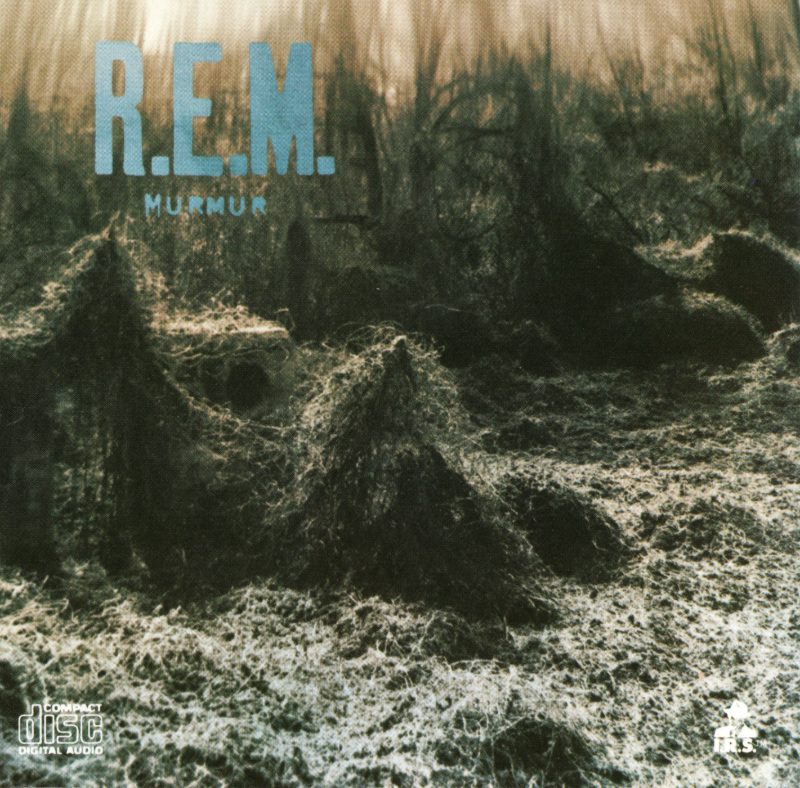
R.E.M.'s debut, recorded in Charlotte in early 1983 with Mitch Easter and Don Dixon: jangling guitars, the studio's pianos and a voice that's hard to make out. A great record, and a careful one.
- Released
- 12 April 1983 (US)
- Label
- I.R.S. Records, manufactured and distributed by A&M (US and UK: SP 70604; Europe: ILP 25433)
- Producer(s)
- Mitch Easter and Don Dixon (producers and engineers)
- Runtime
- 43:55 (12 tracks)
- Chart peak (US)
- #36 (Billboard 200, chart dated 13 August 1983)
- Chart peak (UK)
- #100 (UK Albums Chart, one week ending 23 July 1994); no placing in 1983
- Certifications
- RIAA Gold (500,000), 10 October 1991
- Awards & honours
- Album of the year in Rolling Stone's critics' poll for 1983; #2 in the Village Voice Pazz & Jop critics' poll for 1983; #197 in Rolling Stone's 500 Greatest Albums (2012 edition). The 1981 Hib-Tone 'Radio Free Europe' single, not the album, is on the National Recording Registry
Murmur's mystery came from refusals, not a plan: no synths, nothing that sounded like a bid for a hit, and a fear of guitar distortion. Easter credits the synth veto for a sound that hasn't dated. In our reading, the same caution cost 'Radio Free Europe' some of its life.
When R.E.M. remade 'Radio Free Europe' for Murmur, Michael Stipe sang it standing on a staircase. The landing sat between the control room at Reflection Sound in Charlotte, North Carolina, and a rec room in the basement. He'd go there, turn off the lights and sing into a Neumann U47 FET. “He still had this thing of loving to be invisible,” Mitch Easter, who co-produced the record with Don Dixon, told Sound on Sound in 2009. It's the right picture to start with. Murmur is a debut by a band that didn't want to be looked at, made by producers who chose not to drag them into the light.
It's tempting to hear the record's mystery as a plan: the buried voice, the kudzu on the cover, the lyrics nobody could make out. The people who made it describe something less tidy. Murmur's sound came from refusals. The band refused synthesisers and anything that sounded like a bid for a hit, and they were scared of guitar distortion. The producers worked inside those limits with whatever the studio had to hand. Easter credits the veto on synths for the fact that it still doesn't sound like 1983. Our own reading is that the same caution is why 'Radio Free Europe' came out slower and tamer than the single it remade. Murmur is a great record with a cautious streak, and you can hear the caution.
It began as a rescue. I.R.S. signed R.E.M. in May 1982 and released their Chronic Town EP that August. For the album, the label first paired them with the producer Stephen Hague. Dixon's version, told to Tape Op in 1998, is blunt, though he couldn't recall the producer's surname; Sound on Sound names him. Hague made them play one song over and over, told them Bill Berry couldn't play on the record, and made recordings that sounded like the Cars. The band asked to try some songs with Easter instead. He'd made their first single, 'Radio Free Europe', in 1981 at the Drive-In, his studio in his parents' converted garage in Winston-Salem. Robert Palmer of the New York Times had put that single among his 10 best of the year. I.R.S. agreed, with one condition. It couldn't be the garage. It had to be “a real studio”.
So Easter gave up his own 16-track room for the 24-track Reflection. He brought in Dixon, an old high-school friend who'd worked there and knew the equipment. Their tryout, which included 'Pilgrimage', won them the job. The album was recorded and mixed at Reflection in January and February 1983. The pressure didn't stop at the door. Dixon says I.R.S. wanted singles like the Thompson Twins', because that was what was hot. The Hague sessions had left the band convinced, Easter says, that the studio was “the place where you get turned into a cheese-ball”. They weren't necessarily the ones with the ideas. What they had was a veto, and they used it on anything electronic.
What the veto left was the studio's own furniture. Studios in the South, Easter says, were good about keeping nice pianos and organs, and Reflection also had a vibraphone. He loved the vibes on a record by ABC and talked the band into using them. Pitchfork's review of the 2008 remaster heard them on 'Pilgrimage', layered with low piano. Peter Buck's Fender Twin Reverb had died, so he played every song except 'Pilgrimage' through Easter's 1960s Ampeg Gemini II. Dixon says the band were scared of any hint of distortion on a guitar, so producers raised on loud amps had to work hard for guitar sounds the band would accept. Easter puts Buck's sound down to heavy flatwound strings and a very deliberate way of playing, which leaves every note audible. Mike Mills's bass, sent through the studio's Ampeg B15 and miked from down a corridor, carries much of the tune.
Put on 'Radio Free Europe' and the producers' fingerprints are all over it. It opens on an electrical hum that Easter had stored and then fed through a noise gate, so it cuts in and out in time with the bass. Easter also remembers a separate sputtery noise that they looped and keyed to the bass part in the passage leading into the chorus. That one may sound like a drum machine, he admits, but a real drum machine would have got him and Dixon fired. In the middle of the song comes a clang: a triangle sent through analogue delay, its timing nudged until it went out of tune. Easter's explanation for what the band let through is that they liked anything they could see from an art angle. The minute something sounded hokey or commercial, he says, they hated it. He also overdubbed the song's snare himself, with Dixon punching in, while the band were out. Berry's hi-hat was smothering the original, and the producers knew the band would hate the idea.
The best moments are the ones where a limit turned into an arrangement. 'Perfect Circle', which closes side one, is two pianos played at once. Mills and Berry play a tack piano and a Yamaha, close together under a single microphone. Dixon played the plain bass part because Mills was busy at the keys. Steve Pond, reviewing the album in 1983, singled out the song's stately piano. The dull thud in 'We Walk' turns out to be Berry playing pool, recorded and slowed down. Over all of it sits Stipe's voice, which Pond heard as a nasal snarl. Looking back on the 1981 session, Easter says Stipe's hard-to-follow singing never even crossed their minds at the time. Dixon, talking about the records he made with the band, goes further. Stipe's words got onto them, he says, because nobody could hear them.
Critics in 1983 heard both the pull and the price. Pond, reviewing it for Rolling Stone on 26 May, grumbled that there was no lyric sheet, that Stipe slurred his lines and that even the typeface was hard to read. He was won over anyway, and called R.E.M. “the important Athens band”. Robert Christgau gave it an A− in the Village Voice. He called them “an art band, nothing less or more”. Then he wondered how much their pleasure meant, and decided it was quite a lot. In the Voice's Pazz & Jop critics' poll it finished #2, with 986 points to Thriller's 1,305. Rolling Stone's critics' poll, announced in February 1984, went further and named it album of the year, ahead of Thriller and U2's War.
The public was slower. Murmur spent a single week at #36 on the Billboard 200, in August. Buckley's 2002 biography puts sales at about 200,000 by the end of the year, below what Jay Boberg at I.R.S. had hoped for. Gold, which meant 500,000 copies, didn't come until 10 October 1991. Its reach ran through musicians more than charts. Easter says the band, more than any one record, made others believe they could do it too. Their willingness to keep playing clubs, he adds, made them a model. In 1993 Pavement released a song about the early band, 'Unseen Power of the Picket Fence'. By 2012 Rolling Stone was calling Murmur “the founding document of alternative rock”.
The caution has a price, and the people closest to the record have named it. The remade 'Radio Free Europe' is slower and cleaner than the 1981 Hib-Tone single. Easter, who produced both, told Sound on Sound that the second version now sounds “a little too sedate”, and that he prefers the faster one. The notes to the 1988 compilation Eponymous record that Mills and the band's manager, Jefferson Holt, thought the Hib-Tone version “crushes the other one like a grape”. When the Library of Congress added 'Radio Free Europe' to its National Recording Registry in 2010, it chose the Hib-Tone single too. On the opening track the song isn't the problem; the performance is. The band were wary of the studio, and to our ears you can hear them holding back.
Pond's deeper complaint was about feeling. The band, he wrote, talked about passion more often than they seemed to feel it. That's unfair to 'Talk About the Passion' itself, where Stipe sounds more open than anywhere else on the record. It's fairer to the middle of side two. There, the jittery, half-spoken '9-9' and the slight 'We Walk' sit either side of 'Shaking Through'. Neither is bad. Both are more texture than song, and together they're the album's thinnest stretch. No critic we've found singles them out, so take that as our view rather than the consensus.
What the veto bought is something most records from 1983 lack. Easter's own verdict is that a Murmur made with synths would sound dated now, and that as it is, “you can't really tell when Murmur was done”. He's right. Set beside the other records critics loved that year, it's the one that doesn't announce its decade. Its standing has held, too. Rolling Stone placed it at #197 in the 2012 edition of its 500 greatest albums, and Pitchfork gave the 2008 reissue a perfect 10.0. It doesn't need the bigger claim sometimes made for it, that college rock began here. The dB's and the Replacements were already at work. What Murmur did was give that music a sound you can recognise within seconds.
So Murmur is better than its legend in one way and smaller in another. It's a record of four people saying no, and nearly every no made it stronger. No synths, so it hasn't dated. No clean vocal, so the songs stay open. The exception is energy. The caution that keeps it fresh also keeps its pulse low, and 'Radio Free Europe' was better the first time. Hear it for 'Perfect Circle' and 'Pilgrimage', and for a sound that holds together from the opening hum to the last chord. It's one of the great American debuts, and a slightly careful one.
Pressing guide — the one to own
The original to own is the 1983 US LP, I.R.S. SP 70604, manufactured and distributed by A&M, in a single sleeve with a printed inner sleeve. Greg Calbi mastered and cut it at Sterling Sound, and 'STERLING' is in the runouts. Calbi's mark is a small etched baseball, found on many copies but not all. At least three US plants pressed it, and the catalogue dates them all to 1983: RCA Indianapolis ('R' on the labels), Electrosound Midwest ('B') and Monarch ('C'). A fourth variant has no plant letter and 'GD1' in the runouts, and its plant isn't identified. No source ranks any of them as the first.