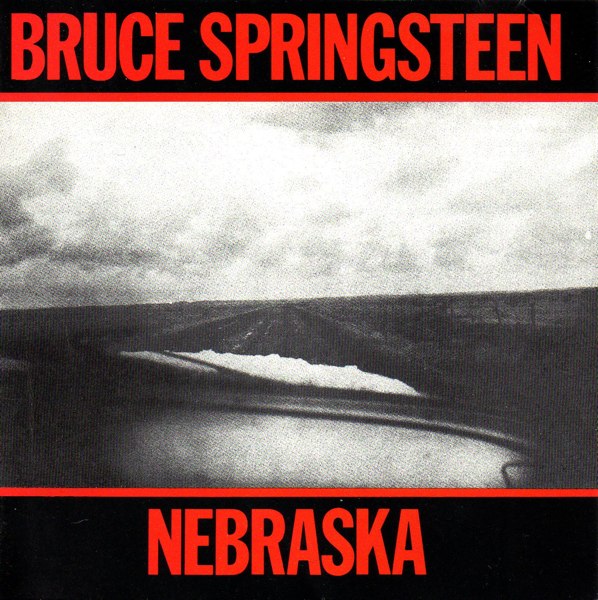
Bruce Springsteen's sixth album is a cassette of home demos made for his band. When the band couldn't beat it and a New York studio couldn't remix it, Columbia released the tape.
- Released
- September 1982 (Columbia, US; CBS, UK and Europe). The exact day is disputed: 30 September in Warren Zanes's account, 20 September in a Billboard report from Toronto in October 1982
- Label
- Columbia (US, TC 38358); CBS (UK and Europe, CBS 25100); CBS/Sony (Japan, 25AP 2440)
- Producer(s)
- None credited. Recorded by Mike Batlan (spelt Batlin on the sleeve)
- Runtime
- About 41 minutes (10 tracks)
- Chart peak (US)
- #3 (Billboard Top LPs & Tape, now the Billboard 200; chart dated 30 October 1982), 4 weeks at #3
- Chart peak (UK)
- #3 (Official Albums Chart, 9 October 1982)
- Certifications
- RIAA Platinum (6 July 1989); BPI Gold (21 July 2013); Music Canada Gold
- Awards & honours
- #3 in the Village Voice Pazz & Jop critics' poll for 1982; #150 on Rolling Stone's 500 Greatest Albums (2020)
Nebraska is the home tape that outlasted every attempt to replace it. Its 10 story songs are among the best Springsteen wrote, and the home recording makes them believable. That same cassette sound is also why the record flattens out over 41 minutes.
The last problem Nebraska set the people making it was getting it onto vinyl. The songs were finished and mixed, and for a while no cutting room could put them on a lacquer. Toby Scott, Springsteen's engineer, later named the rooms that tried. Bob Ludwig tried, Stephen Marcussen tried at Precision, and so did Sterling and CBS. The tape's phasing kept throwing the needle out of the groove. Dennis King at Atlantic Studios in New York failed once, then got it onto disc by cutting at a much lower level. In the end, Scott says, the master used Ludwig's EQ and his facility with King's settings. Yet the lacquers carry King's stamp: every copy of the original American issue has ATLANTIC STUDIOS D.K. in the run-out groove.
It's the right place to start, because the tape resisted every attempt to turn it into a normal record. Springsteen made it at home in New Jersey, as demos for the E Street Band. The band couldn't beat it, and engineers in a New York studio couldn't transfer or remix it. So the record that reached the shops in September 1982 was the cassette itself, mixed at home through an old tape-echo unit onto a boombox. The writing on it is as good as anything he has done: 10 stories told with almost nothing around them. The sound is the price. It makes the songs believable, and across 41 minutes it also makes them flat.
The record began in success. The River, released in 1980, was Springsteen's first #1 album in America and reached #2 in Britain. He told Warren Zanes, whose 2023 book traces the making of Nebraska, that the success left him conflicted about being separated from the people he wrote about. The River tour ended with two shows in Cincinnati in September 1981, and that month he rented a house in Colts Neck, New Jersey. He wrote the title song after watching Terrence Malick's film Badlands and reading Ninette Beaver's book Caril, both drawn from the Starkweather killings. Flannery O'Connor's stories, he wrote in 2003, carried a dark spirituality that matched how he felt. In the same book he names the records of John Lee Hooker and Robert Johnson as the mood he was after.
The method was meant to save time and money. Springsteen told Zanes the demos would give the band a head start and cost less studio time, and he has written that he found studios sterile. Mike Batlan, who engineered the tape, bought a Teac 144 four-track cassette recorder from a local music store. With it came a pair of Shure SM57 microphones and two stands, set up in a spare bedroom. Most of the basic vocal and guitar tracks took four to six takes. Springsteen then added harmonica, mandolin, glockenspiel and a synthesizer himself, at home on the same machine. When all this happened is disputed. Zanes, Peter Ames Carlin and Marc Dolan put the whole tape on 3 January 1982. Two other books spread the demos from 17 December 1981 to 3 January. Either way, the tape held 15 songs, and nine of them became the album.
The sound came from what happened next. Batlan left the recorder's varispeed set fast while they recorded, then put it back to normal for the mix. He and Springsteen mixed the four tracks through an old Gibson Echoplex, a tape-echo unit, onto a Panasonic boombox. Scott says the boombox had sunk in a river the summer before, and came back to life after a week on a porch. Nobody ever cleaned the heads on any of the three machines. Batlan was still finding his levels on the first songs, and Scott says some distortion is audible. By the time Scott heard the story, the Echoplex itself had "gone to meet its maker". None of it was meant for release. It was a guide for the band, nothing more.
Springsteen carried the cassette in the front pocket of his jeans jacket from January to about April, Scott recalls. He sent the songs to his manager, Jon Landau, with two pages of handwritten notes. In April 1982 the band learned them at Roy Bittan's house, then recorded at the Power Station in New York, into May. The 2025 box set Nebraska '82 credits Springsteen, Landau and Steven Van Zandt as the producers of those sessions. Some of the tape thrived there. 'Born in the U.S.A.', 'Downbound Train' and 'Working on the Highway', which grew out of 'Child Bride', all went from the Colts Neck cassette to his next album. The quieter songs didn't survive the move. Chuck Plotkin later blamed the studio itself for making them sound ordinary. Springsteen told Rolling Stone in 1984 that the songs needed their bare, echoing treatment, one man telling his story.
Who decided to release the cassette is still argued over. Mixing and sequencing of the acoustic and electric songs ran through June, and Springsteen considered a double album. Plotkin credits Landau with the idea, Landau credits Springsteen, and Van Zandt claims it for himself. Meanwhile Plotkin and Scott spent weeks trying to transfer the cassette at the Power Station, and attempts to remix it failed. Van Zandt told Springsteen that because it was never meant for release, it would be the most intimate record he'd ever make. He was right, and it's the best argument for what happened. The sleeve reflects how it was made. It credits Batlan, spelt Batlin, as recording engineer, and lists no producer. Billboard's reviewer noticed: "No producer listed." Landau later told Zanes a producer credit hadn't felt right to Springsteen.
What the songs do with so little is the reason to keep playing the record. 'Nebraska' opens it in the voice of Charles Starkweather, who killed 11 people between December 1957 and January 1958. The last 10 died in a January spree with Caril Ann Fugate, aged 14. The song passes no judgement on him, and one line is borrowed from a killer in O'Connor's story 'A Good Man Is Hard to Find'. At about 2:56 the voice stops for some 22 seconds, the one long break before the end. 'Highway Patrolman' is better still. Its narrator, an honest officer called Joe Roberts, lets his brother go after a violent bar fight. The song takes more than 5 and a half minutes over it, and never tells you what to think of his choice.
'Atlantic City' has outlived the rest. Its young man turns to the mob, against the background of the city's gang wars and its turn to gambling. The song alludes to Philip Testa, the Philadelphia boss killed in 1981. By 5 October 2026 it had 66.5 million Spotify plays, more than three times the title track's 20.2 million. It's the song here most shaped like a single, and it was the album's first, in Europe and Japan. 'Johnny 99' is where the record raises its voice. A man loses his job when the Ford plant at Mahwah closes, then shoots a clerk. AllMusic's William Ruhlmann calls the performance raucous, from the falsetto wails at its start to the shouts at its end. 'State Trooper', modelled on Suicide's 'Frankie Teardrop', is the album at its most menacing. It's voice and guitar alone, with no harmonica. Like everything else here it went through the Echoplex in the mix, and here the echo has only a voice and a guitar to work on.
Side two is where the method starts to cost something. The sharpest critic of 1982 explains why. Robert Christgau doubted that Springsteen was imaginative enough as a singer or melodist to carry these stories on guitar and harmonica alone. He's right about two songs. 'Used Cars', a childhood memory of his father, has a sharp story and a plain tune, and the bedroom gives it nothing else to lean on. 'Open All Night' is a Chuck Berry-style rock song about a night drive on the New Jersey Turnpike. Played alone into a cassette, it sounds like what it was: a sketch for a band, which recorded it that spring. 'My Father's House' was recorded on 25 May 1982, months after the rest, with a synthesizer added. It's a dream about his father, followed by a visit to the old house. 'Reason to Believe' closes the album with four short scenes. Rob Kirkpatrick hears in it people who keep going against all the evidence. Those last two songs hold, and the side recovers.
It came out in September 1982 with no American single, no interviews and no tour. Even the day is disputed: Zanes gives 30 September, but a Billboard report from Toronto that autumn referred to a 20 September release. 'Atlantic City' got a video, directed by Arnold Levine. It was Springsteen's first, and he isn't in it. Billboard's review called the album a heartening commercial gamble, and said radio might balk. It reached #3 in Britain on 9 October, and #3 in America on 30 October, where it stayed 4 weeks. Critics voted it #3 in the Village Voice's Pazz & Jop poll for 1982, and Christgau gave it an A− despite his doubts. The Washington Post's Richard Harrington was harder on it. He found the sound flat, and suggested it may be the least dynamic album of the year.
Its standing has risen since. The RIAA certified it Platinum in July 1989, and the BPI made it Gold in Britain only in 2013. Reviewing it for Q in 1989, Richard Williams gave it 2 stars out of 5. He argued it would've been better with the E Street Band and a few more months in the studio. That claim could finally be tested in October 2025, when Nebraska '82 released the band's versions. The Guardian's Caryn Rose heard them and decided that Springsteen had made the right call in 1982. Rolling Stone moved the album from #224 in its 2003 list of the 500 greatest albums to #150 in 2020. Asked in 2008 about Nebraska and two other records, Bon Iver's Justin Vernon called them huge influences. In 2023 Springsteen called it his most definitive album.
One part of the legend deserves less weight. Greil Marcus and others have long heard Nebraska as a portrait of Reagan's America. Steven Hyden argued in 2024 that the songs are neither openly nor quietly political, and were heard that way because of when they arrived. Hyden has the better of it. 'Johnny 99' begins with a plant closing, but the songs around it turn on a killer, a mob recruit and a policeman torn over his brother. They're about the choices people make, more than the conditions they make them in. That's why they haven't dated with the politics read into them.
Nebraska is a great record with a flaw built into its method. The songwriting is why it lasts: stories mostly told by people Springsteen never was, with the judgement left to the listener. One house, one machine and one sound hold it together from the first track to the last. That sound is also the cost. It gives the songs the weight of evidence, and across 41 minutes it flattens them, so the two plainer tunes on side two have nowhere to hide. Christgau was right about those two and wrong about the other eight. Williams's band album exists now, and the Guardian's critic, for one, still prefers the tape. Play it start to finish, late and on your own. It needs that kind of attention, and it pays it back.
Pressing guide — the one to own
The American original is Columbia TC 38358 from 1982, with label matrices AL 38358 and BL 38358 and a stiff-paper inner printed with the lyrics. Three plants pressed it: Pitman (P), Terre Haute (T) and Carrollton (G). All used lacquers from Dennis King's mastering, so the runouts carry ATLANTIC STUDIOS D.K. rather than an 'RL' etch. Nothing documents a first state or a pressing quantity, so pay for condition rather than for a plant letter.