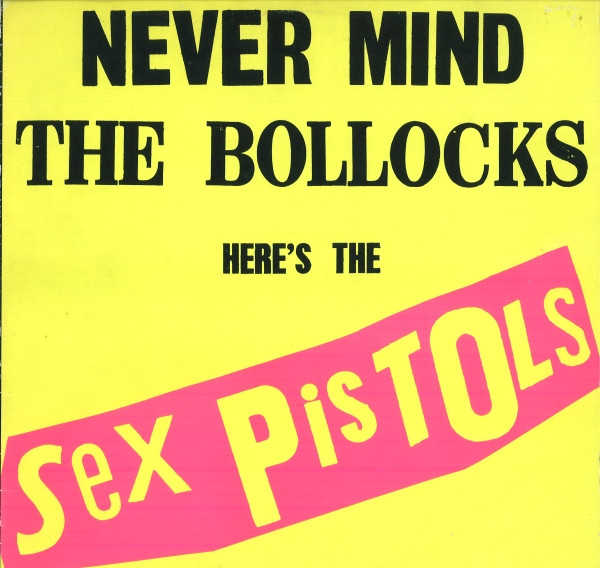
The Sex Pistols' only studio album, made at Wessex in Highbury across most of a year and credited to 'Chris Thomas or Bill Price'. A riot on record, built with great care.
- Released
- 28 October 1977 (UK, Virgin V 2086); 11 November 1977 (US, Warner Bros. BSK 3147)
- Label
- Virgin (UK); Warner Bros. (US); Barclay (France)
- Producer(s)
- Chris Thomas and Bill Price (the 1977 UK 12-track labels read 'Chris Thomas or Bill Price')
- Runtime
- 38:35 (12 tracks, by the 1977 US label timings)
- Chart peak (US)
- #106 (Billboard 200, 21 January 1978), 12 weeks on the chart
- Chart peak (UK)
- #1 (Official Albums Chart, new entry on the chart of 6–12 November 1977), 2 weeks at #1
- Certifications
- BPI 2× Platinum (July 2013); RIAA Platinum (March 1992)
- Awards & honours
- #41 on Rolling Stone's 500 Greatest Albums (2012) and #80 on its 2020 list; Grammy Hall of Fame (2015)
The legend says four amateurs made it in a couple of weeks. The people who made it describe a year of sessions, a guitarist who overdubbed nearly everything and a label boss who picked the songs. The craft is why it lasts. The assembly is why it falls short.
Pick up a 12-track Virgin copy from 1977 and read the label. It gives the producers as "Chris Thomas or Bill Price". The "or" isn't a misprint, and it isn't indecision either. Price told Sound On Sound in 2004 that the two men agreed on it. McLaren had hired Price to produce the album and Thomas to make the singles, and several songs ended up in two versions. Price says McLaren was telling each producer that the other had made everything, and they suspected he was trying to avoid paying. So they took the credit together and split the fee between themselves. The sleeves had to be finished before anyone knew which versions the record would use.
That one word is a better guide to the album than its legend. The legend says four young men who could barely play made it in a couple of weeks. The people who made it tell a slower story. The sessions ran from October 1976 into the summer of 1977, in blocks, while the band went through three record deals. The guitarist played nearly every overdub and, by the 2012 credits, the bass on 11 of the 12 tracks. The head of the label chose the track list. What comes out of the speakers is a carefully built studio record that sounds like a riot. That's why it has lasted. It's also why it earns admiration more than the reverence it usually gets.
Most of the songs existed before the band went into Wessex for the album. Rotten wrote most of the words, and the songs are credited to the whole band. Glen Matlock, the bassist, wrote in his memoir that the words of 'Pretty Vacant' are his, apart from a couple of lines Rotten changed. Only two of the 12, 'Holidays in the Sun' and 'Bodies', came after Matlock left in February 1977. They're credited to Sid Vicious instead. The rest were in hand before he went. The 2012 reissue includes demos of six of them, produced by Dave Goodman with Matlock on bass. So the album is the 1976 live set, recorded properly. That's the source of its force, and of its limits.
It took most of a year because the band kept losing its label. EMI released 'Anarchy in the U.K.' in November 1976. It ended the contract on 6 January 1977, after the band swore at Bill Grundy on Thames Television's Today. A&M lasted a week in March. Virgin came last. None of that stopped the work, because the labels weren't paying for it. Price says two of McLaren's companies financed the sessions, so the recording went on whoever the band was signed to. The band kept returning to Wessex, a Victorian church hall in Highbury that had become a studio. Price was its chief engineer and studio manager. By halfway through the album, he says, Wessex wanted cash for each week before it would record another song.
This is where the legend falls apart. Price told Sound On Sound that Jones was tight and rhythmic from the first minute. In Price's account Jones also did nearly all the overdubbing. Cook was a different case. Price remembers him barely able to play at first, on a kit he called "crappy and beaten-up". The early drum tracks were edited together from many takes on the multitrack. By halfway through the album, Price says, Cook was solid. For his overdubs Rotten sang three to six passes in a session, and Price built the final vocal from the best of them. Then Price mixed by hand, riding the guitar and vocal levels as the tape ran. None of that is how amateurs make records.
The bass is the clearest case. Matlock played it on 'Anarchy in the U.K.' in October 1976, and the 2012 reissue credits him with that track alone. After he left, Vicious was the bassist in name. Price says Vicious and Jones both played on some of the tracks, and then it was a case of "may the best man win". Jones won. The 2012 credits give him the bass on every other song. Chris Thomas, in his notes for the 2025 reissue, describes the moment it clicked. Instead of writing a separate bass line, Jones played his guitar part an octave lower. You can hear the result. The bass follows the guitar like a shadow, and the two parts move as one.
Listen to how the songs start, because that's where the care shows. 'Holidays in the Sun' opens with the sound of marching feet, and Rotten doesn't arrive until 0:25. 'Pretty Vacant' gives its riff 32 seconds before the first line. Matlock wrote that he took that riff from ABBA's 'SOS' and changed it slightly. 'Anarchy in the U.K.' does the opposite. Rotten is in at 0:05, and the song runs on his voice until the band takes over at 1:09 and again at 1:57. Each opening is a different idea of drama. None of them sounds like a band that didn't know what it was doing.
'God Save the Queen' sits at the centre, and its history runs the length of the sessions. It was already on tape by March 1977. Price remixed it on 9 March, the day the band signed to A&M. Virgin released it on 27 May, timed for the Silver Jubilee. The BBC and commercial radio banned it, and it reached #2 behind Rod Stewart. On the album it still lands hard. Rotten is in at 0:19 and drops out for 19 seconds at 1:58, the song's one breath. 'Bodies', one of the two songs written after Matlock left, is the other pole. It's about abortion, and it's the nastiest thing here. Rotten sings it almost without a pause from 0:17 to 2:57.
As an album, though, it's less than the sum of its tracks, and its makers' own accounts show why. Price says he took McLaren at least three running orders, each built from different versions of the songs. In the end Richard Branson, who ran Virgin, chose the track list. All four singles went on it. So anyone who'd bought the singles already owned 4 of the 12 songs. The release itself was a muddle. Virgin put out the first copies early, with 11 tracks, because Barclay's French pressing was already arriving as an import. Then came a package with 'Submission' on a free 7-inch, and then 12-track copies in sleeves that still listed 11. A great album usually sounds decided. This one sounds assembled, from a set list, a year of sessions and a label boss's choices.
The commercial impact was immediate, if smaller than the myth. The album entered the UK chart at #1 in the week of 6–12 November 1977, displacing Cliff Richard's 40 Golden Greats. It held the top for 2 weeks before Bread replaced it. It wasn't the year's best seller. Music Week's chart for 1977 put it at #12, after 6 weeks on sale, with ABBA's Arrival first. In America it got no higher than #106. The fight it started was over a word. Nottingham police told the manager of Virgin's shop to cover the title in his window display, then arrested him. He was charged under the Indecent Advertisements Act 1889. John Mortimer QC defended him. Professor James Kinsley, head of English at the University of Nottingham, gave evidence on the word's history. On 24 November 1977 the bench acquitted him on all four charges, while making clear it deplored the record company.
Its influence is easiest to trace through the people it reached. Kurt Cobain put it at #14 on a handwritten list of his 50 favourite albums, later printed in his Journals. Megadeth covered 'Anarchy in the U.K.' in 1988, with Steve Jones playing a guitar solo on it. Bill Price went on to produce the Clash. Critics still rate the album highly, though less highly than they did. Rolling Stone had it at #41 on its list of the 500 greatest albums in 2012, and at #80 when it redid the list in 2020. America took longer to buy it. It didn't go Gold there until December 1987, or Platinum until March 1992, more than 14 years after release.
What has dated is the outrage, and the outrage was never the best of it. The swearing on Today, the radio ban and the court case are facts about 1977. Played now, without them, the songs sound like what they are: tight, well-made rock songs with a furious singer. What hasn't dated is the sound Thomas and Price built around Jones's guitars and Rotten's voice. Robert Christgau, who gave the album an A, had a chief reservation: that the music could turn heavy. He has a point. Across side one the mid-tempo songs come at much the same weight, and by 'Problems' the record starts to feel like one long song.
So what is it worth now? It's a very good record with clear limits. The playing and the production are better than the legend allows, and its influence is written into the careers of people who came after. Its best songs, 'Holidays in the Sun', 'God Save the Queen' and 'Pretty Vacant', still explain why it changed things. But it's a 1976 set list, four singles and two late songs, put in order by a label boss. It doesn't hang together the way the best albums do, and nobody involved designed it to. Admire it, play the singles loud, and save reverence for records that know what they are. This one was in its sleeve before its producers knew which of their versions it would hold.
Pressing guide — the one to own
The first pressing is Virgin V 2086 in a single sleeve with a plain pink back and only 11 tracks: no 'Submission', no poster and no free single. It was pressed by CBS at Aston Clinton, with runouts V2086 A1 to A3 and B1 to B3. Next came the SPOTS 001 package, the same 11-track LP with a one-sided 'Submission' 7-inch (VDJ 24) and a folded poster, shrink-wrapped with a SPOTS 001 sticker. Its LP runouts are V2086 A3 and B1 only.