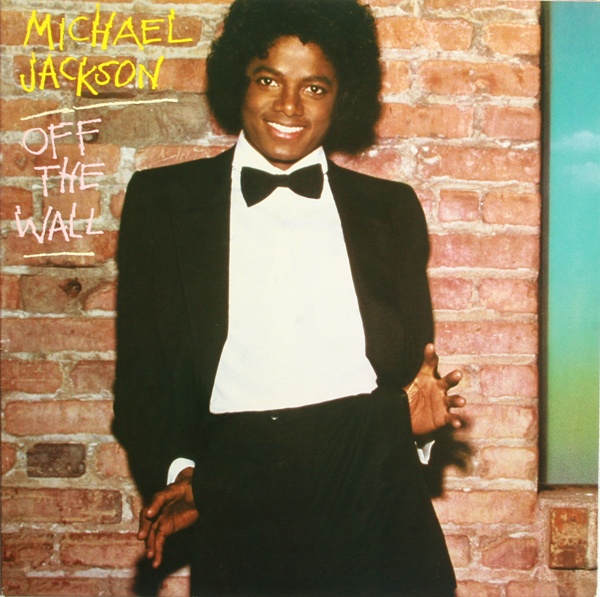
Michael Jackson's fifth solo album and his first with Quincy Jones, made when he was 20. A case for the craft and the voice, and against the idea that it rose above disco.
- Released
- 10 August 1979 (US, Epic); 8 September 1979 (UK, Epic)
- Label
- Epic (CBS)
- Producer(s)
- Quincy Jones; Michael Jackson co-produced three tracks
- Runtime
- 42:11 (original LP label timings)
- Chart peak (US)
- #3 (Billboard 200), on the charts of 16 February to 1 March 1980
- Chart peak (UK)
- #5 (Official Albums Chart, 20 October 1979); #3 on 18 July 2009
- Certifications
- RIAA Diamond (2 September 2025)
- Awards & honours
- Grammy for Best R&B Vocal Performance, Male (1980), for 'Don't Stop 'Til You Get Enough', also nominated for Best Disco Recording. Grammy Hall of Fame (2008). #36 in Rolling Stone's 500 Greatest Albums (2020)
It's usually praised for escaping disco just as the backlash hit. It didn't, and it didn't need to: the Grammys heard its lead single as R&B and as disco. Jones's production and Jackson's singing make it great. A softer second side holds it back.
On 6 November 1979, three months after Off the Wall came out, Michael Jackson wrote himself a note on the back of a tour itinerary. He was still the lead singer of the Jacksons. Pitchfork quoted the note in 2016. Paraphrased, it says he should be a totally different person, and that people should stop thinking of him as the child who sang the Jackson 5 hits. It asks for more besides: a new name, acting, no interviews. By then 'Don't Stop 'Til You Get Enough' had already been #1 in America. 'Rock with You' had just entered the Hot 100, on its way to 4 weeks at the top. On record, the change the note asked for was already under way.
That's the useful way to read Off the Wall: as a change made first in the studio. The album is usually sold on two stories. In the first, it turned a child star into an adult. In the second, it rose above disco just as America turned on it. The first is roughly true. The second gets the record wrong. The sessions ran from December 1978 to June 1979. They were over before disco records were destroyed at a baseball stadium in Chicago. It's a disco-era dance record, and among the best. Its strength is Quincy Jones's production and Jackson's singing, not new ideas. And its second side has a soft middle that the reputation skips over.
The partnership started on a film set. Sidney Lumet's The Wiz was shot in New York between July and December 1977. Jackson played the Scarecrow and Diana Ross was Dorothy. Jones was the film's music supervisor, a job he says he took as a favour to Lumet. He was 44. In Spike Lee's 2016 documentary, Rob Cohen describes the session where Jackson won Jones over. Jackson then asked Jones who should produce his solo record. As Tom Ewing told it in the Guardian in 2011, Jones put himself forward. Epic wasn't convinced. Its executives wanted Maurice White of Earth, Wind & Fire, and some thought Jones too jazzy.
The risk was real, whatever the sales say now. Jackson's previous solo album, Forever, Michael, had stalled at #101 in America in 1975. He was 20 when Off the Wall came out, and he hadn't left the family business. The sleeve names his father, Joe Jackson, as manager, and his brother Randy plays percussion on the opening track. What changed was the room around him. The credits fill with Los Angeles session players: Louis Johnson of the Brothers Johnson on bass, Greg Phillinganes on keyboards and John Robinson on drums. Jerry Hey arranged the horns. Rod Temperton, the keyboard player and writer from Heatwave, came in to write songs.
Temperton's part is the best-told story of the sessions. In interviews on the 2001 reissue, he and Jones explain that he wrote three songs, expecting one to be chosen. Jackson kept all three: 'Rock with You', 'Off the Wall' and 'Burn This Disco Out'. He learned the words overnight rather than read them, and sang the three vocals in two sessions. Jackson wrote two songs alone and a third with Johnson. 'Don't Stop' began as a tune he hummed around the family house in Encino, and Randy played it on piano for the demo. It was Jackson's first solo single that he'd written himself, though not his first song. 'Blues Away' had appeared on the Jacksons' album in 1976.
You can hear what Jones made of that demo before the chorus arrives. 'Don't Stop' opens with Jackson speaking quietly, and then the groove drops in. He sings it high, in the falsetto Stephen Holden praised in Rolling Stone. The title phrase doesn't come until 1:23. By then Ben Wright's strings and Hey's horns are stacked on Johnson's bass. Phillinganes says he suggested the bridge and was told it would count as arrangement, not writing. Jones has backed him. Reviewing the whole album in the Village Voice, Robert Christgau credited Jackson and Jones with 'the dance groove of the year'. Nearly half a century on, that undersells it.
The rest of side one shows the same care with different players. On 'Rock with You' Johnson sits out. The sleeve credits Bobby Watson on bass and Hawk Wolinski on the Rhodes. It's the gentlest of the dance tracks, and the title doesn't land until 0:51. 'Working Day and Night' hands nearly 50 seconds in the middle, from 2:39, to the band alone. Bruce Swedien recorded and mixed all of it. The sleeve credits his 'Acusonic Recording Process' without saying what it was. What you can hear is the result. The arrangements are dense, and every part in them stays clear. That clarity is the production's real achievement, more than any single song.
Side two opens with laughter and spacey effects, and Jackson doesn't come in on the title track until 0:23. Then comes the album's biggest risk. Tom Bahler wrote 'She's Out of My Life' in 1977 with Frank Sinatra in mind, and Jones asked for it before it reached him. It's set for Larry Carlton's guitar, Johnson's bass, Phillinganes's electric piano and Johnny Mandel's strings, with no drummer credited. Jones said in 2001 that Jackson cried at the end of every take, and that he left it on the record. In his 1988 memoir, Moonwalk, Jackson wrote that the song hit him hard. The last line, ending at about 3:09, is where the voice gives.
This is where the doubts of 1979 were sharpest. Dennis Hunt, in the Los Angeles Times that October, called it one of the year's best R&B albums. He also found the voice underpowered, with too much vibrato on the ballads, and credited Jones with camouflaging it. He has a point about the vibrato. But the singing is the other half of why the record lasts. Jackson is light and exact on the dance tracks and exposed on the ballad. On the weaker songs he does more than the arrangements. Hunt heard a young singer being propped up. Now it sounds like a young singer carrying the band. AllMusic's Stephen Thomas Erlewine later called him 'a blindingly gifted vocalist', and that's nearer the mark.
'I Can't Help It' is the second side's high point. Stevie Wonder wrote it with Susaye Greene, originally for his own Songs in the Key of Life, and arranged its rhythm with Phillinganes. Pitchfork's Ryan Dombal hears its influence in Pharrell Williams's funk. Around it and the ballad, though, the side thins out. 'Girlfriend' is a song Paul McCartney wrote with Jackson in mind, and Wings had already released it, on London Town in 1978. Jackson's version is pleasant and slight. In Britain it was the only one of the album's five singles to miss the top 40, stopping at #41.
'It's the Falling in Love', by Carole Bayer Sager and David Foster, is a duet with Patti Austin. It's well sung and carefully made, and it has the thinnest tune on the record. 'Burn This Disco Out' closes the album with the weakest of Temperton's three songs, all drive and very little melody. In November 1979 Holden called the album 'a complete success', while noting some so-so material. He didn't say which songs he meant. These three are the obvious candidates. They're why the second side, for all its peaks, doesn't hold together the way the first does.
The disco question is where the reputation goes wrong. Pitchfork quoted Jones in 2016 saying the plan had been to take disco out, without saying where he'd said it. The Recording Academy heard it differently. At the Grammys on 27 February 1980, 'Don't Stop' won Jackson Best R&B Vocal Performance, Male. It was also nominated for Best Disco Recording, and lost to Gloria Gaynor's 'I Will Survive'. The album wasn't nominated for Album of the Year, and Spike Lee says Jackson took that as a slight. Holden had heard slick R&B-pop with a definite disco slant. That's nearer the truth than the later story. Off the Wall is a disco record, one of the best, and it doesn't need rescuing from the word.
What it changed was mostly what came next. It entered the Billboard 200 at #48 on 1 September 1979 and took more than five months to reach its peak. It stopped at #3 in February 1980, behind Pink Floyd's The Wall and Tom Petty's Damn the Torpedoes. It spent 16 weeks at #1 on Billboard's R&B albums chart. Nelson George counts it as the first album by a solo artist with four US top-10 singles. Three years later, Thriller used the same producer, the same engineer and Temperton again, on a far bigger scale. Ewing wrote that it's the album critics routinely hail as Jackson's best. He also noted that since Jackson's death in 2009, it has been one of his less influential albums. The Weeknd says in Lee's film that it made him feel he could sing. Its influence runs through singers more than through the way records are made.
So the reputation is right about the quality and wrong about the reason. Off the Wall didn't escape disco, and it didn't invent a new kind of pop. It made a familiar kind of record better than almost anyone had. Side one runs just under 20 minutes without a weak bar, and Jackson sings it as if he'd been waiting years to. Side two has the album's two most personal performances and its three weakest songs. That unevenness is real, and it's why this falls short of perfect. It's still a great record: as well made as any dance album of its time, and the clearest sound of Jackson at 20, before the scale of what followed.
Pressing guide — the one to own
The copy to own is the 1979 US original, Epic FE 35745, in its gatefold sleeve. Pitman pressings carry a 'P' stamped in the runout and labels numbered AL 35745 and BL 35745. Runout codes vary widely; PAL 35745-2D / PBL 35745-2C is one pair among many. Bernie Grundman mastered it at A&M. The reason to want a 1979 copy is the music, not the label. Original LPs carry the first album mixes of 'Rock with You' and 'Get on the Floor', which later CDs and the 2025 Mobile Fidelity edition replaced.