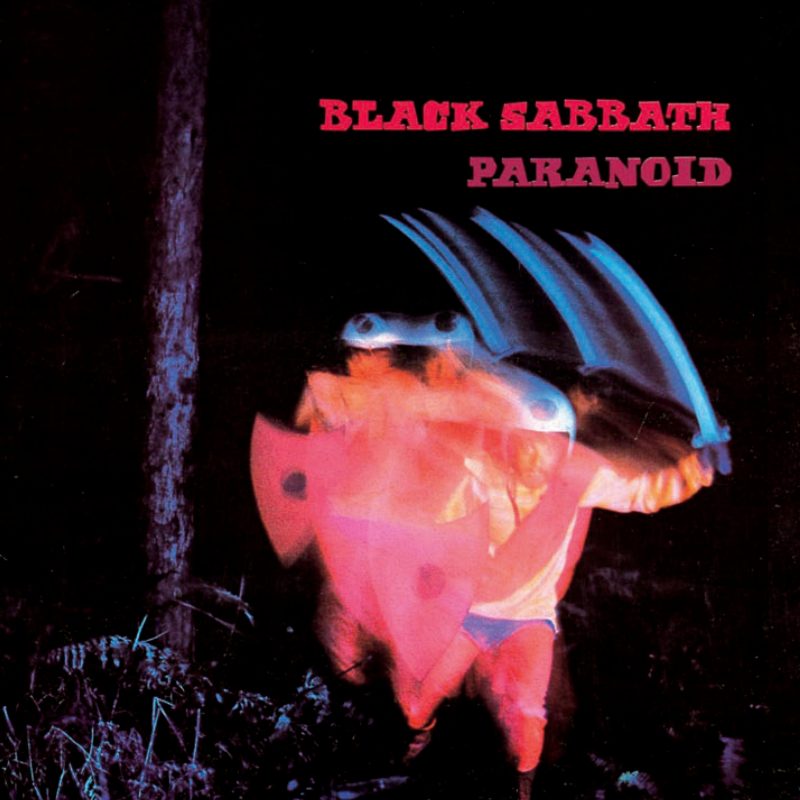
Black Sabbath's second album, recorded in a few days in June 1970. It didn't invent heavy metal, but it took a heavy band from Aston to #1 in Britain with songs about the news.
- Released
- 18 September 1970 (UK, Vertigo); 7 January 1971 (US, Warner Bros.)
- Label
- Vertigo (UK, 6360 011); Warner Bros. (US, WS 1887); Philips (Japan, SFX-7266)
- Producer(s)
- Rodger Bain, for Tony Hall Enterprises
- Runtime
- 42:09 (the track timings listed for the 1970 UK repress; 8 tracks)
- Chart peak (US)
- #12 (Billboard 200, chart dated 20 March 1971)
- Chart peak (UK)
- #1 (Official Albums Chart, 4–10 October 1970), 1 week at the top
- Certifications
- RIAA 4× Platinum (31 January 1995)
- Awards & honours
- #139 on Rolling Stone's 500 Greatest Albums of All Time (2020), after #130 (2003) and #131 (2012); #1 on Rolling Stone's 100 Greatest Metal Albums of All Time (2017)
Paranoid gets the credit for inventing heavy metal, yet the week it reached #1, Led Zeppelin and Deep Purple were in the same Top 10. What Black Sabbath did was cut a stage act into songs people bought, on one great side and one uneven one.
On the British albums chart for the week of 4 to 10 October 1970, Paranoid went to #1. It knocked Bridge Over Troubled Water down to #3. That same week, the title track peaked at #4 on the singles chart. Further down the albums Top 10 sat Led Zeppelin II, at #5, and Deep Purple in Rock, at #6. So loud, heavy guitar records weren't new that autumn. They were already selling. What was new was four young men from Aston at the top, with a record about war and addiction.
That chart is the best argument against the usual story. AllMusic says Paranoid defined heavy metal's sound more than any other record, and Rolling Stone named it the greatest metal album ever in 2017. But Black Sabbath had released their first album 7 months earlier, and they weren't the only heavy band selling. Paranoid's achievement is narrower, and more interesting. It took a band's stage set and cut it into songs that a mass audience bought. And it pointed those songs at the news. It's a very good record, made fast, with a great first side and an uneven second one. The reputation is earned by side one, and side two borrows it.
It was made in a hurry because the first album sold. Olav Wyper of Vertigo explained the logic to Rolling Stone in 2020. The debut had done well in Britain and Germany, so the label wanted the next one quickly. The band didn't have to start from nothing. 'Fairies Wear Boots' had been written by the time of the first album's sessions, and a session log sheet shows it. 'War Pigs' was recorded for BBC Radio 1 in April 1970. Much of the rest grew out of long jams on stage, including a 6-week residency at a Zurich club at the end of 1969. Before recording, they rehearsed at Rockfield, in South Wales. Rodger Bain, the producer, said he heard them there cranked up as if they were on stage.
The recording took a few days in mid-June. Accounts disagree on how many. Iommi remembers a couple of days, Butler 2 or 3, and NPR has said 6. The 2009 deluxe edition dates its outtakes to 16 and 17 June 1970. The basic tracks were cut at Regent Sound, a cramped 4-track room in London's West End. Tom Allom, one of two engineers credited on the album, called it a dump that worked. He recorded Ward's drums in stereo, which he says few engineers did then. The bass went down through a split lead, one side direct and one off the cabinet. The tapes then went to Island's studio in Basing Street, where they were moved to 16-track. There, Bain says, Iommi's lead parts were doubled or tripled, each caught by a close microphone and a distant one.
The song that named the album was an afterthought. Bain asked for one more track, and Iommi told him he'd never written a three-minute song. While the others went out to eat, he stayed behind and found the riff on his own. Ward told Mix that they started on it around half past one and had it finished by two. Butler has put the music at 5 minutes. He and Osbourne worried that the riff was too close to Led Zeppelin's 'Communication Breakdown'. They kept it, and they were right to. The finished song runs under 3 minutes. Its one long break from the vocal is the solo at 1:20, fed through a modulator in the mix. The song is the least typical thing on the record, and Pitchfork credits it with propelling the album. Iommi later said the single brought in "screaming kids", and the band avoided singles for a while afterwards.
The rest of side one shows what the speed didn't damage. 'War Pigs' runs nearly 8 minutes, and Osbourne doesn't sing until 1:02. After his last line at 5:21, there are still about 2½ minutes of instrumental playing. The American label even gives that section its own name, 'Luke's Wall'. A band in a hurry still handed more than 3½ minutes of its opening track to the instruments, and that confidence is the point. Then comes 'Planet Caravan', which goes the other way. It's quiet, and Osbourne sings through a Leslie speaker. Butler has said they wrote it in the studio, as a love song set in space. Placed third, straight after the title track, it shows a range the band's reputation rarely allows them. Pitchfork hears in it an early sign of metal's psychedelic side.
'Iron Man' is where Iommi makes the case for himself. He lost the tips of two fingers at 17, on his last day at a sheet-metal factory. He's left-handed, so the injured right hand is the one that frets. He made caps for the damaged fingers from a melted washing-up liquid bottle, covered them in leather, and used light banjo strings. A processed voice comes in at 0:10, and the first verse doesn't start until 0:41. That's half a minute without a vocal, on a song later released as an American single. It reached #52 there in March 1972. Leaving that space was a bet on the riff, and the song's long life says the bet was right.
Butler wrote most of the words, and his subjects are why the record still sounds current. 'Electric Funeral' is about nuclear war. 'Hand of Doom' is about heroin, which Butler has tied to soldiers coming home from Vietnam. On 'War Pigs' the band's accounts split. Butler has said he was against the Vietnam War and dreaded being called up. Osbourne said they knew nothing about Vietnam and simply wrote an anti-war song. Its working title was 'Walpurgis', and Butler says the record company found that too Satanic. Grayson Haver Currin, reviewing the album for Pitchfork in 2018, heard it as a working-class record against war. That's the right reading. The horror-film menace was the costume. The subject was the news, and that, more than any riff, is what Paranoid added to heavy rock.
Side two is where the haste shows. 'Electric Funeral' is strong, and 'Hand of Doom' is the best case for the album's long reach. Pitchfork's review hears doom metal starting there, and the instrumental stretch from 4:07 to 5:20 is the passage to hear. Then comes 'Rat Salad', 2½ minutes built around Ward's drums. Butler has explained where features like it came from: filling 45-minute club sets. On a 42-minute record, it's padding. 'Fairies Wear Boots' closes the album on a strong riff and an Osbourne lyric that Butler has tied to a run-in with skinheads. Osbourne has remembered it differently. Either way, even Currin's 9.5 review singles that lyric out as the weak spot. The album sags just where it should land.
The production is the least of the record. Bain told Mix the guitar sound drew its power from being kept raw, without compressors and EQ piled on top. On side one that directness is a virtue. Over a whole album, it leaves the variety to the songs, and side two doesn't always supply it. Everything around the music was improvised, too. The album was meant to be called War Pigs. The photographer Keef shot tests for that title at night in Black Park, with his assistant Roger Brown in a helmet, holding a sword and shield. Keef says the label was "in a blind panic to get something out", and it put one of those tests on the sleeve. Then the title changed as well, and Keef has said there was no way to reshoot. Who asked for the new title is disputed. Pitchfork says Vertigo demanded it, and Rolling Stone says Warner Bros. did. The British sleeve carried it nearly 4 months before Warner's release. Butler has said he hates the cover.
The first British review was kind. Disc gave the album 4 stars 6 days before release and rated it above Black Widow's Sacrifice. America was harder. Rolling Stone ran a parody review by Nick Tosches that mixed the band up with Black Widow. Robert Christgau later gave it a C minus and heard its horror as camp. Buyers took no notice. The album reached #12 in America in March 1971, and the RIAA certified it 4× Platinum in 1995. The critics caught up slowly. Rolling Stone ranked it #130 among the greatest albums of all time in 2003, and #139 in 2020. Henry Rollins told NPR in 2020 that there was "not a lot of music" on it. He meant it as praise, and he was right.
Its influence is easier to document than its invention. Pitchfork hears the title track as the link between Led Zeppelin and thrash. When Metallica inducted Black Sabbath into the Rock and Roll Hall of Fame in 2006, Lars Ulrich and James Hetfield said there'd be no Metallica without them. That was about the band, not this album. But the music they chose to play was 'Iron Man', in a medley with 'Hole in the Sky'. Megadeth, Pantera and the Cardigans all covered songs from this album in the 1990s. Sabbath went back to it themselves. Iommi said they wanted the reunion album 13 to recapture the essence of Paranoid, and in 2013 it gave them their second UK #1.
So what is it worth now? Side one is as strong as any side of heavy rock from 1970, with four songs and four different ideas. Side two has one great song, one good one, a drum feature and a closer let down by its words. The influence is the strongest thing about Paranoid, and it's real. So is what it changed: heavy music aimed at the news, and in 'Hand of Doom', on Pitchfork's reading, an early route to doom metal. But influence and quality are different measures, and the reputation leans on the first. Admire it, play side one loud, and credit it with what it changed rather than with everything. It put a band from Aston at #1 for a week, and it got there by an accident in a lunch break.
Pressing guide — the one to own
The first UK issue: Vertigo 6360 011 in a matte gatefold that credits 'Management / Jim Simpson, Big Bear, Birmingham'. That credit was dropped from the second issue, and it's the only difference between them. Side one has the large Vertigo swirl label. On the side-two label, 'Vertigo' sits below the spindle hole. The run-outs are stamped, in the form 6360011 1Y//1 420. Phonodisc Ltd. cut the lacquers and pressed the records.