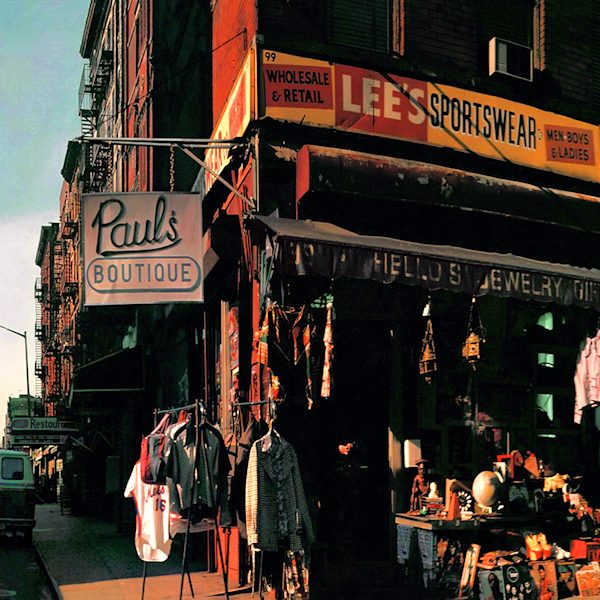
The Beastie Boys' second album, built in Los Angeles from other people's records. It's a producers' record first, with three rappers who had the sense to leave the music alone.
- Released
- 25 July 1989 (US, Capitol)
- Label
- Capitol Records, with the Beastie Boys Records logo (US LP C1-91743)
- Producer(s)
- Beastie Boys and the Dust Brothers (Matt Dike, John King, Mike Simpson); 'Ask for Janice' by Mario Caldato Jr.
- Runtime
- 53:03 (15 tracks)
- Chart peak (US)
- #14 (Billboard 200, chart dated 2 September 1989), 18 weeks on the chart
- Chart peak (UK)
- #44 (Official Albums Chart, chart dated 5 August 1989), 2 weeks on the chart
- Certifications
- RIAA 2× Platinum (27 January 1999)
- Awards & honours
- #125 on Rolling Stone's 500 Greatest Albums of All Time (2020). Pitchfork gave the 2009 reissue 10.0
Paul's Boutique wasn't an outlaw record: most of its samples were cleared and paid for. Its greatness lies in how three producers built it on one sampler and a mixing desk. Its flaw is that the rapping rarely matches the music.
In an interview published by Tape Op in 2002, the engineer Mario Caldato Jr. put a price on Paul's Boutique. About $250,000 went on studio costs, he said, and about $250,000 more on sample rights and licensing. That second number undoes the usual story about the record. In that story the Beastie Boys made an outlaw album in a lawless moment, stacked with samples nobody paid for. It could never be made again, and maybe never sold again either. But Sound on Sound reported in 2005 that most of the samples were cleared, easily and affordably. Mike Simpson, one of its producers, told the magazine that clearing them like that now would be "unthinkable". So the legend is half right. A record like this probably couldn't be made today, but this one was paid for, and it was reissued in 1998, 2009 and 2019.
Take the legend away and what's left is better. Paul's Boutique is a producers' record. Three men at a Los Angeles label built much of its music before the band arrived. They finished it on a 12-bit sampler and a mixing desk that switched sounds in and out. The Beastie Boys' best decision was to leave that music alone and rap on top of it. The result sounds like nothing else they made. It's also the record where the gap between their music and their words is widest. That gap is its one real flaw, and it's why a great album falls short of the perfect one its reputation describes.
It was made in the shadow of a hit. Licensed to Ill was the first rap album to top the Billboard 200. It reached #1 on 7 March 1987 and stayed there for 7 weeks. Rolling Stone's reviewer noted in 1989 that the debut was often credited to Rick Rubin alone, and that the band risked being written off. Mike D, quoted by the same magazine in 2013, said people expected a sequel to a party record, and expected it to fail. By then the band had left Rubin and Def Jam in a dispute over royalties and moved to Los Angeles. The new album would come out on Capitol.
The music was waiting for them there. At Delicious Vinyl, the label Matt Dike ran, Dike, John King and Mike Simpson worked as the Dust Brothers. They'd produced Tone Lōc's Loc'ed After Dark and Young MC's Stone Cold Rhymin', both released in 1989. They'd also built tracks that Simpson thought too busy for any rapper, and set them aside. Adam Yauch told Clash in 2009 that those tracks were meant as club instrumentals. The producers were surprised the band wanted to rap on them, and offered to strip them down. The band wanted them as they were. By Yauch's count, about half the album existed before the three of them walked in. Caldato remembers 'Car Thief' and an instrumental 'Shake Your Rump' as the tapes sent over first.
Where it was made matters, because the old story got that wrong too. It wasn't recorded at G-Son Studios. G-Son was built later, for Check Your Head, and Caldato told Tape Op the name means "son of Mario G's". Mario G's was the band's name for Dike's living room at Delicious Vinyl, where Caldato kept his gear. Some of the album was done there. Then they booked the Record Plant in Hollywood, where they worked only in the control room, and the sleeve credits the mix there. Caldato puts the whole job at about 9 months. Rolling Stone said in 1989 that the album had been a year in the works.
The machines explain the sound. Simpson told Sound on Sound that all of Paul's Boutique was done on an E-mu Emax HD, a mono, 12-bit sampler. The loops ran in Roger Powell's Texture sequencer, locked to tape, and filled the multitrack from top to bottom. The songs were then arranged on an Allen & Heath desk whose automation switched channels on and off. In other words, the arranging was subtraction. Each song holds more than you hear at any moment, and the mix decides what drops out. That's why the record feels crowded but never stuck. A part arrives, does its work for a few bars and goes.
'Shake Your Rump' shows the method at full stretch. It opens on a drum roll taken from Alphonse Mouzon's 'Funky Snakefoot', and the first verse starts a second later. A fan-made sample list, which Simpson thought complete, names Harvey Scales, Paul Humphrey, Funky 4 + 1, Rose Royce and Led Zeppelin among its sources. At 0:38 the rapping stops for 19 seconds and the collage plays on alone. 'Egg Man' does the same thing for comedy. It runs Curtis Mayfield's 'Superfly' bass under a story about throwing eggs, which Caldato says really happened. The strings from Jaws cut in, then the shrieks from Psycho, and a Psycho snippet snaps the track off. The punchlines are in the samples. Caldato's rough mix, made at Ocean Way, was used instead of the final one.
The best moments come when the band gets room. 'The Sounds of Science' rides the Beatles' 'When I'm Sixty-Four' through its first half, then speeds up. It borrows 'The End', 'Back in the U.S.S.R.' and the Sgt. Pepper reprise along the way. '3-Minute Rule' is the plainest track here. Pitchfork counted only two acknowledged samples, plus a bassline MCA played himself, and heard dub in the space around them. Each Beastie takes a verse. Billboard's 2014 review picked it as one of the few tracks that might work without the Dust Brothers. 'Looking Down the Barrel of a Gun' goes further, with live bass and guitar recorded at Ocean Way, the one song they cut there. Three years later, Check Your Head made playing their own instruments the band's method.
'B-Boy Bouillabaisse' is where the collage becomes the form. It runs 12:33 in nine parts, and three of them last less than a minute. One part, 'Hello Brooklyn', was recorded somewhere else entirely, at a place the sleeve calls the Opium Den. Rolling Stone compared the suite to the Abbey Road medley in 1989. In 2020 the magazine called the whole album an extended goof on Abbey Road. The suite earns that comparison by working only in order. Heard on shuffle, its parts are sketches. Heard straight through, it's 12 minutes of a band turning the radio dial, and the album's best argument for its own method.
The words are the problem. The production is full of ideas, while the rapping is mostly full of attitude. Billboard's 2014 review called the album more a musical triumph than a lyrical one, and that's right. Rolling Stone's review had noticed in 1989 that the debut's misogyny and violence were still here, with little remorse. Its reviewer named 'High Plains Drifter' and 'Car Thief' as posturing, and both are mostly pose. The 23-second '5-Piece Chicken Dinner' and the 11-second 'Ask for Janice' are jokes that work once. Robert Christgau gave the album an A in his Consumer Guide. In a 1989 Playboy column, though, he said it didn't grab you the way great rap does. 'Johnny Ryall' shows what the rest could have been. It's a portrait of a homeless rockabilly man who hung around Mike D's block, and the one song where the words are as specific as the samples.
None of this made it a flop. Released on 25 July 1989, it peaked at #14 on the Billboard 200, on the chart dated 2 September. It spent 18 weeks on that chart. 'Hey Ladies' reached #36 on the Hot 100 the same week. In Britain it lasted 2 weeks on the chart, peaking at #44. Next to a #1 album, that looked like failure, and Caldato says the record didn't do well. He also remembers Capitol's president being fired before release, no promotion, and a band that chose not to tour. But the trade paper the Gavin Report covered the resignation of Capitol's chief, David Berman, in its issue of 29 September 1989, two months after release. The RIAA certified the album 2× Platinum on 27 January 1999.
The reputation came later, and it has outrun the evidence. Pitchfork gave the 2009 reissue a perfect 10.0. Rolling Stone ranked it #125 among the 500 greatest albums in 2020. The claims for its influence are bigger than the record of it. Pitchfork's 2009 review placed it beside later sample artists such as the Avalanches and J Dilla, without saying they learned from it. The Avalanches, asked about their own models, have named others. What's documented is narrower. The Dust Brothers went on to produce Beck's Odelay, though Simpson says that record was built more on sound than on samples. Jay-Z and Lil Wayne reworked 'Hello Brooklyn' as 'Hello Brooklyn 2.0' in 2007. And the band itself turned to live instruments.
So what is it worth now? More than the legend, and a little less than the rankings. As production it's still astonishing. The music changes its mind every few bars, and it's nearly always right. As a set of songs it's uneven: a few great verses, two throwaway sketches and too much bragging. Hear it for the Dust Brothers, and for 'Shake Your Rump', 'The Sounds of Science', 'Johnny Ryall' and the closing suite. Don't hear it as a crime scene. Most of it was cleared and paid for, and it's been reissued several times. What makes it special is the music, and what keeps it from perfect is everything said over the top.
Pressing guide — the one to own
The original is the 1989 US single LP, Capitol C1-91743, with the Beastie Boys Records logo on the labels. It came in two jackets. One is an 8-panel fold-out that opens to the full street panorama, with C1-92844 on the spine. The other is a 2-panel gatefold with a picture inner sleeve. Both carry the same runouts: cut by Direct Metal Mastering at Masterdisk and pressed by Specialty Records, the 'SP' in the runout. Rolling Stone's 1989 review said the first pressing came in the eight-fold wraparound. The catalogue entry for that jacket calls it a limited special edition, with a sticker to match. Collectors list about twice as many 8-panel copies as 2-panel ones.