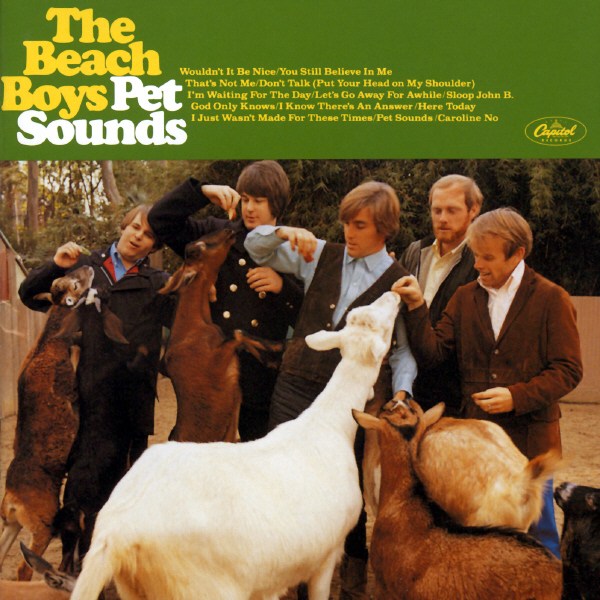
The Beach Boys' 1966 album is remembered as one man's solitary vision. The session logs show a crowded room, and the record is greater for how Brian Wilson ran it.
- Released
- 16 May 1966 (US, Capitol); 27 June 1966 (UK)
- Label
- Capitol (T 2458 mono; DT 2458 Duophonic)
- Producer(s)
- Brian Wilson
- Runtime
- 35:57
- Chart peak (US)
- #10 (Billboard Top LPs, chart dated 2 July 1966)
- Chart peak (UK)
- #2 (Official Albums Chart), 3 weeks behind The Sound of Music; 39 weeks on the chart in its first run
- Certifications
- RIAA 2× Platinum (15 May 2026); BPI 2× Platinum (11 September 2020)
- Awards & honours
- Grammy Hall of Fame (1998); Library of Congress National Recording Registry (2004); #2 on Rolling Stone's 500 Greatest Albums (2020)
Pet Sounds deserves its place near the top of the all-time lists, but for its arranging more than its unity. Brian Wilson's real feat was directing a roomful of other people, and the record keeps the seams the legend leaves out.
The last sounds on Pet Sounds aren't music. When 'Caroline, No' finishes, two dogs bark and a train goes by. The dogs were Brian Wilson's own, Banana and Louie, and he recorded them himself. The train came off a sound-effects tape. The song before them had been changed, too. Brian's father, Murry, told him to speed the tape up by a whole note. So the voice on the record is higher and faster than the one he sang. Brian told all this to David Leaf in 1996. It's a better guide to the album than the legend.
The legend is of a genius alone in a room, building symphonies while his band was away. Some of it is true. The Beach Boys were touring Japan in January 1966 while Brian worked. But Pet Sounds was made in a crowded room. Los Angeles session players cut nearly every backing track. A copywriter from an advertising agency wrote most of the words. All six Beach Boys sang. What makes it one of the great pop albums is how a 23-year-old directed all of them. That's also where its flaw lies. The songs were cut over nine months, for different reasons, and they don't all belong together.
The story starts in December 1964, when Brian had a breakdown on a flight to Houston. The next month he stopped touring. Glen Campbell, and then Bruce Johnston, took his place on the road. The Beach Boys Today!, released in 1965, had already pointed the way, with orchestral arrangements and a second side linked by theme. Then, in December 1965, the Beatles' Rubber Soul came out in America. Brian told Leaf it challenged him to make a great album of his own. He wasn't trying to beat it, he said. He also said Pet Sounds was more him than the surf records had been.
The method came from Phil Spector. Spector had called Brian down to Gold Star a couple of times to watch him work. Two of the album's backing tracks were cut there, with Spector's engineer, Larry Levine. Brian didn't take the sound, though. In his notes for the 1997 box set, Leaf contrasts the two men: Spector overwhelms the listener, and Brian seduces. Leaf is right: Spector built a wall, and you can hear inside Brian's arrangements. The words came from outside the band. Tony Asher was 26, a copywriter at the agency Carson-Roberts who wrote jingles. He'd met Brian once before Brian rang him at work. Asher wrote lyrics for 8 of the 13 songs, working at Brian's house from musical sketches Brian had built up.
Most of the building happened at Western Recorders, in Studio 3, a narrow room about 15 feet by 32. Brian ran the dates from the booth, beside the engineer Chuck Britz. A date usually lasted at least three hours, and there were no rehearsals beforehand. Brian hummed each part to the players and worked it out with them one instrument at a time, while Ray Pohlman copied out chord charts. Some songs went on the logs as 'Untitled'. The players were Hal Blaine, Carol Kaye, Glen Campbell, Larry Knechtel and others later called the Wrecking Crew. The band played only one backing track themselves, 'That's Not Me', and their main job was the voices. They were back in the studio from 9 February 1966, and vocals ran into April. Mike Love remembered more than 30 takes of one background part for 'Wouldn't It Be Nice'.
The arrangements are where the album earns its standing. Start with 'You Still Believe in Me'. It opens with a piano's strings plucked from inside the instrument, with Brian and Asher working together. Accounts differ on who did what. The session archivists have Brian plucking and Asher on the pedals. Asher remembered leaning into the piano himself, trying paper clips, hairpins and bobby pins while Brian held the keys. Hal Blaine adds a bicycle bell and horn. The song began as 'In My Childhood', and that version already had the bell. On the title track, Ritchie Frost strikes two empty Coca-Cola cans. 'Let's Go Away for Awhile' sets 12 violins and four saxophones beside an oboe, a vibraphone and a guitar played with a Coke bottle for a slide. None of this is novelty. Each odd sound sits inside an ordinary one and changes its colour. Brian often doubled a part in unison on different instruments, so you hear a tone nobody is quite playing. That's the record's real invention.
'Wouldn't It Be Nice' opens the album with Barney Kessel's 12-string figure, and two accordions push the verse along underneath. Brian sings lead, and Mike Love takes the bridge. Then there's 'God Only Knows'. Brian gave the lead to his brother Carl. He said Carl could put the message across better than he could. Alan Robinson plays French horn. Don Randi plays a piano with tape on its strings, and Jim Gordon taps paper orange-juice cups. Asher and Brian spent time arguing over whether to put the word God in a song. In Charles Granata's account, the closing round is just two singers: Brian, on two parts, and Bruce Johnston. Carl had gone home. Paul McCartney told Leaf in 1990 that it was a big favourite of his. He'd recently put it at the top of a list of favourite songs for a Japanese radio station.
The writing is nearly as strong as the sound, if less even. On 'Don't Talk (Put Your Head on My Shoulder)', Brian sings over a string sextet with no backing harmonies at all. Philip Lambert counts it among his most harmonically complex songs. 'I Just Wasn't Made for These Times' brings in Paul Tanner on the Electro-Theremin, the instrument he invented. Lambert calls it the Electro-Theremin's first use in pop. Tanner played it again three days later, at the first session for 'Good Vibrations', the single that followed the album in October. 'I Know There's an Answer' began as 'Hang On to Your Ego', a song about acid. Mike Love says he talked Brian into new words and a new title. The new words are tamer, but Tommy Morgan's bass harmonica keeps the strangeness. And 'Caroline, No', which Brian called probably his favourite track here, is the album's plainest song about loss.
Now the weakness the legend skips. Pet Sounds isn't the seamless suite its reputation describes. 'Sloop John B' is the clearest outsider. It was Al Jardine's idea, a folk song he knew from the Kingston Trio's 1958 record. Its backing track was cut on 12 July 1965, six months before the main sessions began. It came out as a single in March 1966 and reached #3 in America. By Granata's account, it went on the album because Capitol insisted. It closes side one, straight after 'Let's Go Away for Awhile', and its cheer breaks the mood the first six songs build. 'Here Today' is the other soft spot. Brian told Leaf it was a mystery song he didn't identify with, though he thought it fit the album. He called it an experiment in bass lines, and it sounds like one.
The mono master keeps its seams, too. In the break of 'Here Today' you can hear Bruce Johnston talking about a camera, then Brian calling 'Top, please'. Granata also points to an audible tape splice in 'Wouldn't It Be Nice', just before Love's bridge. None of this sinks the album. It does undo the idea of a flawless object. So does a phrase often hung on it. 'A teenage symphony to God' was Brian's description of Smile, the album he started next, not of Pet Sounds.
In 1966 the verdict split by country. In America it reached #10 on Billboard's Top LPs chart of 2 July. In Britain it reached #2, held off for 3 weeks by The Sound of Music, and spent 39 weeks on the chart. Melody Maker named it joint pop album of the year with Revolver. Not every British critic was won over. Norman Jopling of Record Mirror noted it'd been widely praised, but his one complaint was that the arrangements were too complicated and cluttered. Capitol put out Best of the Beach Boys two months after release, and whether that amounted to burying Pet Sounds is still argued. Johnston and Carl complained about thin promotion. The writer Peter Doggett calls the sabotage story a myth, and says the album was promoted as heavily as the band's earlier records.
The best evidence of its influence is what the people it touched said about it. McCartney heard it in London in May 1966, at playbacks Bruce Johnston arranged. In 1990 he told Leaf it was the main inspiration for Sgt Pepper. He said he played it to John Lennon a lot, and he pointed to its bass lines. He was precise about one borrowing: only the introduction of 'Here, There and Everywhere'. George Martin said Sgt Pepper wouldn't have happened without it. In America, recognition took longer. The album was out of print from 1974 and turned up in bargain bins. The RIAA certified it gold only in February 2000, almost 34 years after release. On 15 May 2026, the day of its 60th-anniversary reissues, it went 2× Platinum.
Robert Christgau's verdict in 2004 was 'Good record, but a totem.' He was right about the totem. Pet Sounds is so often discussed as the record that led to Sgt Pepper that it's easy to forget it's 13 songs, some better than others. Brian Wilson died on 11 June 2025, aged 82. The album is best heard now without the legend, and it comes through that test easily.
Pet Sounds is one of the best pop albums ever made, and the case rests on the arranging. 'God Only Knows', 'Caroline, No', 'Don't Talk' and 'Wouldn't It Be Nice' are as good as pop songwriting gets. The sound, built by a roomful of players from one man's humming, still surprises 60 years on. It isn't flawless. 'Sloop John B' belongs to another session and another mood, and 'Here Today' is a study rather than a song. The mono master leaves its joins audible. None of that moves it far from the top. It was never the perfect suite people describe, and it doesn't need to be.
Pressing guide — the one to own
The copy to own is a 1966 US mono T 2458 on Capitol's black label with the rainbow colorband and the logo at the top. Los Angeles pressings have a ✲ in the runouts; Scranton pressings have 'IAM' in a triangle. Mono is the album as it was mixed in 1966. The DT 2458 'stereo' issue is Duophonic, processed from the mono. US copies came in a single sleeve; British copies in a laminated flipback.