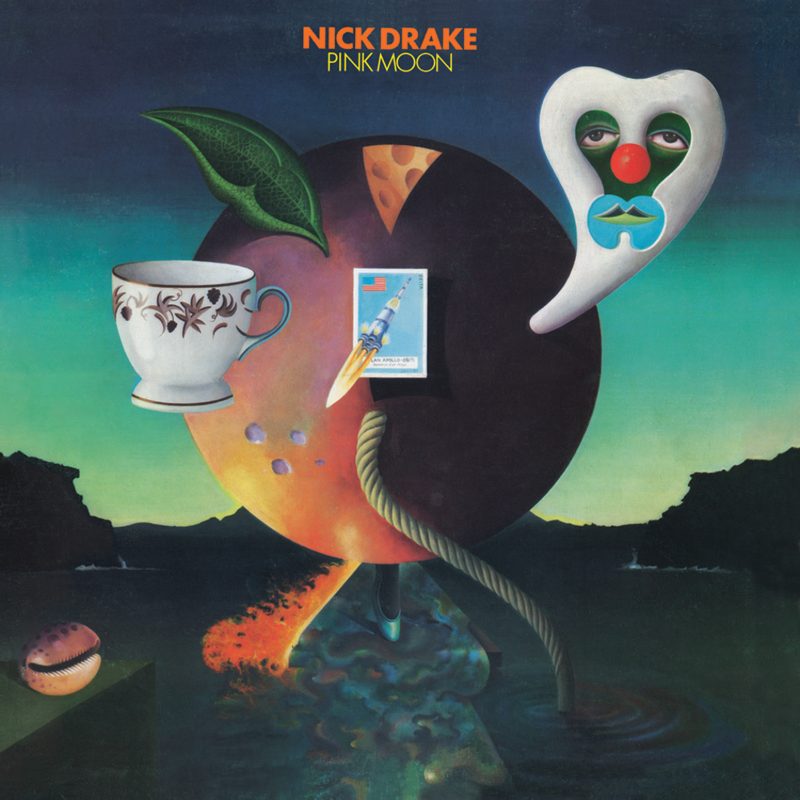
Nick Drake's third and last album: 11 songs in 28 minutes, made over two nights with only an engineer in the room. A deliberate record, kept bare against advice, and slighter than its legend.
- Released
- 25 February 1972 (UK, Island)
- Label
- Island Records (UK, ILPS 9184); in the US, Island SMAS-9318, made and distributed by Capitol
- Producer(s)
- No individual producer. The 1972 sleeve reads 'Produced by Witchseason Productions Ltd.' and credits 'John Wood, Sound Techniques' as engineer; later reissues credit Wood as producer
- Runtime
- 28:12 (11 tracks, timed from the current digital master; the 1972 UK LP prints no timings)
- Chart peak (UK)
- Never on the Official Albums Chart. #26 on the Official Record Store Chart (2013) and #27 on the Official Vinyl Albums Chart (2016)
- Certifications
- BPI Gold (22 July 2013), its only certification
- Awards & honours
- #203 in Rolling Stone's 500 Greatest Albums of All Time (2020); #13 in Pitchfork's Top 100 Albums of the 1970s (2004)
Pink Moon is usually heard as the sound of a man disappearing. The evidence says it was a plan, kept against advice. That plan explains why the album holds together so well, and why three of its songs are barely there.
Two songs in, John Wood thought he knew where the record was going. He'd engineered Nick Drake's first two albums, and he expected to fill this one out a little. He thought Drake might bring in another musician, maybe the bassist Danny Thompson. Then Drake stopped him. 'No, that's it,' Wood remembers him saying. 'That's all we're doing.' Wood told that story to the Guardian in 2022, 50 years after Pink Moon came out. It's the most useful thing anyone has said about the record.
The legend hears Pink Moon as a symptom. A depressed young man, too withdrawn to speak, records 11 songs alone and leaves the tapes at a front desk. Wood's story points the other way. This was a plan, and Drake held to it against the only professional in the room. That plan is why the album hangs together better than anything else he made. It's also why three of its 11 tracks are barely there. Pink Moon is a great record with a real flaw, and both come from the same decision.
Drake had announced the plan seven months earlier. In March 1971 he gave Jerry Gilbert of Sounds the only interview of his career. He said he'd like to make the next album with John Wood alone. He'd told Joe Boyd, who produced the first two records, much the same thing. Bryter Layter, the second, had brass, saxophone and a band, and like Five Leaves Left it had sold poorly. By the time Drake went back to the studio, Boyd had sold his company, Witchseason, to Island and moved to California. According to Richard Morton Jack's 2023 biography, Island didn't even know a new album was being made.
His health is where the accounts split. In 1971 his family persuaded him to get help, and he was prescribed the antidepressant Tryptizol. Chris Blackwell, who ran Island, offered him his villa in Spain. Writing in the Guardian about Morton Jack's book, Tim Jonze placed Pink Moon at the point where Drake was losing touch with reality but could still write. Cally Callomon, who manages the estate, has said the opposite. In his account Drake couldn't write when he was depressed, wasn't depressed while making this record, and was proud of it. That argument can't be settled now. But the Sounds interview and the refusal in the studio are on record, and both describe a man making choices.
The sessions were small even by the standards of his earlier records. Sound Techniques was a former dairy on Old Church Street in Chelsea, run by Wood and Geoff Frost, who built their own desk. Wood could only have Drake there late at night, so the album was made in two back-to-back sessions starting at 11pm. He was 23. Wood says Drake 'played his guitar like a metronome'. He'd never recorded anyone that young, with so little studio experience, who played so steadily. Between takes, Wood recalled, Drake showed neither pleasure nor displeasure. There is one overdub on the whole album: Drake's own piano on the title track.
You can hear the method in the first 2 minutes. 'Pink Moon' repeats its title 10 times, and the voice drops out for any length only once, from 1:01 to 1:26. Ian MacDonald, writing in Mojo in 2000, noticed that its tune pulls Drake below his comfortable range. Kat Lister, in the Guardian, heard hope in the same melody. Both are right. The song is bright in shape and low in register, and the gap between those two things is the album's whole manner. Nothing is explained, and nothing is decorated. The listener has to do the work.
The best songs give the guitar room. 'Road' lasts 2 minutes, and Drake doesn't sing for the first 38 seconds. After a few lines he stops again for another 36. Lister heard propulsion in it, and that's the right word: it's a guitar part with a voice passing through. 'Things Behind the Sun', the longest track at 3:57, leaves the guitar alone for more than half a minute in its middle. Gilbert was disappointed by the album in his Sounds review in March 1972, but he singled out that song and 'Parasite'. Wood says 'Parasite' was where he knew the record was different. It's the darkest writing here, and its last 20 seconds or so are unsung. 'Place to Be' holds back its title until 1:24, then hands the guitar the longest passage in the song. 'From the Morning' closes the album the same way, with about 25 seconds of guitar after the last verse. Again and again, Drake steps back and lets the guitar speak.
The same discipline is where the record thins out. By the clock, 'Road' has no more singing than 'Know' or 'Harvest Breed', about half a minute each. What differs is the song around the singing. 'Horn' is 83 seconds of guitar with no song attached. 'Harvest Breed' sings for about 30 of its 95 seconds, and 'Know' doesn't start singing until 1:12. Lister called those two fragile haikus. Heard next to 'Road', they're closer to sketches, and with 'Horn' they take up more than 5 of the album's 28 minutes. Critics heard the thinness at the time. Gilbert wanted more than Drake's own accompaniment. Duncan Fallowell, in Records and Recording, found the songs 'infinitely similar'. Wood wanted to add a player. On these three tracks it's hard not to wish Drake had let him.
Nor was the method new, and the album doesn't pretend otherwise. A voice and a guitar is where most songs start. What's unusual is the discipline: the refusal to add anything, held for 11 songs. That takes nerve and a hard editor's eye, and it's a real achievement. It isn't an invention. Wood himself, explaining why he rarely talks about it, called it an album that only lasts 20 minutes or so. He was understating it, but the small scale is the point.
Several of the people closest to Drake didn't hear a plan. They heard illness. Boyd first heard the album when Island sent a copy to him in Los Angeles. He said the cover horrified him, the record horrified him more, and he listened to it once. Richard Thompson heard it when Wood played it to him at Sound Techniques, and said it seemed 'a stark cry for help'. Beverley Martyn thought the songs were the product of a sick person. Not everyone agreed. Robert Kirby, who'd arranged most of the strings on Five Leaves Left, called it 'his greatest work, by far'. Drake's father, Rodney, wrote that the songs had always bewildered the family a little, except 'From the Morning'. Even Wood, who'd made it with him, didn't play it for nearly 20 years after Drake's death. He said he felt it was 'intensely personal'.
Island released it on 25 February 1972 and ran full-page advertisements in the music papers that month. Drake did nothing to promote it. Even the delivery of the tapes is disputed. In Mick Brown's account in the Telegraph in 1997, he arrived unannounced and left them at reception. David Sandison, Island's press officer, remembered Drake spending half an hour in his office and leaving them behind. Trevor Dann's 2006 biography and Morton Jack's both say he handed them to Blackwell. Brown also wrote that the album got good reviews but made people uncomfortable, and sold next to nothing. Drake recorded four more songs with Wood in February 1974. On 25 November 1974 he died of an overdose of amitriptyline, aged 26. The coroner recorded suicide. Boyd and other friends believe it was an accident.
The revival took a quarter of a century. The Fruit Tree box set collected the albums in 1979, and in the 1980s Kate Bush and the Dream Academy cited Drake. Then in November 1999 Volkswagen used the title track in a television advertisement for the Cabrio. In 2023 Callomon told the Guardian that the estate says no to most things, but 'there is always a tactic'. The paper's Tim Jonze counted the Volkswagen advertisement among the estate's careful moves. Pink Moon's US sales rose from 6,000 copies before the advertisement to 74,000 in 2000, according to its distributor. By 2006 Drake had sold 907,000 albums in the US since 1991, and only 12% of them before 2000. The advertisement sold the album on its opening song, the brightest-sounding 2 minutes on it. People who bought it for that got 26 more minutes that are far harder to sell.
The critical standing has kept climbing. Pitchfork gave Pink Moon 10.0 in 2014, and Rolling Stone placed it at #203 in its 2020 list of the 500 greatest albums. Musicians name it for practical reasons: in 2017 Cameron Boucher of Sorority Noise said he had drawn on Drake's finger-picking patterns for his own music, especially the one in 'From the Morning'. The British public is cooler. Pink Moon has never been on the Official Albums Chart, and it has been Gold since 2013. Five Leaves Left, the one with the strings, went Platinum in July 2026. Critics treat Pink Moon as the essential Drake album. Buyers, on that evidence, still prefer the debut.
The critics have the better argument, with one reservation. As writing, Pink Moon is as strong as anything Drake made. As a whole it's the most consistent of his three albums: 28 minutes in one voice, with one idea held from start to finish. 'Road', 'Things Behind the Sun', 'Parasite' and 'From the Morning' would stand up anywhere. But the record's single idea was a refusal, and a refusal is only as good as the song it protects. Where the songs were finished, refusing help made them stronger. Where they weren't, it left them as fragments, and three fragments in 11 tracks is a real cost. Hear it as a deliberate record by a 23-year-old who knew what he wanted. He was right most of the time, and the times he wasn't are on the record too.
Pressing guide — the one to own
The original to own is the February 1972 UK Island ILPS 9184, in a matt gatefold with the lyrics inside, on pink rim labels, pressed by The Gramophone Co. Runouts read 'ILPS 9184 A-1U' and 'B-1U', but they carried over to the later pink rim repress and the 1975 reissue, so they don't date a copy. The back cover does. A 1972 copy says 'Printed and made by Tinsley Robor Group Ltd.' and has the Basing Street address under the Island logo. A copy reading 'Printed in England by Robor Limited' was made after late 1973.