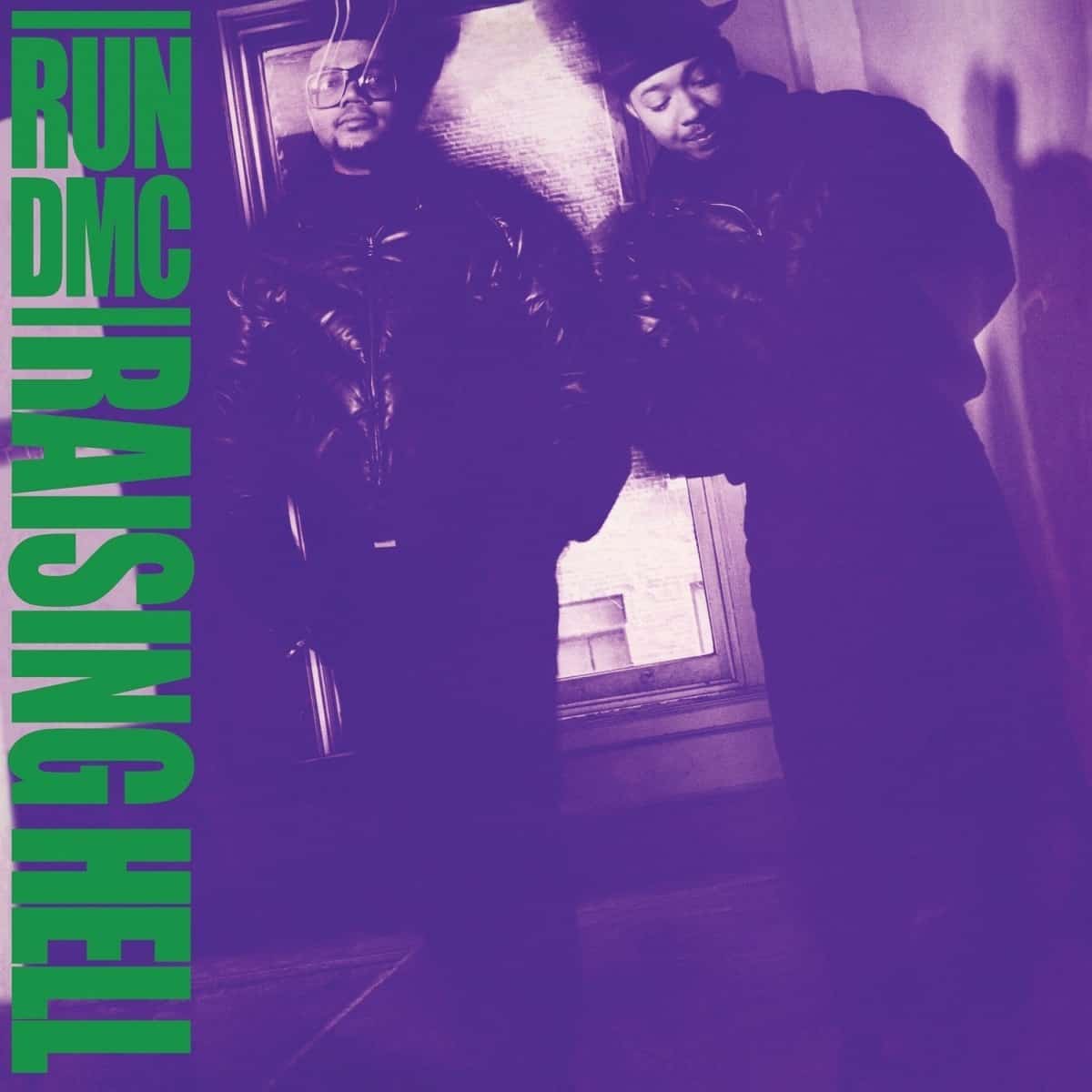
Run-DMC's third album, from May 1986, and the first rap record certified platinum. A rock cover made it famous; the bare tracks around it do the real work.
- Released
- May 1986 (US)
- Label
- Profile Records (US, PRO-1217); London Records (UK, LONLP 21)
- Producer(s)
- Russell Simmons and Rick Rubin; co-producers Jason Mizell (Jam Master Jay) and Joseph Simmons (Run)
- Runtime
- 39:43 (12 tracks)
- Chart peak (US)
- #3 (Billboard Top Pop Albums, charts dated 20 September to 4 October 1986); #1 on Top Black Albums for at least 7 weeks
- Chart peak (UK)
- #41 (Official Albums Chart), 26 weeks in two runs, 1986–87
- Certifications
- RIAA Platinum (July 1986) and 3× Platinum (April 1987)
- Awards & honours
- Grammy nomination, Best R&B Performance by a Duo or Group with Vocal (1987). #5 in the Village Voice Pazz & Jop critics' poll for 1986. National Recording Registry, class of 2017. Rolling Stone's 500 Greatest Albums: #123 (2012), #209 (2020)
Raising Hell is remembered as the album where rap met rock. It's better heard as a rap record: two voices over bare beats, six tracks that still hit hard, three of filler, and one famous cover that was never its point.
Richard Cromelin counted the guitars. Reviewing Raising Hell in the Los Angeles Times on 25 May 1986, as it reached the shops, he found three tracks with guitar on them. Those three stood out, he wrote, because everything around them was so spare. The rest ran on percussion: Jam Master Jay's scratching, metallic pings, sounds made with the mouth. Forty years on, the album is filed as the moment rap met rock. Cromelin's count is a better place to start.
Raising Hell is a rap record first. It's two voices trading lines over hard, bare beats, with a DJ working the gaps. The rock crossover that made its name is one song out of 12. It was recorded in a different studio, from an idea the two rappers didn't like. The album's best tracks are its plainest ones. Its weakest are three slight tracks, where the brags wear thin and one joke turns sour. It's a very good record with clear limits, and its influence is bigger than its music.
It was Run-DMC's third album for Profile, after Run-D.M.C. in 1984 and King of Rock in 1985. Both had gone gold by August 1986, the Washington Post reported. Both had already tried rock, on 'Rock Box' and on King of Rock's title track. What changed was the producer. Tom Breihan, reviewing the reissues for Pitchfork in 2005, notes that Rick Rubin had taken over from Larry Smith. The sleeve credits Rubin and Russell Simmons, Run's older brother and the head of Rush Productions, as producers. Jam Master Jay and Run are credited as co-producers. Profile expected a hit. At the end of May, Billboard reported advance orders of more than 500,000. The label's Cory Robbins called it the first rap record to ship gold.
'Walk This Way' was Rubin's idea. Geoff Edgers, who wrote a book about the song, says the group already used the beat from the start of Aerosmith's 1975 record. They didn't know it had words. Rubin handed them the record and a notepad, and sent them off to write the lyrics down. They didn't like what they found. Aerosmith, in Edgers's phrase, were "fallen rock gods" by then. The song was recorded with Steven Tyler and Joe Perry on 9 March 1986, at Magic Venture Studios in New York rather than Chung King. So the album's best-known track was cut in another room, with guests, from an idea its rappers resisted. That doesn't make it bad. It does make it an odd thing to treat as the album's essence.
The rest of the sleeve is short. Jay is credited with keyboards and percussion, and every other instrument goes to Run-DMC. Four engineers are listed, Andy Wallace among them, and Howie Weinberg mastered it at Masterdisk. Robert Christgau, in the Village Voice, heard it as all hard beats and declaiming voices. He called it their most uncompromising album, and noted that it had no 'Rock Box' or 'King of Rock'. Our reading is that even with 'Walk This Way' on it, he didn't hear a rock record. Run, quoted by the Library of Congress in 2018, said the album was made very easily. You can hear that ease, for good and ill. The best tracks sound thrown off in the right way. The worst sound thrown off in the wrong one.
Start with 'Peter Piper', the opener. It's built on Bob James's 1975 recording of 'Take Me to the Mardi Gras', and Breihan singled out its bells. At 1:03 the rhymes stop for nearly 20 seconds, and the track runs on without them. That willingness to let the track run on without its rappers is the album at its best. Then comes 'It's Tricky'. In 2006 the Knack's songwriters sued, claiming it sampled their 'My Sharona'. Its title phrase lands 7 seconds in. Breihan thought it was as good as Run and DMC ever got, and he's right. The pleasure is in the trade-offs between the two voices, which Cromelin found dazzling at their best.
'My Adidas' doesn't bother with an introduction. The title is the first thing you hear. It was the first single, and by the end of May Robbins was telling Billboard it had sold 200,000 copies. It's the album's simplest idea, carried out with total conviction. The title track is the album's real rock song, and it belongs to Rubin. The sleeve credits him with the guitar and Daniel Shulman with the bass. The Library of Congress's citation points to Rubin's power chords and riffs, and Breihan heard a dirty Southern-rock riff. Three times the vocals drop away for more than 20 seconds, at 0:48, 1:55 and 3:49. If you want the album's rock, it's here, in Rubin's own playing on side two, not in the cover.
'You Be Illin'' is the comedy, a run of what Cromelin called "off-center vignettes". He heard its piano and saxophone as an updated Coasters song, and Breihan called the piano cartoonish. Nobody raps for the first 22 seconds. It's the lightest thing here and one of the best, and it has the humour Cromelin wished the rest of the record had. Next to it, 'Walk This Way' is a stunt that came off. The rapping starts at 0:26 and the title doesn't arrive until 1:10. Cromelin picked it as the standout of the three guitar tracks, riding Joe Perry's riff. Edgers calls Jay a calming force, and says he and Rubin were in control. But it's a cover, and it never stops sounding like one.
The case against the album is about its middle and its manners. Breihan called 'Perfection', 'Hit It Run' and 'Dumb Girl' filler, and heard 'Perfection' as borrowed from Slick Rick. He's right about all three. 'Hit It Run' is a human-beatbox track that spends 3:10 on one idea. 'Dumb Girl' is worse. Co-written by Russell Simmons, it's where the misogyny Cromelin found grating in 1986 is hardest to miss. Christgau, who graded the record A minus, thought the group showed less respect for women than the Rolling Stones. Cromelin added that the same old brags were wearing thin. 'Perfection' closes side one and 'Hit It Run' opens side two. Anyone turning the record over meets two weak tracks in a row.
The album ends on its most serious song. 'Proud to Be Black' closes side two. Cromelin, a little drily, said it ends the record on a more important and uplifting note than the subject of 'Dumb Girl'. Christgau took the group's pride as pride in what their music let them do. The song was written by Andre Brown, Daniel Simmons and DMC. It complicates the easy picture of the album as shoes, brags and a rock hit, and it deserves to be better known. It also landed in a summer when the group's image was being fought over. After violence at a Long Beach show, the Washington Post noted, the group's anti-drug message was being cited in its defence. A closer like this one argued the group's case better than the newspapers did.
The album sold fast from the start. It entered Billboard's pop albums chart at #59 on 14 June 1986. In July the RIAA certified it gold and platinum at once. Billboard reported it as rap's first platinum album, and the first independently distributed album to go platinum in several years. By late August the Washington Post was reporting double platinum. The album hit #3 on the chart of 20 September, the week 'Walk This Way' stood at #6 on the Hot 100. It held #3 for 3 weeks, and it spent at least 7 weeks at #1 on the black albums chart. Billboard noted that 'Walk This Way' was Profile's first top-10 hit.
Two pictures from that summer outlasted the charts. The first was the video. Profile's co-owner Steve Plotnicki wanted it in MTV's regular rotation, which Edgers says was unprecedented for a rap song in 1986. Jon Small shot it for $67,000 in a closed theatre in Union City, New Jersey. MTV's programming chief, Les Garland, remembered putting it on the day after it arrived, and Edgers calls it an immediate hit. The second was the shoes. At Madison Square Garden on 19 July 1986, the crowd held their shoes in the air during 'My Adidas'. That summer Adidas signed the group. Guinness World Records lists the deal as the first non-sporting sneaker endorsement, worth $1.6 million.
Its influence on other records is easier to trace. The Beastie Boys' Licensed to Ill followed later in 1986, with the same producer. The Village Voice's critics' poll ranked the two albums #5 and #6 for 1986. Billboard reported that both had passed 3 million in April 1987. Public Enemy's Yo! Bum Rush the Show came out in early 1987. Edgers describes it as a record inspired by Run-DMC's crunch, with a political edge. Official recognition was mixed. The Grammys nominated Raising Hell in 1987 in an R&B category, which says something about where the industry still filed rap. The Library of Congress added it to the National Recording Registry in March 2018. Its critical standing has slipped, though. Rolling Stone ranked it #123 among the 500 greatest albums in 2012, then #209 in 2020. The slide looks more like a correction than a slight.
The case for Raising Hell was always partly about what it did: rap's first platinum album, a sneaker deal, a hit with a rock band. Those firsts belong to 1986. Today the record has to stand on its 12 tracks, and about half of them still do the work. 'Peter Piper', 'It's Tricky', 'My Adidas', the title track, 'You Be Illin'' and 'Proud to Be Black' still sound lean and alive, and the two voices are the reason. Around them sit three tracks of filler, a cover that outgrew the album, and attitudes that have aged badly. Raising Hell deserves real admiration, short of awe. Play it for the bare tracks and the doors it opened, and don't mistake the rock single for the record.
Pressing guide — the one to own
The original to own is the 1986 US Profile LP, PRO-1217. It came in two jackets, purple front with red back and green front with blue back, and the records inside carry the same runouts. Howie Weinberg mastered it and cut the lacquers at Masterdisk. In the runout, 'MASTERDISK' and the Hauppauge plant's triangle are stamped, and the rest is hand-etched, with 'HW' below MASTERDISK. The lacquer letters vary from copy to copy. Nothing documents which came first, so there's no first-pressing marker to pay extra for.