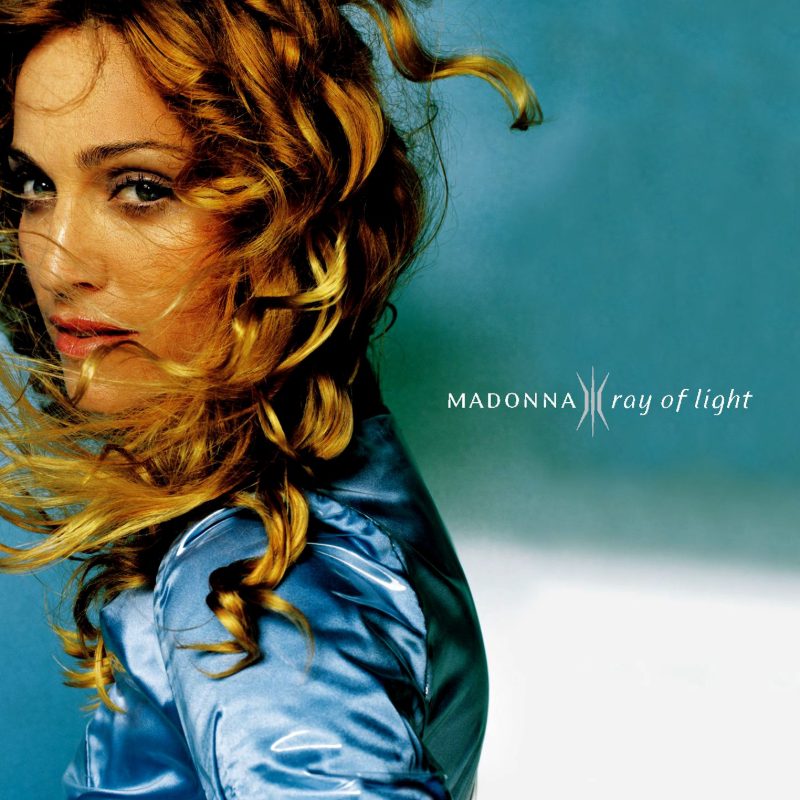
Madonna's seventh album, made with William Orbit from rough sketches, a sampler rig and a demo mix nobody replaced. A great singer's record whose producer had too few tricks for 67 minutes.
- Released
- 2 March 1998 (UK); 3 March 1998 (US)
- Label
- Maverick / Warner Bros. (US CD 9 46847-2; European LP 9362-46847-1)
- Producer(s)
- Madonna (all 13 tracks) · William Orbit (12) · Patrick Leonard (4) · Marius De Vries (3)
- Runtime
- 66:45 (13 tracks)
- Chart peak (US)
- #2 (Billboard 200, chart dated 21 March 1998), behind the Titanic soundtrack
- Chart peak (UK)
- #1 (Official Albums Chart), 2 weeks at the top
- Certifications
- RIAA 4× Platinum (16 March 2000); BPI 6× Platinum (10 January 2003)
- Awards & honours
- 4 Grammys at the 1999 ceremony: Best Pop Album, Best Dance Recording ('Ray of Light'), Best Short Form Music Video ('Ray of Light') and Best Recording Package. Her only album nominated for Album of the Year. #222 on Rolling Stone's 500 Greatest Albums (2020)
Ray of Light is usually heard as Madonna's electronic reinvention. It's better understood as a singer's record, built over sketches left rough on purpose. That roughness makes 'Skin' and 'Mer Girl' great, and it makes the long middle sag.
The first song on Ray of Light was never meant to be finished. William Orbit told Keyboard magazine in July 1998 that 'Drowned World/Substitute for Love' was a demo mix. It was a rough, he said, not a final mix. But it worked, so it's what you hear. Madonna's first line arrives 43 seconds in, over a track nobody went back to polish. Orbit also quoted one of her favourite studio phrases: “Don't gild the lily”. He took it to mean keep it rough.
That rule explains the record better than the story usually told about it. In that story, a pop star hires an electronica producer and comes back sounding new. Rob Sheffield judged it on those terms in Rolling Stone in 1998. As an experimental dance album, he wrote, it was fairly useless. In the same review he said she hadn't made this many songs worth her time since Like a Prayer in 1989. He was right both times. Ray of Light isn't a great electronic record. It's a great singer's record, built over sketches that were left rough on purpose. Its flaw comes from the same place. Orbit worked with a small kit and a few favourite tricks, and nearly 67 minutes is a long time to hear them.
Something had changed in the voice first. For Evita, Madonna studied with a vocal coach. She told Spin in April 1998 that she'd found “a whole piece of my voice I wasn't using”. The film also gave her time off from being herself, she told the Los Angeles Times. Then her daughter Lourdes was born, on 14 October 1996, and she said the birth felt like a rebirth. By the time the album came out she'd been doing yoga seriously for a little over a year. She was also studying Kabbalah, Buddhism and Hinduism. All of that ends up in the lyrics, for better and for worse. The voice is what makes it land.
Finding someone to build the music took longer. Sessions with Babyface were dropped. He said later that she didn't want to repeat herself. With Rick Nowels she wrote 9 songs in 10 days at his studio on Mulholland Drive, and 3 made the album. She told the Los Angeles Times that Tricky, Goldie and Prodigy all turned her down. She told Spin that Goldie loved 'To Have and Not to Hold' and took the master tapes to work on alone, then went silent. Then Guy Oseary, at her label Maverick, asked Orbit for some material. Orbit sent a DAT of sketches. She was back on the phone within 5 days, already writing to it. Those refusals were the record's luck.
She knew what she was hiring. She'd long been a fan of his textures and his melancholy, she told Spin. She wanted a European sensibility she couldn't get from an American producer. Orbit had made records as Strange Cargo, and had remixed her before, on 'Justify My Love' and 'Erotica'. At first he thought he was there for a couple of tracks. He ended up producing 12 of the 13. The way they worked was loose. He gave her tapes of 8- and 16-bar phrases, and she played them over and over until lyrics came. Then she took the ideas back to him, and the songs grew between them. 'Mer Girl' was the exception. She asked him to put the tape up as it was, and sang over it in one take.
The recording was as rough as the sketches. Vocals were first roughed out at the Hit Factory in New York. Orbit flew home to London for his gear, and the last stage was done at Larrabee North in Universal City, California. Recording took about 4½ months, and Lourdes came to the studio every day. The equipment was modest and mostly old. Much of the album was played on a Roland Juno-106, with a Korg MS-20 for the spikier sounds. Orbit sequenced it on an Atari ST running Cubase II, which at one point caught fire. A Los Angeles drummer didn't work out, so Fergus Gerrand recorded at Orbit's home in London. Orbit chopped the takes up in his two Akai samplers. Usually everything but the vocals came out of those Akais through a valve compressor. Pitchfork heard “a unified tonal consistency” in the result in 2017. Orbit, who made it, said he heard a lot of stylistic variation.
'Frozen' is where the voice and the method meet. Madonna wrote it to Patrick Leonard's music while obsessed, she said, with the film The Sheltering Sky. Craig Armstrong arranged the strings. Suzie Katayama conducted the orchestra, which played its parts for 'Frozen' and 'The Power of Good-Bye' in a single day. Madonna comes in at 0:36, low and unhurried, and she never pushes. Orbit's drum fill goes from something like mallets to hard wooden sticks, all of it done with filters. At 2:58 the voice drops out for almost a minute, and the arrangement carries the song alone. It's the best minute of production on the record. The singing either side of it is the clearest sign the Evita lessons took.
The rough edges elsewhere are deliberate, and they're the fun of it. 'Skin' was made by Orbit, Marius De Vries and Madonna together. The opening vocal runs through a Panscan on one side of the stereo, so it comes out chopped. Where the track drops down, the sound is a guitar phrase looped and pitched up and down. A flute De Vries recorded in a Moroccan market turns up now and then. Orbit faded the end early because the sequence finished in applause. 'Mer Girl', the closer, goes further. It sounds like ambient drift, but Orbit says it has verses, bridges and choruses. At the fourth verse he stacked conflicting time signatures on top of each other, on purpose. The song is about her mother's death, and the one-take vocal sounds like it. Nothing on the record is less polished, and nothing hits harder.
The singles show the method at its most generous. The title track grew from 'Sepheryn', a Curtiss Maldoon song that came to Orbit via Christine Leach's Strange Cargo demo. All three writers share the credit. Sheffield heard Oasis-style rock guitar on the first three tracks, and here it drives. The title isn't sung until 2:24, and by then nobody's waiting for a chorus. It reached #2 in Britain and #5 in America. 'The Power of Good-Bye' and 'Nothing Really Matters' are plainer songs, and the album needs them. Five singles from it made the UK top 10.
The same method explains what's wrong with the record. Sheffield's complaint was that Orbit didn't know enough tricks to fill a whole CD. He kept pressing, Sheffield wrote, “a spaceship-bleep button”. That's unkind, and it isn't wrong. More than half the songs run past 5 minutes, and by the middle of the album the textures are repeating. 'Sky Fits Heaven' has fine drums, and words largely inspired by a Max Blagg poem from a Gap advert. Then comes 'Shanti/Ashtangi', a Sanskrit chant that Orbit named as a track that split listeners. Billboard ranked it last of the 13 in 2023. Robert Christgau wrote in 1998 that enlightenment “invariably kicks off an awkward stage” for a pop star. On this stretch of the album, he has a point.
It mattered at once. Robert Hilburn of the Los Angeles Times called it the most satisfying album of her career, for its candour. It entered the UK chart at #1 and stayed there for 2 weeks. In America the Titanic soundtrack held it at #2, but it stayed on the Billboard 200 for 78 weeks. In February 1999 it won 4 Grammys, including Best Pop Album. They were her first outside the video categories. Billboard noted in 2023 that its opening week had been, at the time, the biggest by a woman in the SoundScan era. It's also her only album nominated for Album of the Year. Of all those numbers, the 78 weeks say the most: this was an album people lived with, not one they bought for a single.
Its influence is real, but narrower than its reputation. Nelly Furtado told The Fader in 2016 that she'd used it as a template for Loose, her 2006 album. Kelly Lee Owens told the BBC in 2025 that it was a major influence on her album Dreamstate. Orbit went on to produce Blur's 13 in 1999 and Britney Spears's 'Alien' in 2013. Pitchfork heard Ray of Light in 'Alien', but that's a critic's reading of a shared producer. Beyond those, the lines critics draw to younger artists are readings, not testimony. This was a record people loved more than a record people copied, and influence is the weakest part of its case.
Some of it has aged. Shaad D'Souza told the BBC in 2025 that it's probably the best-sounding Madonna album now, though the production can “sound a little bit dated” in places. That same year Madonna released Veronica Electronica, the remix companion she'd first conceived in 1998. Rolling Stone put the album at #222 in its 2020 list of the 500 greatest albums. Orbit died at home on 23 July 2026, aged 69. That March he'd said a sequel wouldn't happen: he had an album ready, had reached out to her, and had no response.
So both of Sheffield's verdicts still hold, and the second one matters more. As electronic music, Ray of Light is a handful of good ideas used too often. As a singer's record it's among the best things Madonna has made. 'Frozen', 'Skin' and 'Mer Girl' stand with anything in her catalogue. The production is why it works, rough and all of a piece. It's also why the middle sags, when tricks that thrill on 'Skin' have turned routine by 'Sky Fits Heaven'. Lose 'Shanti/Ashtangi' and 10 minutes elsewhere, and you'd have something close to flawless. As it is, it's a great record with a long middle. Its best argument is still the rough mix that opens it.
Pressing guide — the one to own
There was no American retail LP in 1998: the only official US vinyl was the PRO-A-9378 promo. The original to own is that European double LP, Maverick 9362-46847-1, pressed by WMME in Alsdorf, Germany. Andreas Tews cut it by Direct Metal Mastering. It comes in a matte, unlaminated sleeve with colour-printed inner sleeves, and its labels misprint track 11 as 'To Have And Not To Have'. Every 1998 retail LP came from that plant, including the Japanese WPJR-2003/4, pressed there from the same cut and sold in a gatefold.