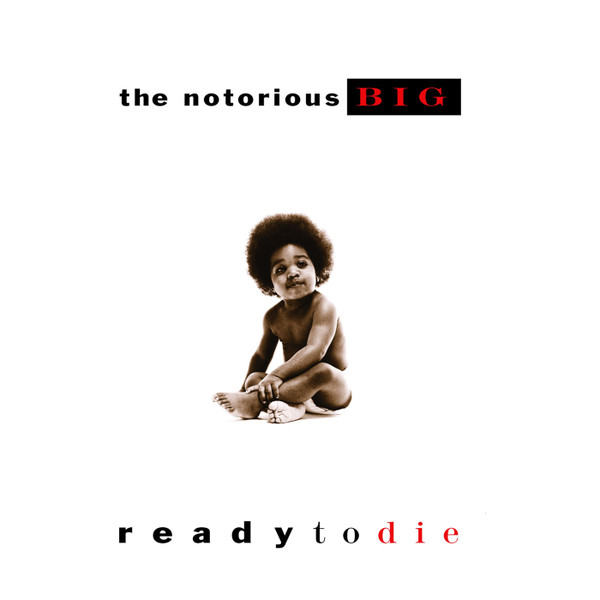
The Notorious B.I.G.'s debut, and the only album released in his lifetime: a street record first recorded in 1993, with Sean Combs's radio hits added the following year.
- Released
- 13 September 1994
- Label
- Bad Boy Entertainment, distributed by Arista; Puff Daddy Records / Arista in the UK and Europe
- Producer(s)
- Easy Mo Bee, Sean 'Puffy' Combs, Chucky Thompson, the Bluez Brothers, Poke, Darnell Scott, DJ Premier and Lord Finesse; executive producer Sean Combs
- Runtime
- 68:58 (17 tracks, by the original US CD label timings)
- Chart peak (US)
- #15 (Billboard 200, chart dated 1 October 1994, its first week); 97 weeks on the chart
- Chart peak (UK)
- Never in the Official Albums Chart Top 100; #2 on the Hip Hop and R&B Albums Chart and #9 on the Vinyl Albums Chart (21 October 2021)
- Certifications
- RIAA 6× Platinum (4 April 2018); BPI Platinum (17 January 2020); Music Canada 3× Platinum (21 May 2024)
- Awards & honours
- 4½ mics in The Source (October 1994); 10/10 from Pitchfork (2017); #22 on Rolling Stone's 500 Greatest Albums (2020); added to the National Recording Registry (announced 16 April 2024)
Wallace wanted a street album, and Sean Combs pushed him to add the hits. The voice that holds the two together is the best thing on the record. The joins, and a sagging middle, are where it falls short.
'Suicidal Thoughts' ends in a gunshot and a slowing heartbeat. There's a thud in there too. Prince Charles Alexander, an engineer on the album, told XXL in 2004 where it came from. They'd searched tapes of sound effects for a body hitting the floor, and nothing worked. So he and Sean Combs turned off the lights in the booth. They told Wallace to fall as hard as he could when the gun went off. He did. One of the last sounds on The Notorious B.I.G.'s debut is its author pretending to die, and Alexander says he and Combs thought it was hilarious.
That mix of dread and comedy is the whole record. Ready to Die is about a young dealer who expects to be killed, and it's often very funny. Its biggest hits are bedroom songs made for the radio. That range is its genius, but it wasn't planned as one album. It came out of a tug of war between a rapper who wanted a street record and a label boss who wanted hits. You can hear where the rope frays. Wallace's voice holds the halves together, and it's the best thing on the album. The joins are the worst.
Christopher Wallace still lived with his mother in Bedford-Stuyvesant, Brooklyn, when the album came out. Touré reported in the New York Times in December 1994 that he'd started selling crack on Fulton Street at about the age of 12. He'd also spent 9 months in a North Carolina jail before making bail. A demo recorded in the basement of the DJ Mister Cee went to Matty C, who ran the Unsigned Hype column at The Source. Matty C took it to Combs, then at Uptown Records, and Uptown signed him. None of this is backstory the album keeps at a distance. Touré called it perhaps the most balanced portrait of a dealer's life in hip-hop, the thrill and the fear both.
The album was made in two stages, a year apart. XXL's oral history puts the first in 1993, at Uptown, when Wallace cut 'Ready to Die', 'Gimme the Loot' and 'Things Done Changed'. On those, XXL says, his voice is higher, hungry and paranoid. He still wrote some of his rhymes down in notebooks. Then Uptown fired Combs, in July 1993, and dropped Wallace. He went back to dealing, in Raleigh, North Carolina. Combs sent him a ticket home, and the house was raided the day after he left. By the time he came back to the studio in 1994, his voice was smoother. He'd also learned to keep his lyrics in his head.
Combs had started his own label, Bad Boy, with Arista distributing it, and he wanted hits. Lord Finesse told XXL that once Wallace had his raw street songs, Combs told him it was his turn now. Combs asked the producer Poke for a melodic radio record and suggested Mtume's 1983 'Juicy Fruit'. Wallace, Poke said, thought it was 'a popcorn record' and wanted to make nothing but gangsta songs. Wallace and Matty C both wanted 'Machine Gun Funk', a hard Easy Mo Bee track, as the first single. Combs got his way. 'Juicy' reached #27 on the Hot 100, then 'Big Poppa' made #6 and the remix of 'One More Chance' #2. On the numbers, the man who wanted hits was right.
Was he right about the music? The 1993 songs say only partly. They're the album's spine, and its meanest songs. 'Gimme the Loot' is a robbery planned by two men, and both of them are Wallace. Easy Mo Bee says he recorded one voice, left gaps, and came back to fill them with the other. Mister Cee scratched in a fragment of A Tribe Called Quest's 'Scenario (Remix)'. The title track has bluesy guitar and wah-wah feedback, which Cheo H. Coker picked out in Rolling Stone in 1994. None of it asks to be liked, and that's its strength.
'Things Done Changed' opens the album proper on a sample from Dr. Dre's The Chronic, as Billboard notes. Pitchfork points out that it's Dre's voice between the verses. That's a Brooklyn song built on a Los Angeles record, and it isn't the only nod west. In the intro's run through the eras, Pitchfork hears the 1990s arrive as Snoop Dogg's Doggystyle. Chucky Thompson says they were listening to Snoop's album while they made 'Big Poppa'. Billboard's Todd Williams wrote in 2019 that the West Coast dominated rap in 1993 and 1994. He credits this album with bringing the East Coast back. It did that partly by borrowing from the West.
'Juicy' is the pop half at its best. Poke, who was staying at Combs's house in Scarsdale at the time, built it on an MPC60. He looped 'Juicy Fruit' and reinforced its drums and bass. Total sing the hook, and Wallace's first words come 2 seconds in. It was made by a man who thought it was beneath him, and the RIAA certified it 6× Platinum in 2022. 'Big Poppa' went higher on the chart. Thompson says he gave it 'that little West Coast line' to take Wallace out of the New York vibe, and Pitchfork heard a synth line pitched at West Coast ears. It's another borrowing from the side of the country New York was trying to beat.
Combs's hand shows elsewhere, and not always well. XXL says 'One More Chance' was remixed three times for the album. Combs had the engineer ride the level of its piano sample so it wouldn't sound as it had before. The album version still isn't the hit. That was a remix, 'One More Chance/Stay With Me', and Pitchfork's 2017 review calls the original disposable beside it. 'Me & My B***h' had its sample refused. Lord Digga says Stevie Wonder, who wrote the Minnie Riperton song it used, wouldn't allow the swearing. So Thompson replayed the music. The Source found its beat repetitive in 1994, and Pitchfork heard tinny drums on it, and on 'Respect', in 2017. Both reviews were raves, and both were right about these tracks.
The bigger problem is the running order. The album runs 68:58 across 17 tracks, and the middle sags. Combs designed it as a life story. The intro, his idea, moves through the eras on old records, past a father shouting about an unruly boy and a robbery on a train. It ends with a release from jail. 'Suicidal Thoughts' closes the story. In between, it keeps stalling. '#!*@ Me', a 1:31 sex skit with Lil' Kim, sits between 'One More Chance' and 'The What'. Shortie, reviewing the album for The Source in October 1994, gave it 4½ mics. She still called its two sex skits annoying. They're more annoying now, because there's nothing in them to hear twice.
What carries it through is Wallace. Method Man, the only guest rapper, told XXL the track was arranged after a show at a club he remembers as Shelter. They wrote their verses side by side. He also says Combs took 2 months to pay him his $2,500. On 'Warning', over an Isaac Hayes beat that Big Daddy Kane had turned down, Wallace voices two characters again. 'Suicidal Thoughts' is staged as a late-night phone call to Combs. Lord Finesse, who made the beat, wasn't even at the vocal session. Robert Christgau, who gave the album an A−, took the suicide song at its word. He also found the sex raps erotic and the jokes funny, which is the range the hits needed. Touré wrote that the album's pathos was unusual not only in hip-hop but in pop. The voice is the reason. It never sounds rushed, and it changes character without changing weight.
It came out on 13 September 1994, the day President Clinton signed the Violent Crime Control and Law Enforcement Act. Nothing connects the two but the date, and it's a pointed coincidence all the same. The album entered the Billboard 200 at #15 on 1 October and never climbed higher, but it stayed for 97 weeks. On 30 November Tupac Shakur was shot at Quad Studios in Times Square, while Wallace and Combs were upstairs. Within two and a half years both rappers were dead. Wallace was shot in Los Angeles on 9 March 1997, aged 24, and Life After Death followed 16 days later. The title has been heard as prophecy ever since. The Times profile suggests something plainer: a 22-year-old who told a reporter he was 'scared to death'.
Its influence is well documented. Williams argued that after it, New York's stars, Nas and Jay-Z among them, paired street verses with R&B singles built on samples. Pitchfork called it Combs's proof of concept for New York hip-pop, a formula he went on to use with Mase and Shyne. That's the album's real invention, and it belongs to Combs as much as to Wallace. The parts weren't new. Coker measured the album against Ice Cube's AmeriKKKa's Most Wanted, and ranked 'One More Chance' among the bawdiest sex raps since Kool G Rap's 'Talk Like Sex'. What was new was selling all of it on one record. Its standing has kept rising since. Rolling Stone ranked it #133 in 2003 and #22 in 2020, and it joined the National Recording Registry in 2024.
So the reputation is a little too clean. It treats Ready to Die as flawless, and even Pitchfork's 10/10 review spends a paragraph saying otherwise. Take out the album version of 'One More Chance', the interlude and 'Me & My B***h', and the record gets better. Some of the production has aged faster than the rapping. But the rapping is why it lasts. Wallace plays a stick-up kid arguing with himself and a man on the phone with a gun, and both of them sound like him. Ready to Die is a great album with a padded middle. Wallace arrived fully formed. The record around him didn't quite.
Pressing guide — the one to own
The original vinyl is a single LP, Bad Boy 78612-73000-1 (1994), with 9 of the album's 17 tracks. Specialty Records Corporation pressed it, and 'HFM '94', for Hit Factory Mastering, is in the side A runout. The full album on vinyl is the gatefold double LP 78612-73005-1, with 'Who Shot Ya?' added, a poster and a different cover. The catalogue entry dates it to 1995. Its labels misprint the number as 76812, but so does at least one unofficial copy, so the misprint proves nothing on its own.