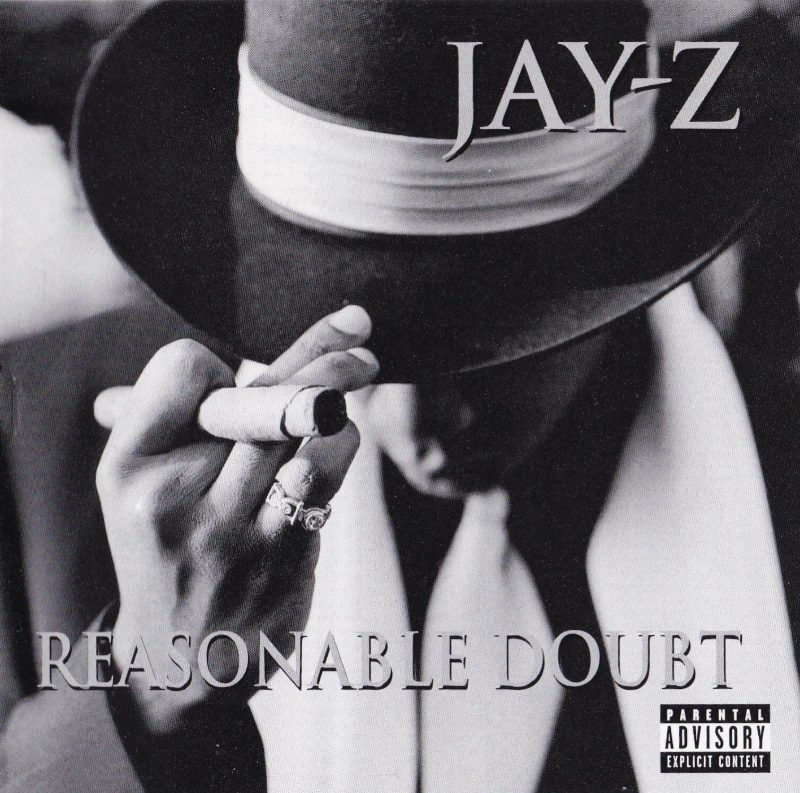
Jay-Z's 1996 debut, paid for with his Roc-A-Fella partners and recorded at D&D Studios in New York: a record about rapping more than about sound.
- Released
- 25 June 1996 (US); 20 February 1997 (UK, Northwestside)
- Label
- Roc-A-Fella / Freeze / Priority (US: P1 50592 on LP, P2 50592 on CD)
- Producer(s)
- Ski · DJ Premier · Clark Kent · Knobody · DJ Irv · Big Jaz · Peter Panic, with co-producers Sean Cane, Dahoud and Damon Dash
- Runtime
- 55:21 (14 tracks, sleeve timings)
- Chart peak (US)
- #23 (Billboard 200, chart dated 13 July 1996); #3 (Top R&B Albums)
- Chart peak (UK)
- #16 (Official Hip Hop and R&B Albums Chart, 1 October 2026); #19 on first release (15 March 1997); not on the main Official Albums Chart
- Certifications
- RIAA Platinum (7 February 2002); BPI Gold (27 June 2025)
- Awards & honours
- 4 mics in The Source (1996). Rolling Stone's 500 Greatest Albums: #248 (2003), #67 (2020). Grammy Hall of Fame (2025)
Jay-Z made his debut as if it were the only album he'd ever release, and the care is in every line. The rapping is as good as he's ever been. The beats, from seven producers, are skilled work that rarely surprises.
Half of the record that put Jay-Z on the Hot 100 isn't on his first album. 'Ain't No Nigga' and 'Dead Presidents' were paired on one single. It entered the chart on 6 April 1996 and peaked at #50. When the album came out on 25 June, it kept 'Ain't No Nigga' and dropped the other side. In its place is 'Dead Presidents II', and the back cover adds two words to the title: 'new lyrics'. He had a song that was already working, and he did it again with new words.
That habit explains the record. Jay-Z talked about Reasonable Doubt as the only album he'd make, according to its art director, Adrien Vargas, and to Pitchfork's 2017 review. Kareem 'Biggs' Burke, one of his two partners, said he made it 'to impress his friends'. Someone making one album, for the people who knew the life best, was going to get every line right. That's how it sounds. The rapping is as good as anything Jay-Z has recorded. The beats are good, and sometimes better than good. But they're the part of the album that plenty of New York could have made in 1996, and they're why it stops short of the very top.
He'd already had a record deal, and walked away from it. Jay-Z signed to Payday Records, and the deal didn't last. He told Yahoo! Music in 1999, as Revolt later quoted him, that what the label was setting up for him he could have done himself. With Damon Dash and Biggs he set up Roc-A-Fella, with an office at 17 John Street. XXL's 2006 oral history says the label ran on 'capital saved from the streets'. Robert Christgau called it a self-financed debut. Priority Records manufactured and distributed it. Biggs said in 2016 that Priority wasn't putting much behind the album, so the partners paid for its promotion themselves.
The money changed hands in the plainest way. Sean Cane, co-producer of the opening track, told XXL that the payment for it came at D&D Studios in a shoebox of single dollar bills, under $10,000. Ski remembered being paid with a backpack of money. The sleeve credits every track's recording to D&D, and Joe Quinde engineered all but one. Seven producers share the 14 tracks. Ski made four, DJ Premier three and Clark Kent three, with one each from Knobody, DJ Irv, Big Jaz and Peter Panic. Biggs and Vargas say Jay-Z didn't write his lyrics down, and Ski remembers seeing only a few words on his paper. The release date slipped twice, from April to 14 June and then to 25 June, because of recording delays.
The album opens on somebody else's voice. 'Can't Knock the Hustle' starts with a Scarface impression by Pain in Da Ass, whom the sleeve thanks as part of the Roc-A-Fella family. Jay's first line doesn't arrive until 0:46. Knobody made the beat at his mother's house around 1994, on Marcus Miller's 'Much Too Much'. Sean Cane told XXL that Mary J. Blige came in to sing the hook on the day of the mix, after a singer called Veronica had cut a guide version. The chorus first lands at 1:53. It's the album's one obvious play for radio. It was the second single, not the first, and it entered the Hot 100 on 14 September 1996 before peaking at #73. Even here, Jay doesn't raise his voice to meet the hook.
Ski's four tracks set the album's tone. He told XXL he heard the Stylistics' 'Hurry Up This Way Again' on an oldies station and chopped it that night. Clark Kent brought a beat on the same sample an hour later. Jay took Ski's because it came first. That became 'Politics as Usual'. Jay's last line starts at 2:52, and the track runs on for most of a minute after it. 'Dead Presidents II' is built on Lonnie Liston Smith's 'A Garden of Peace' and a sample of Nas's 'The World Is Yours'. Jay's last line starts at 3:48, with 39 seconds of the track still to run. Jayson Greene, writing in Pitchfork, hears soft soul samples under a voice that never rises above conversation. That's the right split of credit. The loops are lovely, and the patience is Jay's.
DJ Premier's three tracks are harder, and two of them are among the best things here. Christgau singled out the piano loop on 'D'Evils', the one track Joe Quinde didn't engineer. At the 2006 anniversary show Jay called it a song about betrayal. 'Friend or Foe' lasts 1:49, and it isn't a skit. It's a single, complete verse over a Premier track, and nothing on the album is more tightly written. Premier's third, 'Bring It On', shares the track with Sauce Money and Big Jaz. It's solid, and it's a sign that the second half has less to say than the first.
The middle of the record shows how much room a narrow sound leaves. 'Feelin' It' began as Ski's own track, hook and flow included, worked up with Geechi Suede of Camp Lo before Jay took it over. It's the lightest thing here, and it became the third single, peaking at #79 in 1997. 'Can I Live', Irv Gotti's only production, sits on Isaac Hayes's 'The Look of Love'. Jay named it his favourite song of the 2006 anniversary show, and it's the album's most underrated track. 'Ain't No Nigga' goes the other way. It's a duet with Foxy Brown. XXL and Rolling Stone both say she was 16. Big Jaz built the beat on a Whole Darn Family record. It's the one song here built for a party, and it had already been a single.
The famous guest spot had a doubter inside the camp. On 'Brooklyn's Finest' Jay shares the track with the Notorious B.I.G. Irv Gotti, who produced 'Can I Live' as DJ Irv, told XXL he argued against it in case Jay came off as Biggie's sidekick. The accounts of how it was made don't agree. Clark Kent said the two properly met at the session. Lenny Santiago, who was doing promotion at the time, and Biggs say the idea came up at the 'Dead Presidents' video shoot. Biggs says Jay cut his part quickly and left gaps for Biggie. Biggie went away and came back to finish, two months later in Clark Kent's memory. Kent says he wrote and sang the hook himself, at about 3 a.m., while the song was being mixed. Dash remembers making it up with Kent and getting Kent to perform it. Gotti's fear was misplaced. Neither man gives an inch, and Jay is the calmer of the two.
The second half is where the album thins. 'Cashmere Thoughts' runs 2:56 and adds little to what 'Feelin' It' had already said. 'Coming of Age' gives a verse to Memphis Bleek, and it's the track you'd skip. The bigger problem is the one Christgau named in 2011. He heard a disciplined austerity that took some of the fun out of the rhymes. He noted that Jay could later afford 'less austere' producers. He's right about the music. Seven producers, whose tracks were all recorded at one studio and drew mostly on soul, jazz and funk records, made a consistent album and rarely a surprising one. Few of these beats would have startled anyone following New York rap in 1996.
It wasn't a hit. The album entered the Billboard 200 at #23 on the chart dated 13 July 1996, and that was as high as it went. It had shown up on the R&B chart a week early because shops broke the street date, then reached #3 there. It spent 18 weeks on the Billboard 200 that year. XXL put first-year sales at 420,000. The RIAA's Platinum award came on 7 February 2002, more than five and a half years after release. The Source gave it 4 mics, a review Greene summed up as 'approving, not rapturous'. In 2016 DJBooth argued that it was never an instant classic. Biggs said the same year that people didn't get it at first, and got it a lot more once the second and third albums came out.
Its reputation grew backwards from what Jay-Z became. Rolling Stone ranked it #248 among the 500 greatest albums in 2003, and #67 in 2020. The Recording Academy added it to the Grammy Hall of Fame in 2025. Jay has looked after it himself. He played it in full at Radio City on 25 June 2006, and every song from it at Yankee Stadium on 10 July 2026. That month it returned to the Billboard 200 at #24 and topped Billboard's Vinyl Albums chart. Some of that is a famous man's back catalogue selling. Some of it is earned. Young Jeezy told MTV News in 2006 that the album was his bible. Ski said that year that 'Politics as Usual' was the blueprint for the soul-sample style Kanye West and Just Blaze were using. That's a producer talking about his own record. Greene hears an idea from 'D'Evils' picked up on Kendrick Lamar's To Pimp a Butterfly, which is a critic's reading rather than a credit. What people took from the album was mostly the voice.
Complex argued in 2011 that The Blueprint is the better album. On sound alone, that's a fair fight. But Reasonable Doubt has the better rapping. Line for line, Jay-Z's performance here is the best of his first decade, exact without ever sounding effortful. The production around it is skilled and rarely more, and the second half sags. That makes it a great record with a real flaw, not a perfect one. Play 'Dead Presidents II', 'D'Evils' and 'Friend or Foe' back to back, and the case for it is plain.
Pressing guide — the one to own
The original to own is the 1996 US double LP, Roc-A-Fella/Freeze/Priority P1 50592. It was pressed at Rainbo Records from lacquers cut by Duncan Stanbury at Master Cutting Room. The hand-etched runouts read '0 4992 50592-1 A S-33598 Mcrds' on side A, running to 'D S-33601 Mcrds' on side D. The matching CD is P2 50592. Catalogue number 50040 belongs to the 1998 reissue, which adds 'Can I Live II'.