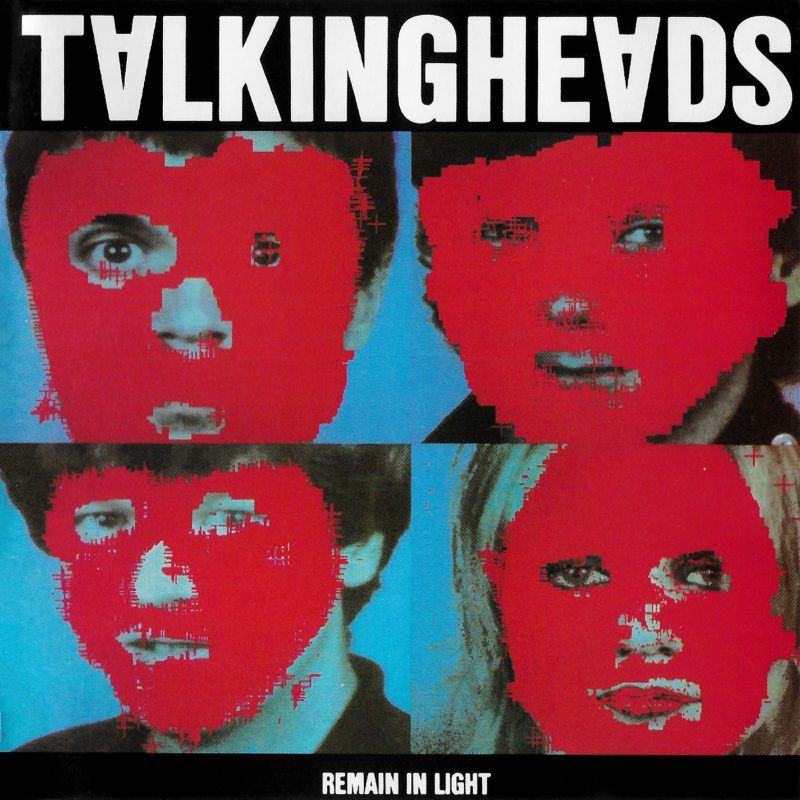
Talking Heads' fourth album, made in Nassau and New York in 1980 with Brian Eno producing: a record built by the whole band, and argued over ever since.
- Released
- 8 October 1980
- Label
- Sire Records (marketed by Warner Bros. Records)
- Producer(s)
- Brian Eno
- Runtime
- 39:48 (8 tracks)
- Chart peak (US)
- #19 (Billboard Top LPs & Tape)
- Chart peak (UK)
- #21 (Official Albums Chart, week of 15 March 1981)
- Certifications
- RIAA Gold (17 September 1985); Music Canada Gold (1 February 1981); BPI Gold (3 October 2019)
- Awards & honours
- Library of Congress National Recording Registry (announced March 2017); #3 in the Village Voice Pazz & Jop critics' poll for 1980; #39 on Rolling Stone's 500 Greatest Albums (2020)
Remain in Light is four musicians and a producer learning to play like a tape loop. Its first side is as bold as anything from 1980. Its second shows what that method cost: grooves that waited for songs.
Take an American copy of Remain in Light out of its sleeve and the credits start to argue with each other. The labels say every song was written by David Byrne and Brian Eno, with Jerry Harrison added on two. The inner sleeve says Byrne, Eno and Talking Heads. On copies pressed at the Specialty plant, the inner sleeve goes further. It gives the initial music to all five, and the additional music to Byrne and Eno. Chris Frantz later called the credits "simply appalling". An argument printed on paper is an odd way into a record. Here it's the right one.
The dispute is about the thing that makes the album great. Remain in Light was built from grooves the four of them found by playing together. Those grooves were then played over and over, as if the band were a tape loop. In NPR's 2000 summary of Byrne's view, the band had become human samplers. The method gave Talking Heads the most inventive record they made. It also gave them a problem they never quite solved. A groove isn't a song, and on side two the album sometimes forgets the difference.
It started with a record Eno played to Byrne. In May 1977, on the night they first met, Eno put on Fela Kuti's Afrodisiac at his flat in London. Eno later said it became the template. Byrne, for his part, has said the Afro-funk way of working was a way out. He meant out of the paranoia and personal torment he'd been writing about in New York. Tina Weymouth heard something else arriving. She told NPR in 2000 that hip-hop's arrival showed them the landscape was shifting. Those are three different reasons, and the record carries all of them.
The band were also close to coming apart. By David Bowman's account, Weymouth had told Frantz that Byrne was too controlling, and the couple thought about leaving. Instead they went to the Caribbean and bought an apartment above Compass Point Studios in Nassau. Byrne and Harrison joined them there. Eno was reluctant to produce the band a third time. He changed his mind when he heard their instrumental demos. Frantz says the band members were paying for the record themselves. It was a gamble on their own money.
The method sounds simple. The band jammed, and the best parts of each jam were picked out, learned and played again as long loops on one chord. Harrison told Guitar Player in 2022 that with so few chord changes, it was hard for Byrne to find melodies and words. The engineers found Eno's pace hard going. Rhett Davies left after an argument with him, and Steven Stanley took over. Frantz says it was Stanley who recorded the basic track of 'Once in a Lifetime'. Robert Palmer and José Rossy added percussion. In New York, Jon Hassell added trumpets and Nona Hendryx sang. Eno is the only credited producer, and the record sounds like one mind organised it.
Eno's hand shows most in the finish. By Bowman's account the mix was split in two in August 1980. Eno, John Potoker and Harrison mixed half in New York. Byrne and Dave Jerden mixed the other half at Eldorado in Los Angeles. You'd never guess it. The record holds together as one sound, dense but clear, with each part placed so the others can still be heard. Ken Tucker called Eno a fifth Head in his Rolling Stone review, and the production is the evidence. After the ideas themselves, it's the best thing about the album.
Put on 'Born Under Punches' and the groove is already running before Byrne's voice comes in at 0:19. Frantz's drums and Weymouth's bass hold one pattern while guitars and keyboards cut across it. Nothing resolves, and nothing needs to. The strangest sound on the track is a guitar solo that doesn't sound like a guitar. Byrne built it piece by piece, Harrison says, using the hold button on a Lexicon Prime Time delay. Adrian Belew played the part on stage, but the record is Byrne's. It's the album in miniature: a person making a machine stutter, and a machine keeping the marks of the person.
'Crosseyed and Painless' runs the method at full speed. Pitchfork's Dan Brooks hears Weymouth crowding her notes into the first half of each bar and leaving the second half empty. That gap is what keeps the track tipping forward. Late in the song Byrne fires off a rapid spoken list. Bowman traces it to Kurtis Blow's 'The Breaks', which Frantz had given him. 'Once in a Lifetime' opens side two and nearly didn't survive. Its working title was 'Weird Guitar Riff Song'. Weymouth thinks Frantz came up with the bass riff during one of their jams. Eno heard the third beat of the bar as the first, which gave the track two centres of gravity. Byrne told NPR the song is about living on autopilot. The groove under the title phrase, at 0:53, doesn't budge, and that's the point.
Words came last, and you can hear it. Byrne couldn't sing over the tracks at first, and few vocals were cut in Nassau. He scatted over cassettes of rough mixes until the nonsense turned into words. His sources were preachers, early rap and John Dean's Watergate testimony. On the best tracks that method produces a new kind of singing, half sermon and half news report. Hendryx, Byrne and Eno often sang as a trio, and the massed voices are part of what makes side one feel like a crowd. On the weaker tracks the words sit on top of the groove without changing it.
That's the album's real flaw, and it shows most on side two. Reviewing the record for Rolling Stone in December 1980, Ken Tucker called 'The Great Curve' and 'The Overload' "droning drags". They're the last tracks on each side, and he was half right. 'The Great Curve' has Belew, who did all his parts in a single day in New York. He was told to wait until he felt a solo was due, and his solos are the wildest playing on the record. 'The Overload' has no such rescue. It's 6 minutes of murk over a groove that never turns into a song. Belew says it was dropped from the live show because it didn't fit. 'Seen and Not Seen' is a spoken story over a pulse, and 'Listening Wind' is lovely but slight. After 'Houses in Motion', side two has textures to spare and songs to find.
It wasn't a big hit. The album reached #19 in America. In Britain it peaked at #21 in March 1981, while 'Once in a Lifetime' was in the singles chart. That single reached #14 in the UK. In America it stalled at #103, just under the Hot 100. NPR said in 2000 that the album sold modestly. The RIAA didn't certify it Gold until September 1985. The critics moved faster. In Rolling Stone, Tucker called it a "brave, absorbing" attempt to find common ground between black and white music. Robert Christgau gave it an A in the Village Voice. It was #3 in the paper's Pazz & Jop poll for 1980, behind London Calling and The River.
The record also changed the band. Eno had told them it was too dense for four people to play, by Bowman's account. So they hired Bernie Worrell, Steve Scales, Busta Jones and Dolette McDonald, and kept Belew. The nine-piece played its first show at the Heatwave festival in Ontario on 23 August 1980, before the album was out. None of the four new players is on the record. Scales was still with them for Stop Making Sense in 1984, a film that ends with 'Crosseyed and Painless'.
Its standing has risen since. Rolling Stone put it at #126 in its list of the greatest albums in 2003, and at #39 in 2020. In answers posted on Radiohead's website in 2000, Thom Yorke called it the band's big reference record while they made Kid A. In 2018 Angélique Kidjo recorded the whole album song for song, with Fela's old drummer Tony Allen on it. That same year Pitchfork asked whether white art-school musicians playing West African music could be taken at face value. It's a fair question, and Byrne half answered it himself in 1982, when he said there was less Africanism in the record than they'd implied. Kidjo's version is the better answer. She'd heard 'Once in a Lifetime' as a student in Paris and told her classmates it was African music, not rock.
So who made Remain in Light? The honest answer is close to that Specialty inner sleeve. The initial music came from all five, and the words came mostly from Byrne. The album's greatness lives in the first part: four players and a producer making a jam as steady as a machine and still plainly human. Its flaw lives in the second. Melodies and words had to be found for grooves built without them, and by side two they were getting harder to find. Side one is as bold as anything released in 1980, and Radiohead were still learning from the record 20 years later. Side two is a great band running out of songs. It's a great record that sags in its second half, and it deserves its place near the top of any list of the decade.
Pressing guide — the one to own
The original is the 1980 US Sire SRK 6095, marketed by Warner Bros. It's a single sleeve, not a gatefold, with a colour inner sleeve carrying credits for each track and a separate black-and-white lyric sheet. Copies were pressed at Winchester, Los Angeles and Specialty in 1980, and at Jacksonville by 1981. Most Winchester, Los Angeles and Jacksonville runouts carry a STERLING stamp. The Specialty copies with the SRC logo on both sides don't. Look twice at the Specialty pressings. Their back cover names all five writers, and the inner sleeve splits the music between the band and Byrne and Eno.