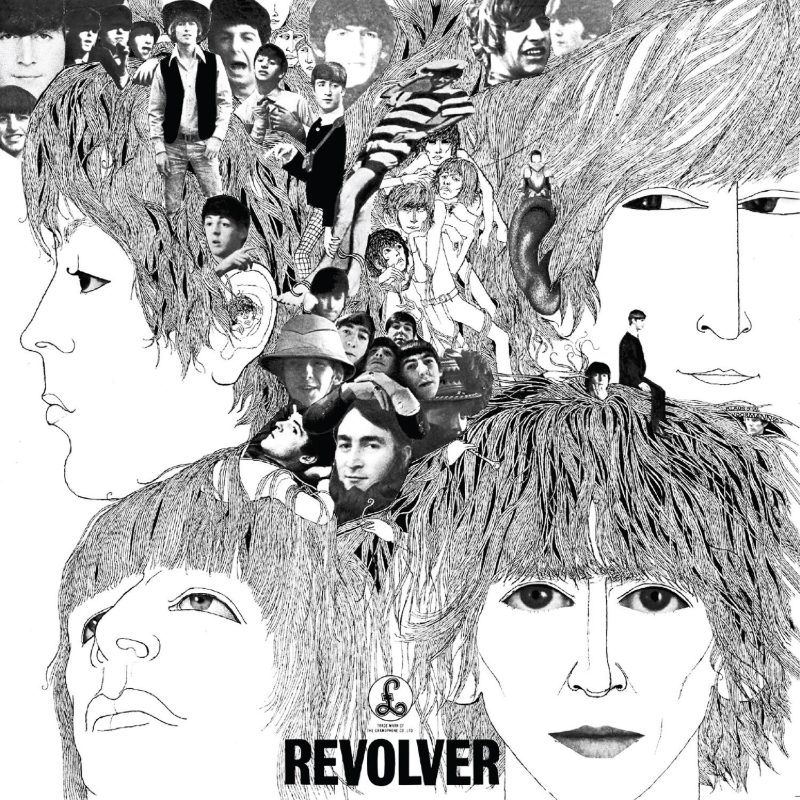
The Beatles' seventh album, made in more than 220 hours at EMI, April to June 1966. The studio became part of the writing, and three songwriters peaked at once. Their boldest record, and their best.
- Released
- 5 August 1966 (UK, Parlophone PMC 7009 mono / PCS 7009 stereo); 8 August 1966 (US, Capitol T 2576 / ST 2576, 11 tracks)
- Label
- Parlophone (UK); Capitol (US); Odeon (Japan)
- Producer(s)
- George Martin
- Runtime
- 34:52 (14 tracks, 1987 CD timings); 27:47 (US edition, 11 tracks, Capitol label timings)
- Chart peak (US)
- #1 (Billboard Top LPs), 6 weeks from the chart of 10 September 1966
- Chart peak (UK)
- #1 (Record Retailer, now the Official Albums Chart), 7 weeks from 13 August 1966; 34 weeks on the chart under the original listing
- Certifications
- BPI 3× Platinum (27 February 2026); RIAA 5× Platinum (25 July 2000)
- Awards & honours
- Grammys, March 1967: Best Album Cover, Graphic Arts (Klaus Voormann) and Best Contemporary (R&R) Solo Vocal Performance (Paul McCartney, 'Eleanor Rigby'); nominated for Album of the Year. Grammy Hall of Fame (1999)
Revolver is where the Beatles began writing with the studio itself. But tape tricks aren't why it lasts. Its songs are, and its one real weakness is that those 14 songs never quite add up to a single album.
At 8pm on 6 April 1966, in Studio 3 at EMI's studios in Abbey Road, the Beatles began their seventh album with the song that would end it. 'Tomorrow Never Knows' was Lennon's, adapted from Leary, Metzner and Alpert's book The Psychedelic Experience. In Ian MacDonald's account, Lennon wanted to sound like the Dalai Lama chanting from a mountaintop. Geoff Emerick, aged 20 and promoted to engineer for these sessions, broke into the circuit of a Leslie speaker and put Lennon's voice through it. The same day, Ken Townsend invented artificial double tracking, which Lennon had asked for. The next day, the tape loops went on.
Most of what Revolver is famous for starts in that first session. The studio stopped being a place to capture songs and became part of how they were written. That's the usual case for the record, and it's true. But the tricks aren't why it has lasted. It lasts because three songwriters were at their best at the same time, and the studio gave each of them a different sound. The same fact explains its one real weakness. Revolver is 14 songs, most of them brilliant, that never quite become an album.
It was made because, for once, the Beatles had time. Rubber Soul came out on 3 December 1965. The band then turned down a third film, which left them about three months free of engagements, their longest break since 1962. They wanted a more modern studio than EMI's. In March 1966 Brian Epstein looked at Stax in Memphis, but the plan fell through. So they stayed at Abbey Road and asked it to do things it hadn't done before. Steve Turner puts the recording at more than 220 hours, without the mixing. Rubber Soul had taken fewer than 80.
Their heads had changed as well. Lennon and Harrison had been taking LSD since the spring of 1965. Lennon later called Revolver the acid album, and Rubber Soul the pot album. McCartney got to the same place by another road. Barry Miles had been his guide into London's underground. The tape loops grew out of McCartney's admiration for Stockhausen's Gesang der Jünglinge. Harrison had already played sitar on 'Norwegian Wood'. In March 1966 Lennon predicted that the next record would be very different. He undersold it.
Emerick recalled, in Mojo in 2002, that the band encouraged the engineers to break the rules and wanted each instrument to sound unlike itself. There was no rehearsal: songs arrived as outlines and were built in the studio. For the first time at EMI, the four-track machines sat in the control room. Emerick damped Ringo Starr's bass drum with a sweater, moved the microphone to about 3 inches away and ran it through a Fairchild limiter. He put microphones close to the strings on 'Eleanor Rigby', which alarmed the players. He put them into the bells of the horns on 'Got to Get You into My Life'. Ian MacDonald argues that Starr's drum sound sent American studios off to rebuild themselves to copy it.
'Tomorrow Never Knows' is where all of this meets. Under the whole song sits a drone on C, from Harrison's tambura and McCartney's bass. Starr's drums are played, not looped, and heavily compressed. Over them run the loops. George Martin said about 30 were brought in and 16 chosen. They played on machines in rooms around the building, each with a technician holding the loop on a pencil. The four Beatles worked the faders, Martin panned and Emerick watched the meters. McCartney's laugh, sped up until it sounds like a gull, arrives about 7 seconds in. From 0:52 to 1:27 the loops and a reversed guitar take over from the voice. Martin said the mix could never be repeated. It was a performance on the desk, and it's still the most daring track the band released.
McCartney's songs are the album's most finished. No Beatle plays an instrument on 'Eleanor Rigby'. Martin scored it for eight string players, taped in Studio 2 on 28 April, and Lennon and Harrison sing harmonies. Martin recorded the strings with and without vibrato and chose the take without. Before the album came out, McCartney told David Frost he was disappointed by the arrangement. His vocal on it won a Grammy the following March. 'For No One' is just as bare: McCartney on piano and clavichord, and the horn player Alan Civil playing the solo. 'Here, There and Everywhere' answers 'God Only Knows'. McCartney and Lennon had heard Pet Sounds at a private playback in mid-May, about 6 weeks into the sessions.
Harrison is the album's other surprise. He has three songs, his most on any Beatles single LP, and the record opens with one. 'Taxman' is a protest at the 95% top rate on unearned income. McCartney plays its guitar solo with Harrison's blessing, and Walter Everett hears James Jamerson in the sliding bass. 'Love You To' goes further. Peter Lavezzoli calls it pop's first conscious attempt to copy a non-Western form in both structure and instruments. Harrison made it in April, before Ravi Shankar agreed to teach him on 1 June. 'I Want to Tell You' turns on one sour chord, an E7♭9, which Harrison described as an E and an F together. That's three different ideas of what a Harrison song could be, on one record.
Lennon's songs are the strangest. The backing track of 'I'm Only Sleeping' was taped faster than it plays, so what you hear is slower and lower than what they played. Harrison worked out a solo and recorded it with the tape running backwards, one line clean and one fuzzed. It took a five-hour session on 5 May. 'She Said She Said' began with Peter Fonda at a party in Beverly Hills in August 1965, talking about nearly dying as a child. It was the last song recorded, in one nine-hour session on 21 June. McCartney remembered a row and walking out, and who plays bass on it is still disputed. Lennon wrote five of the 14 songs. American buyers got two of them.
That gap is the oddest part of the record's history. Capitol wanted new songs, and on 16 May Martin chose three Lennon tracks from the six that were finished. 'I'm Only Sleeping', 'And Your Bird Can Sing' and 'Doctor Robert' came out on Yesterday and Today on 20 June. The American Revolver had 11 tracks: two by Lennon, three by Harrison and six by McCartney. It sold 1,187,869 copies in the US by the end of 1966. Tim Riley calls that Capitol edition the band's most artistically compromised album. The 14-track sequence was standard everywhere only from the CD of 30 April 1987. Rob Sheffield dates the album's steady climb in public estimation to that CD, and his is the best explanation.
Britain understood it quickly, if not unanimously. Melody Maker predicted it would change the direction of pop. Record Mirror thought it would split pop fans, and Ray Davies rated it below Rubber Soul. NME readers voted it joint album of the year with Pet Sounds. In America the row over Lennon's remark about Jesus muted it, and KRLA Beat complained in September that it was being overlooked. None of its songs was played on the tour that ended at Candlestick Park on 29 August. Its influence is easier to name. Tony Visconti said it showed him the studio could be an instrument, and it was part of why he moved to London. Barry Miles credits its example with pushing Pink Floyd towards The Piper at the Gates of Dawn.
Its standing took decades to settle. Ralph J. Gleason, in the San Francisco Chronicle that September, called it the most outstanding pop album in years. Richard Goldstein's review in The Village Voice called it revolutionary. Robert Christgau, in Esquire in December 1967, thought it twice as good as Rubber Soul. Still, Sgt. Pepper led the lists for years. Colin Larkin's All Time Top 1000 Albums put Revolver first in 1998 and again in 2000. Rolling Stone had it at #3 in 2003, behind Pepper, and at #11 in 2020, with Pepper down at #24.
Its weakness is the one its admirers tend to skip. Christgau, writing in 2020, found it somewhat cluttered and ranked it below Sgt. Pepper, Rubber Soul and Abbey Road. Side one alone holds a tax protest, a string elegy, a piece in Indian form and a singalong. The running order sets each song against the last rather than building anything. Paul Williams, reviewing the shorter American edition in Crawdaddy! in 1966, found that it didn't hold together, but said the cause was outside the group's control. The full British running order has no such excuse. 'Yellow Submarine' is the clearest misstep, and Williams derided it too. Placed between 'Here, There and Everywhere' and 'She Said She Said', it plays as a novelty.
None of that moves it far. Revolver is one of the best pop albums ever made, and on balance the best the Beatles made. Abbey Road sounds better, and Sgt. Pepper hangs together better. Neither has as many songs this good, or as much that later records took from it. The flaw is real: it's a collection, and the sequencing does little to hide that. But the collection holds 'Eleanor Rigby', 'For No One', 'I'm Only Sleeping' and 'Tomorrow Never Knows'. Sixty years on, those four still sound like decisions nobody else would have made.
Pressing guide — the one to own
The original to own is the first UK mono, Parlophone PMC 7009, released on 5 August 1966. The first state is told by side two. A runout of XEX 606-1 carries 'Remix 11' of 'Tomorrow Never Knows', a mix that was withdrawn and replaced. Side one on these copies is XEX 605-2. The label and sleeve read 'Dr. Robert', and the single flipback sleeve was printed by Garrod & Lofthouse or E. J. Day.