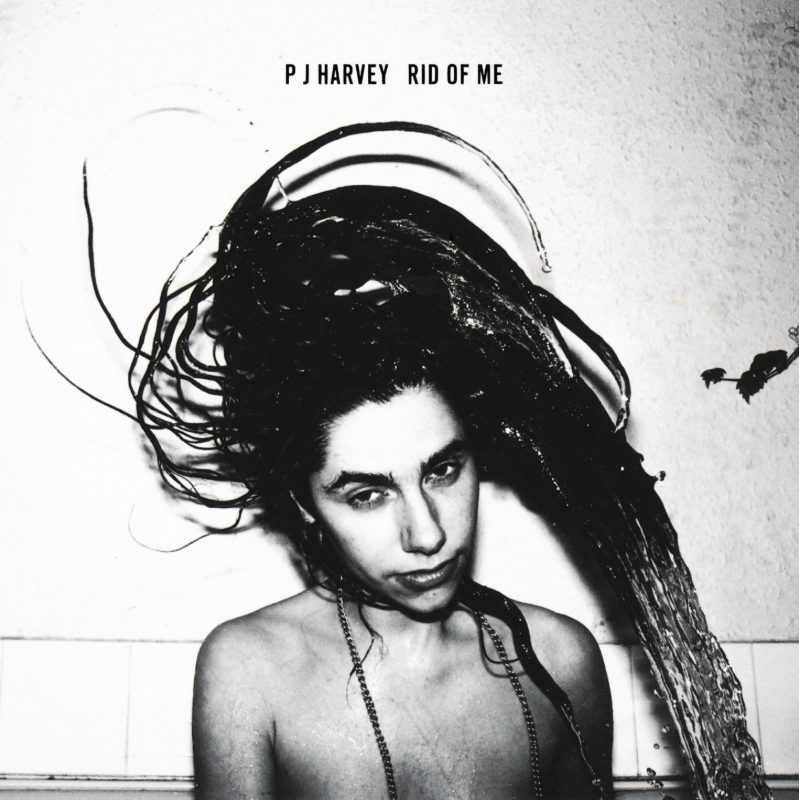
PJ Harvey's second album, played live by her trio in a snowbound Minnesota studio and recorded by Steve Albini. Three people in a room, and a recording that tidies nothing away, down to a cough.
- Released
- 26 April 1993 (UK, Island); 4 May 1993 (US, Island)
- Label
- Island Records: ILPS 8002 / 514 696-1 (LP, pressed for Europe); CID 8002 (UK CD); 314-514 696-2 (US CD, no US LP)
- Producer(s)
- No producer credited. Steve Albini recorded 13 of the 14 tracks; PJ Harvey and Rob Ellis recorded 'Man-Size Sextet'
- Runtime
- 47:59 (14 tracks)
- Chart peak (US)
- #158 (Billboard 200, chart dated 22 May 1993), 1 week; #10 on Billboard's Heatseekers chart
- Chart peak (UK)
- #3 (Official Albums Chart, week of 2–8 May 1993), 4 weeks
- Certifications
- BPI Silver (its only certification, as of October 2026)
- Awards & honours
- #3 in the Village Voice Pazz & Jop critics' poll for 1993; #4 in Spin's albums of 1993; #153 on Rolling Stone's 500 Greatest Albums (2020)
Rid of Me lives by a single device, a whisper that breaks into a roar. It's devastating on the title track and predictable by the end. The reason to keep coming back is the playing, and above all Harvey's voice.
The title track opens at little more than a whisper. Harvey doesn't sing until 46 seconds in, and you reach for the volume. Then the band arrives at full force, at 2:11 by Jeff Terich's count in Treble. Whatever level you chose is suddenly the wrong one. Harvey wrote the song on her bed in a damp shared flat in Tottenham, next to a gas heater. She later said it shocked her. The whole album is built to pass that shock on.
Rid of Me is PJ Harvey's second album, recorded in Minnesota in December 1992 and released in April 1993. It lives by that one device: near-silence that breaks into violence. On the title track the device is frightening. By the second side it has become a habit, and you start bracing for it. What carries the record past that problem isn't its famous recording. It's three people playing in a room, and above all the woman singing.
It was made under pressure, and on purpose. Harvey's debut, Dry, reached #11 on the UK albums chart in 1992 and set off a bidding war among labels. She signed to Island. She'd put off a sculpture degree to make Dry, and afterwards decided to make one more record and put it off again. She started writing in Tottenham, then moved to a rented flat above a restaurant by the sea in Dorset. Most of the album was written there. She'd been through what she preferred not to call a breakdown, with exhaustion, a break-up and pressure from the industry. While writing she listened to Howlin' Wolf, Tom Waits and Pixies.
Harvey has said she wanted to write songs that shocked, and to say something that hadn't been said that way before. The choice of engineer followed. A first attempt, at the Manor in Oxfordshire with the producer Head, lasted about five days and finished one song: a version of 'Man-Size' with a string sextet. Ellis says Harvey, unsettled and unhappy, didn't want to make a record that way. Head later said the move to Albini was as much his decision as hers. Harvey had heard Albini's recordings of Pixies. She wanted that bare sound, where you can feel the room. Albini heard the demos first, and understood that the band wanted their big shifts in volume presented more dramatically. That's a brief about dynamics, not about polish.
Who produced the result is still argued over, and the sleeve doesn't settle it. It names no producer at all. It says Albini recorded 13 of the 14 tracks. The exception, 'Man-Size Sextet', was recorded by Harvey and Rob Ellis, and Ellis arranged its strings. It is very likely the version finished at the Manor. When Albini died in May 2024, the New York Times noted that he scoffed at being called a producer. Island's copy for the 2020 reissue says 'Produced by Steve Albini' anyway. Harvey, talking to Hot Press in 1995, credited his 'production and engineering work'. That's the fairest summary. He recorded almost all of it, mixed it, and refused the title.
Pachyderm is a residential studio in Cannon Falls, Minnesota, added in 1988 to a 1960s house. That December five people lived there: the trio, Albini, and Albini's girlfriend, who cooked. Ellis remembers them snowed in, with an indoor swimming pool and nowhere to go. By his account they were there 10 days, and the record was done in three. Pitchfork puts the whole job at barely 2 weeks, mixing included. Albini set the band up to play as they would live, and kept the schedule short by choice. Ellis says the three of them were barely talking, and that his marriage was failing. Head later called the album a recording of the band's tension. You can hear it.
The recording hides nothing, and that's its first virtue. On 'Rub 'Til It Bleeds' someone coughs during the strummed opening, and the cough stayed in. Andy Gill picked it out in a hostile review for the Independent. Harvey has said the song's pauses took a long time to get right. They're the point of it: the song holds back, then gives way. Rob Ellis's falsetto backing vocals, which Greg Kot singled out in Rolling Stone, give the trio a second voice that's eerier than the first. And 'Missed', which Pitchfork called the album's most conventionally pretty song, proves the band could do more than whisper and scream.
The smartest decision on the album is to play 'Man-Size' twice. The first version, closing side one, is for strings and voice, and Kot compared its cello to Psycho. Four tracks later the full band plays the same song as rock. Met in that order, the song is a nightmare before it's a riff. 'Highway '61 Revisited', Bob Dylan's song and the only one Harvey didn't write, was her parents' suggestion. Terich hears it as nastier than Dylan's, with a deeper groove, and he's right. '50ft Queenie', inspired by the film Attack of the 50 Foot Woman, is 2:23 of swagger. It was the first single, and it's the closest the album comes to fun.
The songs are mostly about power, and who holds it in a love affair. '50ft Queenie' and 'Man-Size' try on size and swagger as if they were clothes. Pitchfork hears 'Me-Jane' as a lament from Tarzan's partner, though Kot heard her telling him off. 'Snake' is Eve's encounter with the serpent, and 'Hook', in Pitchfork's reading, a possibly abusive relationship. The stories, it notes, often take the form of dialogues. The Los Angeles Times heard sexual politics with an occasional feminist edge. Harvey kept her distance from that label, Pitchfork notes, and the songs bear her out. They don't argue a position. They act out roles, at full volume, and leave you to decide who's winning. That's why they've aged better than the arguments about them in 1993.
The second side is where the method starts to show. 'Yuri-G' is a useful case. Albini mixed it straight, tried a rockabilly version that nobody liked, then went back to straight. That was right, and it's the album's approach in miniature. But in 'Dry', written for the debut and held back, a quiet sets in the first time she sings the song's kiss-off line, as Pitchfork notes. It's the title track's trick again. 'Me-Jane' and 'Snake', at 2:42 and 1:35, have strong ideas and feel like sketches of songs. By 'Ecstasy', which ends with more than a minute in which Harvey doesn't sing, the drop into quiet no longer surprises. Kot's reservation in 1993 was that the relentless dynamics left Harvey little room to move emotionally. On this side of the record he has a point.
He's wrong about the singing. Harvey's voice is the record's real subject, and a recording this plain gives it no cover. She can sound small and close, then savage, inside one song. Pitchfork argues that even as she sang from her soul, Harvey was acting, and you can hear both at once. The Los Angeles Times compared her arrival to Sinéad O'Connor's. Kot himself praised the 'you-were-there' immediacy of the recording. Under her, Steve Vaughan and Ellis hold together through what Terich hears as odd time signatures on 'Missed', 'Hook' and 'Man-Size'. That's a band playing live with no safety net. It's why the record still sounds dangerous more than 30 years on. Some fans prefer 4-Track Demos, released that October, with eight of these songs recorded at Harvey's home. Stereogum noted those fans in 2016 and disagreed. So do we: the demos lack the band, and the band is the point.
Buyers were slower than critics. In Britain it entered the albums chart at #3, behind R.E.M. and World Party, but stayed only 4 weeks. Its only certification is Silver. In America it spent a single week on the Billboard 200, at #158. Critics did better by it. Robert Christgau gave it an A in the Village Voice. The paper's Pazz & Jop poll of critics placed it #3 for 1993, behind Liz Phair's Exile in Guyville and Nirvana's In Utero. There were dissenters. Entertainment Weekly gave it a D and dismissed it as doctrine with no heart. Andy Gill wrote in the Independent that Albini's roughness left 'precious little here but the warts'. Since then its standing has risen. Stereogum put it first among her 12 albums in 2016. Rolling Stone moved it from #406 in its 2012 list of the greatest albums to #153 in 2020.
Its influence is easier to claim than to trace. One link is documented. Albini sent the record to Nirvana, and Kurt Cobain told him he really liked the way her singing came across. Albini went on to record In Utero, which came out later in 1993. Beyond that, the lines are drawn by critics. Spin has run one from Harvey to Karen O, and Louder another to Phoebe Bridgers and Ethel Cain. Courtney Love said in the 1990s that Harvey made her feel she was nothing by comparison. Those are readings and tributes, not a school. The clearest response came from Harvey herself. In 1995 she told Hot Press that the album had rid her of her need for that abrasive sound, and that she was moving to something subtler.
So Rid of Me is a great record with a flaw built into its method. The title track, 'Man-Size Sextet' and 'Rub 'Til It Bleeds' are as strong as anything Harvey has made, and the playing hasn't lost its nerve. But the album's central idea is a single idea, and over 48 minutes you learn to brace for it. Harvey saw that first, and two years later she'd moved on. Play it loud from the first second, and play it whole. By 'Snake' you'll know what's coming. On the best songs, it lands anyway.
Pressing guide — the one to own
The original is Island ILPS 8002, also numbered 514 696-1, pressed by DFI for Europe in 1993. There was no American LP. It comes in a single sleeve with a printed black-and-white inner, with a band photograph on one side and the credits on the other. Every 1993 LP listed has 'ILPS 8002 A3' etched on side A and 'ILPS 8002 B3' on side B, each with 'DFI-93-4'.