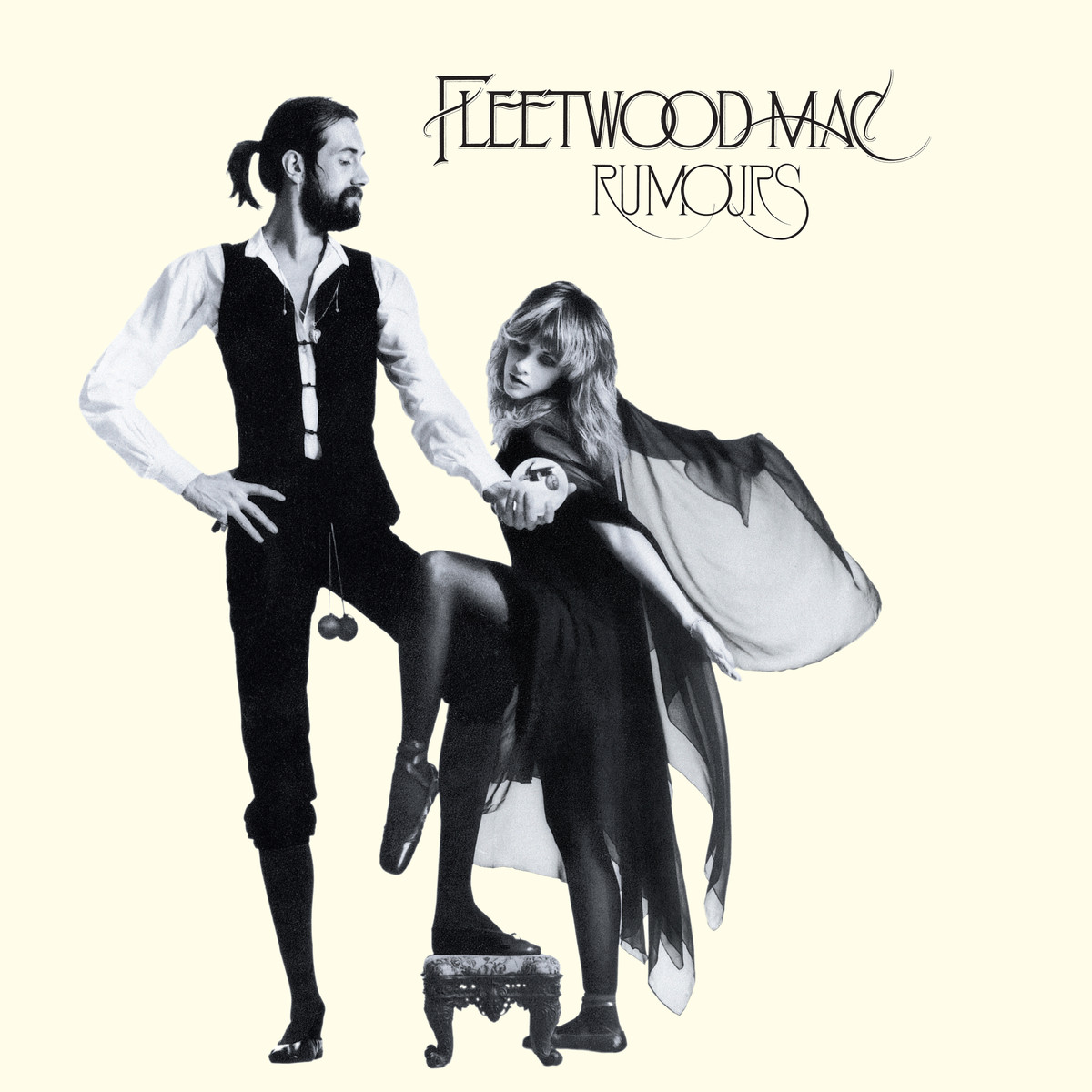
Fleetwood Mac's 11th album, made in 1976 as two couples in the band came apart. It spent 31 weeks at #1 in America, and the craft, more than the gossip, is why it lasts.
- Released
- 4 February 1977 (US, Warner Bros. BSK 3010); February 1977 (UK, Warner Bros. K 56344)
- Label
- Warner Bros.
- Producer(s)
- Fleetwood Mac, with Ken Caillat and Richard Dashut
- Runtime
- 39:03 (11 tracks)
- Chart peak (US)
- #1 (Billboard 200), 31 weeks at the top across 1977–78, not in one run
- Chart peak (UK)
- #1 (Official Albums Chart) for 1 week, on the chart dated 28 January 1978
- Certifications
- RIAA 21× Platinum (19 July 2023); BPI 17× Platinum (16 January 2025)
- Awards & honours
- Grammy for Album of the Year (1978), its only Grammy; National Recording Registry (class of 2017, announced in March 2018)
Rumours is remembered as a diary of break-ups, but the tapes tell of loops, splices, comped solos and a rescue from worn-out masters. Heartbreak supplied the songs, control made the record, and control is also what stopped it taking risks.
Some time in 1976, at Wally Heider Recording in Los Angeles, Ken Caillat began to think his ears were going. Each playback of the new Fleetwood Mac tapes sounded duller than the last. The tape itself was shedding, and the heads had to be cleaned after every pass. When he soloed the kick drum and then the snare, nobody in the room could tell which was which. The tapes had simply been played too often. What saved them was a habit of the Sausalito studio where the band had started. It ran two 24-track machines side by side on basic tracks, so a second set of masters existed. A technician at ABC Dunhill lined the two tapes up by ear, steering one machine's speed all night, so the overdubs could move onto fresh drums. Without him, Caillat said in 2007, the album would have been just about dead.
That night is a better key to Rumours than the gossip. The record came out on 4 February 1977: 11 songs in 39 minutes. Its legend is a diary. Two couples in the band were splitting up, a third marriage was ending offstage, and the songs were aimed across the room. All of that is true, and it gave the band its songs. But much of what we hear wasn't captured in one pass. It was built, from loops, splices, comped solos and rescued tape, and that's why it sounds so easy. It's also the record's limit. Rumours perfects a kind of pop-rock that already existed. It never gambles with its own form, and the one big call it made for the sake of its running order cost it the best song Nicks wrote for it.
The pressure came from success. The 1975 album Fleetwood Mac, the first with Lindsey Buckingham and Stevie Nicks, had sold 4 million copies by early 1977. It was by then Warner Bros.' best-selling record ever. Caillat remembers the day the label rang to say how important the follow-up would be. Suddenly everyone wanted to hear their own part soloed. Sound on Sound's 2007 history of the sessions says the band went to the Record Plant in Sausalito mainly to get away from attorneys and record-company executives. They arrived in February 1976, straight off a six-month American tour. Christine and John McVie, married for almost 8 years, had split and weren't speaking. Nicks and Buckingham were about to part as well. Mick Fleetwood was in the middle of a divorce.
Then they wrote about it. Nicks told Cameron Crowe in 1977 that her songs on the album were about people in the band. She made a partial exception of 'Gold Dust Woman', then said even that came into it. John McVie described the lump in his throat when he turned round and found the writer of a song sitting right there. Buckingham's 'Go Your Own Way' and Nicks's 'Dreams' answer each other, and she later called them “twin songs”. Christine McVie, by then seeing the band's lighting director, Curry Grant, wrote the bright 'You Make Loving Fun'. Caillat remembers Nicks and Buckingham screaming at each other between takes of its backing vocals. When the tape rolled, they sang it sweetly together, then went straight back to the insults. That's the album's real drama. Its harmonies were sung by people who had just been shouting at each other, and you can't hear the seam.
'Dreams' shows how the calm was made. Nicks told Blender she wrote it in about 10 minutes, on the bed in a side studio the Record Plant had built for Sly Stone. Accounts of what came next differ. In Caillat's version, she walked back in and played it on the Rhodes, the band joined in, and she sang a guide vocal. Caillat wanted a better take, because the drums leak into her microphone, but she couldn't beat it. The groove isn't quite a performance either. Fleetwood shifted his parts around, as Caillat says every drummer does, so the engineer made an 8-bar loop of his playing. He has said he's amused when people praise the rhythm section on this song, because what they're praising is a drum loop. Far from a scandal, the loop is the point. Caillat says it gave the song a deep, hypnotic effect, and that steadiness carries it for over 4 minutes.
Buckingham is the record's engine, and its foreman. 'Go Your Own Way' began with him beating an acoustic guitar as hard as he could. The drums came from a conversation in the car, overheard by Caillat, about Charlie Watts on the Rolling Stones' 'Street Fighting Man'. Buckingham asked Fleetwood for drums with big tom fills, like the Stones track. Fleetwood couldn't quite play it, and kept what he later called his “mutated interpretation”. That imperfect copy is the best thing on the track. Caillat built the closing solo from six or more takes, riding the faders like an instrument. On 'Second Hand News' Buckingham went further. He wanted a hint of disco, borrowed from the Bee Gees' 'Jive Talkin'', and got some of it by beating a Naugahyde chair. While John McVie was away, he replaced McVie's flowing bass part with a plain line of quarter notes. Caillat dates Buckingham's habit of calling the shots from that moment.
'The Chain' is the clearest case of all. It started as 'Keep Me There', a Christine McVie song and the first thing the band worked on in Sausalito. Caillat and Richard Dashut nearly got fired while chasing its drum sound. Caillat has put that struggle at 5 days in one interview and 8 or 9 in another. John McVie found his bass line during a run-through. Then the song stalled for months. Buckingham eventually had Caillat cut blank tape in where the verses had been. He wrote new verses around the section they all liked, and only the ending survived from the original track. They called it 'The Chain', Buckingham told Rolling Stone in 1977, “because it was a bunch of pieces”. It's the only song on the album credited to all five, and it's held together with splicing tape.
Christine McVie's four songs carry the record. Caillat heard 'Songbird' when she played it at the end of a session, and decided it needed a concert hall. On 3 March 1976 they recorded it at the Zellerbach Auditorium in Berkeley, on a 9-foot Steinway, with roses and coloured spotlights on the piano. Caillat put two microphones close and the rest at a distance, because he wanted the room to speak. The session ran until 7 the next morning, and Buckingham's acoustic guitar was recorded live alongside her. 'Don't Stop' is the one Caillat never liked. It only opened up, he says, when McVie asked Buckingham to make it a duet. 'You Make Loving Fun' got its bite from a Clavinet borrowed from Sly Stone's room. Fleetwood worked its wah-wah pedal on his hands and knees while she played.
For all that, Rumours is a careful record more than a daring one. Robert Christgau gave it an A minus in March 1977, and in the same review called it easy-listening rock. He later raised the grade to an A. Jessica Hopper gave the 2013 reissue a perfect 10 in Pitchfork and still found it “so flawless it feels far from nature”. Both of them are right. Nothing here changes what a rock album could be. The strangest sounds on it, Fleetwood's smashed glass and the jet-phased harpsichord on 'Gold Dust Woman', are colours added to a conventional song. Every track is shaped like a single, and none runs past 4:51. The care shows most in the running order, and that's where the album makes its one real mistake.
'Silver Springs', Nicks's song about Buckingham, was cut late in 1976 because it was too long for a 22-minute side. Caillat, by then in the ninth month of work, also worried that the album was coming out too slow. In its place the band recorded 'I Don't Want to Know', an older, country-ish song of Nicks's that she and Buckingham had played live. They cut the track without her. She was told in the car park, and she later wrote that the swap put a shadow over the new song. 'Silver Springs' ended up as the B-side of 'Go Your Own Way', the song Buckingham wrote about her. The swap gave the album a quick, cheerful song and took away a wounded one. With the plain 'Oh Daddy' beside it, the second half sags in a way the first never does.
None of that slowed it down. Warner shipped Rumours in greater quantities than any record in its history, Crowe reported in March 1977. It spent 31 weeks at #1 on the Billboard 200 across 1977 and 1978, which Billboard calls the longest reign ever for an album by a duo or group. On 23 February 1978 it won Album of the Year at the Grammys, beating Aja, Hotel California, JT and Star Wars. It won nothing else that night. Britain took longer. The album reached #1 there for a single week in January 1978, almost a year after release. By October 2026 it had spent 1,169 weeks in the Top 100. In 2023 the RIAA certified it 21× Platinum.
Its reputation has moved from the sales to the songs. In 2013 Pitchfork gave it that perfect score. In 2018 the Library of Congress added it to the National Recording Registry. In 2020 Nicks told Harry Styles that his album Fine Line was his Rumours, as if the title were a unit of measurement. That October a viral TikTok video sent 'Dreams' back into the Hot 100, at #21, for the first time since its 1977 run. The album climbed from 27 to 13 on the Billboard 200 the same month. Nobody streaming 'Dreams' in 2020 needed to know who had split up with whom. What they heard was the loop.
So Rumours earns its reputation, though not quite for the reason usually given. The confession sold it. What keeps it alive is the making: three writers at their best, three voices that fit, and a studio team that could save a dying tape and build a song from fragments. It's a great record, and you can hear that from the first bar of 'Second Hand News'. What it lacks is surprise. Its sounds were refined rather than discovered, and the one time it put order before feeling, it chose wrong. Side one still plays like a greatest-hits record. Side two has a gap in it the shape of 'Silver Springs'.
Pressing guide — the one to own
The original to own is the 1977 US Warner Bros. BSK 3010 in its textured sleeve, with the 11.5 × 23 inch fold-out insert. There are 80 catalogued US vinyl versions from 1977, pressed at several plants and told apart by their runouts. The Los Angeles, Jacksonville and Pinckneyville copies below carry 'MASTERED BY CAPITOL' and Ken Perry's 'KP'. The RCA club edition has its own matrix numbers.