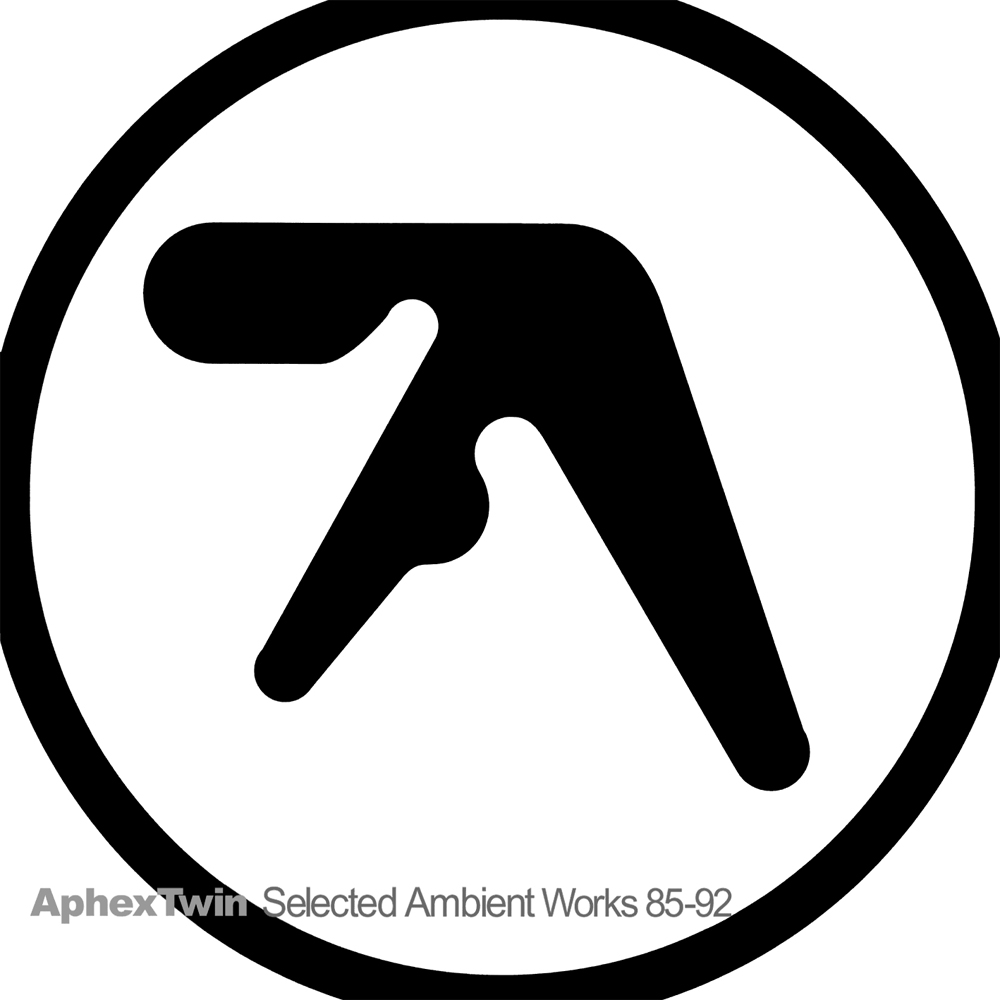
Aphex Twin's first album: 13 home recordings, mastered on a hi-fi cassette deck with the tape damage left in. Its tunes over rave drums shaped IDM, and its worn sound holds it back.
- Released
- 9 November 1992
- Label
- Apollo, the ambient imprint of R&S Records (Belgium): 2×LP AMB LP 3922, CD AMB 3922 CD, cassette AMB 3922 MC (the cassette credited to R&S Records)
- Producer(s)
- Richard D. James
- Runtime
- 74:20 (13 tracks, by the 1992 label timings)
- Chart peak (UK)
- Never in the Official Albums Top 100. #6 on the CIN Dance Albums chart (26 December 1992); later Dance Albums #5 (2022), and #10 on both the Vinyl and Independent Albums charts (April 2026)
- Certifications
- BPI Silver (26 March 2021)
- Awards & honours
- #1 in Fact's 100 best albums of the 1990s (2012); #1 in Pitchfork's 50 best IDM albums (2017)
Pitchfork called Selected Ambient Works 85-92 IDM's true founding document, and its reach earns that. What made it was melody over rave drums, on tracks chosen from a box of worn cassettes. The worn sound is its real limit, and its maker said as much in 1993.
In April 1993, Richard D. James told Future Music that the tape holding "Xtal" had been chewed in about seven places. He left the damage in. Everything on Selected Ambient Works 85-92 had been mastered to ordinary tape on a hi-fi cassette deck, and very little of it was EQ'd. He said he was surprised when people praised the sound, because he thought it was poor. The record Pitchfork would call IDM's founding document began life as a box of worn cassettes.
That origin explains both what's great about the album and what holds it back. The tracks weren't made as an album. Future Music reported in 1993 that friends in Cornwall had picked them from tapes they played on car stereos and Walkmans. James reckoned some of the masters had been through around 50 cassette players. Whoever did the choosing, the selection favours tunes over experiments, and it hangs together as a set of favourites rather than a design. It also sounds worn, because the tape is part of every track. The record's reach deserves the praise it gets. Its sound deserves less.
James was born in Limerick in 1971 and grew up in Lanner, in Cornwall. He told i-D in 1993 that he'd been making music since he was 12. That year he told Simon Reynolds he bought a synth at 12 and took it apart, and told Future Music he bought a Roland 100M at 13 and started customising his keyboards. "Digeridoo" came out of the same Cornish world. Future Music wrote that it was made to finish people off after nights of raving on Cornwall's beaches, and the Guardian later reported that a friend had asked him to write it. It was the favourite of his crowd at the Bowgie in Crantock, according to i-D. James told the magazine he knew there would be an audience for his music because he'd tested it out first.
The route to a label was short. In 1991 the Analogue Bubblebath EP became the first release on Mighty Force, Mark Darby's label in Exeter. Renaat Vandepapeliere, who had run the Belgian label R&S since 1983, heard a white label of it. He told Vice in 2014 that James came to Belgium in 1991 with a full box of cassettes, and he remembers him sitting in his apartment, listening to them. Two albums came out of that box, he says. Fact's 2017 account has the two of them picking out the 13 tracks. Future Music's 1993 account had James's friends doing it. Both may be true. Neither describes an artist planning a statement.
It came out on 9 November 1992, the first catalogue number on Apollo, the ambient imprint R&S founded that year. James was 21, and he'd moved to London in 1992. Vandepapeliere says techno purists hated his Aphex albums and accused R&S of destroying its name. He says he wanted to break the label open, and Apollo went on to issue records by Biosphere and Locust. What the purists heard as betrayal was, on the evidence of the record, melody. These tracks have tunes you can hum, and they sit over drums that never left the rave.
Start with "Xtal". The voice and the grainy chords aren't James's. They come from "Evil At Play", library music recorded in 1986, which the YouTuber SynaMax identified only in 2021. Under the sample sit what James called "modified 808 sounds". MusicRadar thinks they came from a Roland R-8 drum machine with an 808 card, and notes kicks repitched to carry the bassline. So a borrowed choir drifts over a kick drum made for dancing. It's too restless to be ambient and too gentle for a club, and that gap is where the album lives.
"Ageispolis" is the record at its best. Short melodic plucks open it, likely from an SH-101 by MusicRadar's reading, over another repitched-kick bassline and triplet hi-hat rolls. The Guardian's Geeta Dayal heard a grand, cinematic sweep in it. The trick is proportion. The melody is simple enough to whistle and the beat is firm enough to dance to, and James lets neither win. Philip Sherburne, writing for Pitchfork in 2017, called it the psychedelic blueprint for Boards of Canada. That's a critic's reading, but the music makes it easy to believe.
Two tracks lean on films. "Green Calx" runs on an acid patch that MusicRadar hears as more resonant than the one on "Ptolemy". Pitchfork's David Pecoraro heard industrial clanks around it, and a line of dialogue from RoboCop arrives at about 3:56. "We Are the Music Makers" takes its title and its spoken hook from Gene Wilder in Willy Wonka & the Chocolate Factory, first heard 11 seconds in. Underneath are DX7 electric-piano chords and a dark, low sawtooth bass. In 1993 James told Future Music he didn't sample records he bought, and the magazine noted Wilder and Julie Andrews as occasional exceptions. The album leans on borrowed voices more than that suggests. Three of its most memorable sounds come from a library recording and two films.
The kit behind it was modest, and much of it was modified. Future Music described a Casio FZ-10 sampler with custom filters, used, the magazine said, on 80% of his tracks. He also had a Korg MS-20, a modified Roland SH-101 and a Yamaha DX7. He later said an Alesis Quadraverb was on every track. By his own estimate the music was 99% sequenced, and only string parts were played by hand. So there's little performance here in the usual sense. What there is instead is patience. "Schottkey 7th Path" rests on what Pecoraro called a creeping keyboard loop, changed all the way through and never removed. "Heliosphan" puts triplet hi-hat rolls and a snare from the Apache break under a tune Dayal ranked among his best. The pleasure is in small changes to a figure that keeps coming round.
The title is the album's least accurate part. Only "i" fits it cleanly, with 73 seconds of a single pad through heavy reverb. Elsewhere the drums rarely leave. "Pulsewidth" sits on a dry four-to-the-floor kick. Fact's Joe Muggs heard in it, and in "Ptolemy" and "Delphium", a Cornish teenager who had grasped Todd Terry, Jamie Principle, Derrick May and Larry Heard. Sherburne heard Larry Heard's deep house in "Delphium". Even "Tha", at 9:01 the longest piece, splits critics. Pitchfork heard it as almost free of percussion, while Dayal heard beats buried in murk. Pitchfork said in 2017 that it isn't really ambient music, and Muggs that it is far from ambient in the true sense. DJ Mag split the difference in 2019, calling it an ambient record for the post-rave era. The drums make Pitchfork's case. Simon Reynolds reported in 1993 that James had only recently caught up with Cage, Reich, Eno and others. James told him that for years he'd known little beyond acid and techno. The Eno lineage is the critics' idea, not his.
The cost of the archive is the sound. MusicRadar traces its background noise, muddiness and audible distortion to cassettes transferred to DAT for the finals. On the gentler tracks the hiss works as distance, and Muggs compared it to Burial. On "Hedphelym" it becomes a problem. Pecoraro described a house throb in feedback haze, and DJ Mag heard atonal drones over a crunching, distorted thud. There the murk swallows the tune, and 6 minutes feel long. Pecoraro, scoring the album 9.4 in 2002, still allowed that it might sound somewhat dated. Kris Needs said in 2008 that it hadn't dated at all. On "Hedphelym", Pecoraro has the better of it.
It wasn't a secret for long. Music Week reported in December 1992 that it was selling on import for up to £20, and that Vandepapeliere had turned down a UK licensee. It still entered the CIN Dance Albums chart at #6 on 26 December 1992. A month later James had two albums in that top 10, the other being Surfing on Sine Waves as Polygon Window. In June 1993, Kodwo Eshun reported in i-D that it had sold 30,000 copies. Yet the album has never entered the Official Albums Top 100. The BPI certified it Silver only on 26 March 2021. It has kept selling. The 2008 remastered CD entered the indie chart at #49. In April 2026, the month a Rough Trade picture disc came out, the album reached #10 on both the vinyl and the independent albums charts.
The idea that it invented a genre needs correcting. Warp's compilation Artificial Intelligence came out on 6 July 1992, four months earlier, and sold itself as "electronic listening music". James was on it, as The Dice Man. Pitchfork traced the IDM name, at least obliquely, to that compilation, then put this album at #1 of its 50 best IDM albums in 2017. Fact had named it the best album of the 1990s in 2012. Most of the influence is argued by critics. Pecoraro called it the foundation for the careers of Boards of Canada and Plaid. Sherburne heard the template for industrial techno in "Hedphelym", so even its weakest track had heirs. Among musicians, the producer Paul White told Fact it was what led him into electronic music. James has made his dislike of the IDM label plain.
So what's it worth now? Its opening 23 minutes, from "Xtal" to "Ageispolis", are the album at its warmest and most assured. Its reach outruns its execution, though. The sound is worn in ways its own maker disliked, "Hedphelym" is a dead patch, and the title points listeners to the wrong tradition. None of that cancels the tunes. It does mean the reverence is often aimed at the wrong things, at the hiss and the founding myth. What deserves it is a handful of melodies over rave drums, pulled from a box of tapes that had been played until they wore thin. That's a very good record, and an important one. It's not a flawless one.
Pressing guide — the one to own
The original is the 1992 Belgian double LP on Apollo, AMB LP 3922. Neither the sleeve nor the labels carry that number: it appears only in the runouts. The tells are no barcode, three tracks each on sides C and D, and a side-D runout reading 'AMB LP 3902- D2'. Early represses share those matrices and add a barcode to the rear sleeve; one also exists with 'DIL' in the runouts. No pressing plant is credited on any 1992 vinyl issue, while the 1992 CD was glass-mastered by DADC in Austria. An unofficial Czech and Slovak double LP copies the missing barcode, the missing catalogue number and the three-and-three split, so check the runouts against the original's matrices, and pass on translucent vinyl.