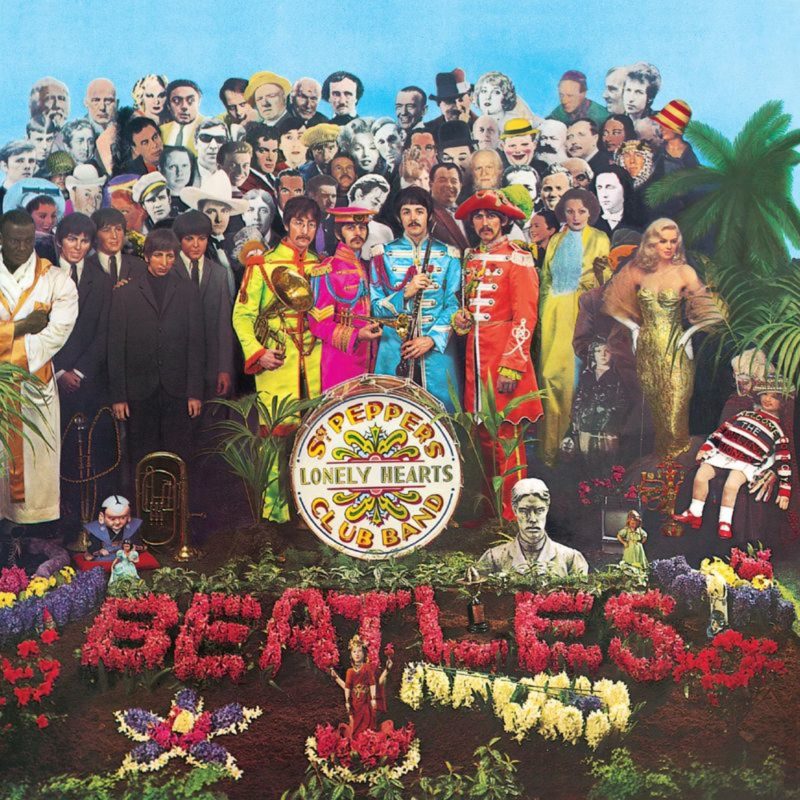
The Beatles' eighth album, made over 5 months at Abbey Road once they'd stopped touring. Its triumph is the studio work, not the songs or the fictional band on the sleeve.
- Released
- UK: in shops from 26 May 1967, ahead of the official date of 1 June (Parlophone PMC 7027 mono, PCS 7027 stereo). US: 1 or 2 June 1967, sources differ (Capitol MAS 2653 mono, SMAS 2653 stereo)
- Label
- Parlophone (UK), Capitol (US)
- Producer(s)
- George Martin
- Runtime
- 39:52 (2009 CD timings, including the run-out groove)
- Chart peak (US)
- #1 (Billboard), 15 weeks in a row, 1 July to 7 October 1967
- Chart peak (UK)
- #1 (Official Albums Chart), 23 weeks in a row from June 1967; 27 weeks at #1 in the first run, and one more in June 2017
- Certifications
- RIAA 11× Platinum (Diamond, 10 January 1997); BPI 18× Platinum (10 August 2020); Music Canada 8× Platinum
- Awards & honours
- Four Grammys at the 10th awards (29 February 1968), including Album of the Year; National Recording Registry, Library of Congress (2003)
Its concept lasts two songs and a reprise, and its songs fall short of Revolver's. Sgt. Pepper is still one of the great records, because what it does to sound changed what an album could be.
On 22 February 1967, in Studio Two at Abbey Road, four men sat at three pianos. John Lennon, Paul McCartney, Ringo Starr and their assistant Mal Evans struck one chord together, and George Martin played it with them on a harmonium. As the sound died away, the faders were pushed up to follow it, and it hangs for more than 40 seconds. It ends 'A Day in the Life', the last song on Sgt. Pepper's Lonely Hearts Club Band. It isn't a tune, or a performance in the usual sense. It's a sound made in a studio, and it could only exist on a record.
That chord is the album's argument in small. Sgt. Pepper isn't great because of its concept, which barely exists. By Walter Everett's account, Lennon and Starr both thought it covered only the first two songs and the reprise. Nor is it great because of its songs, which are weaker than those on Revolver, released 10 months earlier. It's great because of what the Beatles, Martin and their engineers did to sound. They treated a four-track studio as a place to build things no band could play live, and the records that followed took the lesson. That's also why the album still belongs near the top, long after critics stopped calling it the best.
The way it sounds starts with a decision. The Beatles played their last concert at Candlestick Park in San Francisco on 29 August 1966, and George Harrison had said he'd leave unless the touring stopped. They took 3 months apart. Harrison spent 6 weeks in India studying with Ravi Shankar, and Lennon went to Spain to act in How I Won the War. McCartney scored a film, The Family Way, with Martin, then went to Kenya with Evans. When they met at Abbey Road on 24 November 1966, nobody needed them on a stage again. Every song could be built for the record alone, and that freedom explains the album's best moments as well as some of its worst.
The sessions began with 'Strawberry Fields Forever', followed by 'When I'm Sixty-Four' and 'Penny Lane'. The first and last of those look back to Liverpool, and Ian MacDonald and Pitchfork's Scott Plagenhoef both describe an album about the city that was later dropped. EMI and Brian Epstein wanted a single, and pressed Martin for one. So the two Liverpool songs came out together in February 1967 and, as the band's habit was, stayed off the album. The single missed #1 in Britain, and the papers asked whether the bubble had burst. Martin later called dropping the two songs the biggest mistake of his professional life. He was right. They're better than half of what replaced them.
The fictional band was McCartney's idea, though at first it was only a song. It came to him on the flight home from Kenya in November 1966, and Evans helped coin the name. McCartney has said it began with him mishearing Evans ask for the salt and pepper. Only in February 1967, the month the single came out, did it grow into a plan to present the whole album as that band's show. Pitchfork calls the fictional band the album's second concept, and the dates agree. So the frame does look like a patch over the lost Liverpool theme. McCartney's thought was that an alter ego would free them from being the Beatles. That freedom mattered more than the story, which never really held.
What held the album together was the studio. EMI's four-track machines meant finished parts had to be mixed down to free tracks for more. For the orchestra on 'A Day in the Life', Ken Townsend ran two machines in sync. Tape speed and Townsend's artificial double-tracking were tools as well, used on voices as freely as on instruments. The limits show in the result. For all its detail, the album rarely sounds crowded, because every layer had to earn its place on the tape. Martin put the whole job at about 700 hours, and most of the care went into the mono mix. Geoff Emerick recalled 3 weeks on the mono against perhaps 3 days on the stereo, and Mark Lewisohn says the Beatles had little to do with the stereo. The mono is the record they made.
Listen to how the opening is assembled. The crowd murmur comes from EMI's tapes of concerts at the Royal Albert Hall and the Queen Elizabeth Hall, and the laughter from Martin's own recording of Beyond the Fringe. McCartney plays lead guitar, and four French horns play a passage he arranged with Martin. The song crossfades into 'With a Little Help from My Friends', where Starr sings as Billy Shears. On 'Lucy in the Sky with Diamonds', McCartney's phrase on a Lowrey organ was treated with ADT until it sounded like a celeste. Harrison's guitar shadows Lennon's vocal, and Peter Lavezzoli hears a sarangi player following a khyal singer there. Harrison had come back from India with a technique, and here it shapes a Lennon song.
'Being for the Benefit of Mr. Kite!' takes the same method further. Lennon took his words almost entirely from an 1843 circus poster he'd bought in an antique shop in Sevenoaks. By Mark Lewisohn's account, he told Martin he wanted "to smell the sawdust on the floor". Martin's answer, after much failed experiment, was to have Emerick cut tapes of fairground organ into pieces, throw them in the air and splice them back together. The song itself is slight, a circus bill set to music. The production makes it one of the album's best moments, because it turns a recording into a place you can stand in. That's the album's real gift, more than any single tune.
'A Day in the Life' is the best thing on the record, and the one place where the songwriting matches the method. Lennon's verses drew on a Daily Mail report of 17 January 1967 about the death of Tara Browne, a 21-year-old Guinness heir. McCartney's middle section came from memories of mornings before school. Martin's orchestra joins them with a part that climbs from each instrument's lowest note to its highest over 24 bars, with reference points in every bar. Forty players recorded it in Studio One on 10 February, in evening dress and party props, with Mick Jagger and Donovan among the guests. The climb comes twice: the first takes Lennon's verse into McCartney's section, and the second leads to the chord. Plagenhoef wrote in 2009 that the song has only grown. He's right, and the rest of the album is better for its company.
The weaknesses are real, and they're in the writing and the playing more than the sound. The concept is the obvious one. Lennon said his songs had nothing to do with Sgt. Pepper's band, and Plagenhoef called the idea "rather daft". It lasts two songs, a reprise and a sleeve. The songs are uneven too. 'Lovely Rita' and 'Good Morning Good Morning' are clever and minor. 'Within You Without You' carries a sermon that Alexis Petridis found smug in 2017, though he thought the music rescued it. Peter Clayton counted 'She's Leaving Home' among the best tracks in Gramophone in 1967, and Plagenhoef notes how far it has slid from view since. Much of the album isn't a band playing, either. No Beatle plays on 'She's Leaving Home', and only Harrison plays on 'Within You Without You'. Harrison said he liked about half the songs and couldn't stand the rest.
None of that slowed it down in 1967. It entered the British chart at #8, then spent 23 weeks in a row at #1. In America it held #1 on Billboard for 15 weeks from 1 July. Not every critic was won over. In the New York Times, Richard Goldstein called it an album of special effects, "dazzling but ultimately fraudulent". Kenneth Tynan, the theatre critic, called it a decisive moment in the history of Western civilisation, though sources quote his wording differently. In February 1968 it won four Grammys, including Album of the Year. The praise has lasted better than the complaint, but Goldstein saw where the album's strength lay, even if he didn't value it.
Its influence is easier to document than to measure. It was the first Beatles album issued with the same track list in Britain and America, so for once American buyers heard the same songs in the same order. Keith Richards later called the Stones' Their Satanic Majesties Request "a bit of flim-flam". It was time for another Stones album, he said, and Sgt. Pepper was coming out. Robert Fripp said his life was never the same after hearing it. Roger Waters, looking back on The Dark Side of the Moon, said he learned from Lennon, McCartney and Harrison that Pink Floyd could write about their own lives. More than any other record, he said, Sgt. Pepper gave his generation permission to do whatever they wanted. The author Martina Elicker credits it with making 'concept album' a familiar term. McCartney, though, told people during the sessions that this was the Beatles' version of Freak Out!, the Mothers of Invention's 1966 debut.
Its reputation has moved more than its sound has. NME's critics put it first in 1974 and left it off their list in 1985. Robert Christgau, who had defended it against Goldstein in 1967, found it "bound to a moment" by 1976. In 1981 Lester Bangs decided Goldstein had been right. Reviewing the 2017 edition, David Quantick wrote that its standing lasted nearly 20 years, until the CDs arrived and Revolver and the White Album shifted the balance. In 1998 Colin Larkin's list of the top 1,000 albums put it at #2, behind Revolver. That December, Melody Maker polled 60 musicians, DJs and journalists, who voted it the worst album ever made. On the songs, the doubters are right: Revolver's are stronger and steadier. But judging Sgt. Pepper by its songs misses what it was for.
Judged on what it does, Sgt. Pepper is one of the best albums ever made. Its strengths are its production and its invention: the crowd and horns of the opening, the spliced tape of 'Mr. Kite!', the orchestra and the chord. Its weakness is that too many songs don't earn the work spent on them, and the concept never got past the costume. Hear the mono, the mix the band actually worked on. Then play Revolver and decide which you'd rather keep. It may well be Revolver. But the records that came after sound more like this one.
Pressing guide — the one to own
The original to own is the 1967 UK mono, Parlophone PMC 7027: the mix the Beatles worked on. It has black-and-yellow Parlophone labels with 'The Gramophone Co.' on the rim, and runouts reading XEX 637-1 and XEX 638-1, with mother and stamper letters. The laminated gatefold was printed by Garrod & Lofthouse. A complete copy keeps the red-and-white inner sleeve and the card of cut-outs. Narrow-spine and wide-spine sleeves are both catalogued as first pressings, and neither listing says which came first.