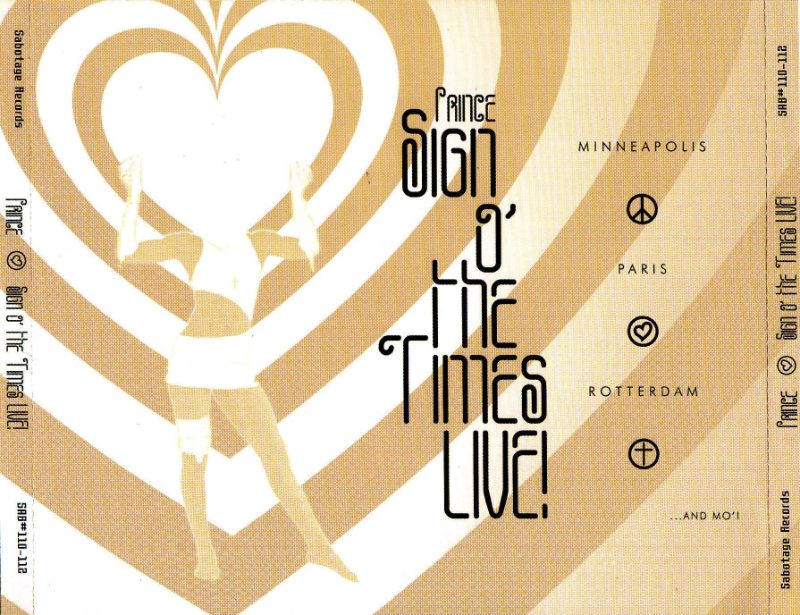
Prince's ninth album, a double LP built in 1986 from a broken-up band and three records that never came out. Its best songs are among his finest, and the joins still show.
- Released
- 30 March 1987 (UK); 31 March 1987 (US)
- Label
- Paisley Park / Warner Bros. (US 9 25577-1; UK WX 88)
- Producer(s)
- Prince
- Runtime
- 80:06 (16 tracks across 2 LPs, by the label timings)
- Chart peak (US)
- #6 (Billboard 200, 9 and 16 May 1987)
- Chart peak (UK)
- #4 (Official Albums Chart, chart dated 11 April 1987)
- Certifications
- RIAA Platinum (2 July 1987); BPI Platinum (31 August 1990)
- Awards & honours
- #1 in the Village Voice Pazz & Jop critics' poll for 1987. Nominated for Album of the Year at the 30th Grammys, which The Joshua Tree won. Grammy Hall of Fame, 2017
Sign 'O' the Times was salvaged from a year of losses: the Revolution, a flop film, Dream Factory, Camille and Crystal Ball. The salvage is why it's great, and why, at 80 minutes, it never quite becomes one record.
The first song Prince cut at his new home studio came out wrong. In March 1986 the console at his house on Galpin Boulevard, in Chanhassen, Minnesota, wasn't finished being installed. Prince wanted to record, so the designer was sent home. Susan Rogers, his engineer, has described what followed. One of the console's power supplies was down, and everything came out muffled, as if heard from underwater. Prince listened and kept it. 'The Ballad of Dorothy Parker' sits fourth on Sign 'O' the Times with the fault still audible. It's one of the strangest and best things he ever recorded.
The whole album was made that way. Before it, Prince watched a film flop, broke up his band and saw three albums go unreleased. Sign 'O' the Times is what he built from the pieces. There's a live track by the band he'd let go. There are songs begun years earlier, one as far back as 1979, and songs from an abandoned album sung by a sped-up alter ego. Around them sits what was left of a triple album his label refused. That salvage is why the record is great. It's also why, at 80 minutes, it never quite turns into one thing.
Some of the losses were commercial. After Purple Rain, his stock had dipped with Around the World in a Day and Parade, and his film Under the Cherry Moon had flopped. On 29 March 1987 the Razzies named it joint worst picture of the year, with Howard the Duck, and Prince the worst actor. The next day, by the BBC's account, Sign 'O' the Times was in the shops. Rogers has said one aim of the record was to win back Black radio. She called the title track a serious attempt at social commentary. Both goals show. This is a record that wants to be heard, and taken seriously, by people who'd stopped listening.
The band went next. Dream Factory, a double album made with Wendy Melvoin and Lisa Coleman, was shelved. On 17 October 1986 a press release announced that the Revolution was over, opening with a quote from Joni Mitchell. The musicians had asked for a raise; Duane Tudahl has said their pay was $800 a week. Rogers has linked the tension to Prince's engagement to Susannah Melvoin, Wendy's twin. The keyboard player Matt Fink tried to talk him out of it, and stayed. Whatever the reasons, the result was a man alone in a room with the instruments, and no band left to argue with.
Alone, Prince turned into someone else. Camille, which began with 'Housequake', was an album sung entirely by a pitched-up alter ego. Rogers has explained the trick. He sang over tape running slow, so his voice came back high at normal speed. Camille ran to eight songs, and test pressings were made. Then he folded it into Crystal Ball, a three-LP set, and submitted that to Warner Bros. late in 1986. The label said no. Rogers has said nothing like that had happened before. By Tudahl's account seven songs came off. Prince rebuilt the set around the title track and added 'U Got the Look'.
The method was speed and solitude. Rogers has said songs came out of him like a sneeze, and he often finished one in a day. He cut his vocals alone while she waited outside the door. Accidents stayed in. On 'Forever in My Life' the backing vocals arrive before the lead, a slip he decided to keep. Even the party on 'Housequake' is partly the studio crew: the credited party voices include Rogers and her fellow engineer Coke Johnson. Few other musicians appear at all. Wendy and Lisa are heard on 'Slow Love' and 'Strange Relationship'. Sheena Easton sings on 'U Got the Look', and Eric Leeds and Atlanta Bliss add saxophone and trumpet.
The title track shows what being alone made possible. Tudahl dates it to 15 July 1986, at Sunset Sound in Los Angeles. The BBC's oral history says it followed an earthquake there. It opens on a news item, a death in France from AIDS. Crack, gangs, a hurricane and a rocket explosion follow, one after another, in the same level voice. Nelson George, reviewing it for Pitchfork in 2016, heard it as Prince's own version of 'The Message'. That reading fits. Nobody else plays on the track, and the arrangement never comments on the news it carries. On the album the vocal ends at 3:37, and the track runs on without him for about 80 seconds. The single edit had no room for that.
The songs with Camille's voice are where the record finds a subject of its own. 'If I Was Your Girlfriend' is sung in the sped-up voice, credited on the sleeve to Camille, and that changes what the song asks. A man asking to be his lover's girlfriend is one kind of song. The same request in a voice pitched up on tape is stranger and more tender, and it doesn't resolve into a joke. 'U Got the Look' goes the other way, loud and blunt. Prince said in 1994 that he made it to test whether a friend who loved Robert Palmer's 'Addicted to Love' would dance to it. Easton has said she was asked only for backing vocals. He liked her loose take, and built a duet around it. It reached #2 in America, the album's biggest US hit.
Side four is the best run of songs he put on one record. 'The Cross' starts on acoustic guitar and sitar, Nelson George notes, and builds into drums and fuzz guitar. 'It's Gonna Be a Beautiful Night' was recorded live in Paris with the Revolution, and the obi on Japanese copies calls it the band's last recording. Sheila E.'s rap was added later, in Los Angeles. Then 'Adore' closes the record with 6:29 of slow soul. After the bulletin that opens side one, it's an odd place to end. It's also the right one. The record starts by reading the paper and finishes in bed, and it makes both rooms feel like the same house.
The trouble is the middle. Rogers, who was there, sorted the songs herself into core songs and segue scenes. Her segue scenes are 'I Could Never Take the Place of Your Man', 'Slow Love', 'It' and 'Forever in My Life'. That's close to 20 minutes, and the tag is fair to at least two of them. 'It' leans on its title as a riff and doesn't go anywhere. 'Hot Thing', which she doesn't name, is a groove waiting for a song. Rogers also says each side was meant as an act in a play. That design is hard to hear. The album holds together because one person made all of it, not because its four sides build an argument.
Critics heard the flaws as well as the gifts, then and since. Rolling Stone's 1987 review complained about the sprawl, and about Prince starting to repeat himself. Robert Christgau gave it an A in the Village Voice, later raised to A+. Writing up the 1987 poll, he still faulted Prince as a lyricist, and named the title track as his example. Nelson George gave it 10 out of 10 in 2016 and still found the drums "clearly of their era". The critics' verdict came fast anyway. The Village Voice's Pazz & Jop poll for 1987 put it first with 1,491 points and a 579-point margin. Christgau called it "easily the biggest winner" in the poll's history.
Buyers were slower. It entered the Billboard 200 at #40 and peaked at #6 in May 1987, behind U2's The Joshua Tree. The Joshua Tree also beat it to Album of the Year at the Grammys. Prince didn't tour it in America. In Europe the Wembley shows were cancelled, and the concert film shot in Rotterdam was partly reshot at Paisley Park. Its RIAA certification is still the Platinum it reached on 2 July 1987. The reputation has grown since, but it hasn't overtaken Purple Rain's. Rolling Stone ranked it #93 among the greatest albums in 2003 and #45 in 2020, with Purple Rain at #8. Pitchfork's 1980s list put it at #17, and Purple Rain first.
Its documented influence is thin, too. Simple Minds took the title track to #18 in Britain in 1989, and TLC covered 'If I Was Your Girlfriend' on CrazySexyCool in 1994. That's a short list for a record of this standing. Part of the reason may be the method. A record made by one man playing nearly everything, often through a varispeed voice, is hard to borrow from. You can copy a sound. You can't easily copy a year of losses turned into 16 songs. Sign 'O' the Times became the album critics reach for when they want to show Prince was more than a pop star. Rogers has said her hunch is that he never recognised what he'd made.
She may be right that he didn't, and it doesn't matter. At its best, this is as good as anything Prince made. The title track, 'Housequake', 'If I Was Your Girlfriend', 'U Got the Look', 'The Cross' and 'Adore' are six different musicians, all of them him. The singing and playing are the record's real strength, and the songs nearly match them. Its weakness is built into its history. It was assembled from three abandoned albums under a label's veto, and you can hear where the pieces were trimmed to fit. Play the core and it's a great record. Play all four sides and it's a great record with a sag in the middle, which is still more than most double albums manage.
Pressing guide — the one to own
The original to own is the 1987 US double LP, Paisley Park 9 25577-1. A complete copy has the heart-shaped 'Specially-Priced Two Record Set' sticker on the shrink and two printed dust sleeves with photos, lyrics and credits. Some copies also carry a New Breed fan-club postcard. US copies were pressed at Allied and at Specialty, and the runouts say which. The British catalogue number is WX 88, but those copies were made in Germany from US-plated mothers.