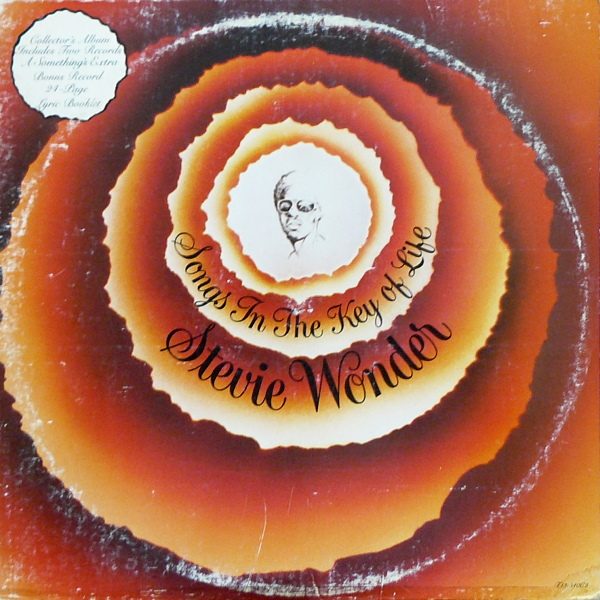
Stevie Wonder's 1976 double album plus a bonus EP: 21 songs in 104 minutes, made under a contract Billboard called an industry high. The songs are his best. The shape is the weak point.
- Released
- 28 September 1976 (US, Tamla); 29 September 1976 (UK, Motown)
- Label
- Tamla (US, T13-340C2); Motown (UK, TMSP 6002)
- Producer(s)
- Stevie Wonder
- Runtime
- 104:38 (two LPs, 86:30, plus a 4-song 7-inch EP, 18:08; 21 tracks)
- Chart peak (US)
- #1 (Billboard 200; entered at #1 on 16 October 1976; 14 weeks at #1, 13 of them in a row) · #1 (Billboard Soul LPs)
- Chart peak (UK)
- #2 (Official Albums Chart), 3 weeks at #2; 62 weeks on the chart
- Certifications
- RIAA Diamond (29 March 2005); BPI Platinum (1 December 1976); Music Canada 2× Platinum (1 April 1978)
- Awards & honours
- 4 Grammys (February 1977): Album of the Year; Best Pop Vocal Performance, Male; Best R&B Vocal Performance, Male ('I Wish'); Producer of the Year. #1 in the Village Voice Pazz & Jop poll for 1976. National Recording Registry (2005). #4 on Rolling Stone's 500 Greatest Albums (2020)
Wonder's finest writing is all here, played by him and a band at full stretch. So is his one bad habit: he wouldn't cut a song he cared about. The genius and the flaw are the same thing, and the album's second half is where you feel the cost.
Gary Olazabal and John Fischbach, the two engineers on Songs in the Key of Life, had T-shirts that read 'Are We Finished Yet?' and 'Let's Mix "Contusion" Again'. They'd mixed that instrumental at least 30 times. In August 1975 Billboard told the industry that Stevie Wonder's next record, a double album, was expected that autumn. It came out on 28 September 1976, about a year late. By then it was two LPs, a 7-inch EP and a 24-page booklet. Olazabal later explained the EP simply. There were songs Wonder couldn't fit on two records, and he wanted them in the package anyway.
That refusal to cut is the record's genius and its flaw, and you can't have one without the other. Song for song, this is the best writing of Wonder's life, sung and played with a confidence few records of the decade can match. It's also 104 minutes long, because when the songs wouldn't fit on two records, Wonder added a third record rather than lose them. Vince Aletti's review in Rolling Stone, in December 1976, likened it to a feast that had turned into a potluck. He was half right. The food is extraordinary. But the meal runs on, and by the second half you can feel it.
The length came out of freedom, and Wonder had won that freedom twice. In 1971, when he turned 21, he let his Motown contract lapse and came back with creative control and a bigger royalty. The first record under that deal was Music of My Mind, in 1972. Innervisions and Fulfillingness' First Finale then won Album of the Year at the 1974 and 1975 ceremonies. By 1974 he was talking in public about giving up music to work with handicapped children in Ghana, and a farewell tour was floated. Rolling Stone notes that some saw the talk as leverage on Motown.
If it was leverage, it worked. On 16 August 1975 Billboard's front page called his new contract an industry high: $13 million guaranteed against royalties, at a royalty of at least 20%. Rolling Stone later set out the rest. The deal ran for seven years. He kept control of his publishing and could record anywhere, with anyone. He had a veto over singles, and Motown couldn't be sold without his approval. Wonder said he stayed because Motown was the only viable Black-owned company left in the record business. Terms like those removed every outside reason to stop, and he didn't. The wait became a joke. Accepting Album of the Year in February 1976, Paul Simon thanked Wonder for not making an album that year.
What he wanted was range. The working title was Let's See Life the Way It Is. According to Rolling Stone's 2016 history, the final title came to him in a dream, and he set himself the challenge of writing about as many subjects as he could. So the record holds a song for a daughter born in February 1975, a tribute to Duke Ellington, a song about his own childhood and a history lesson for the Bicentennial year. A brief like that can't produce an arc, and the album doesn't have one. It has a spread.
Most of it was made at Crystal Sound, Fischbach's studio on the east side of Hollywood. There were sessions at the Record Plant in Los Angeles and in Sausalito. At the Hit Factory in New York, Fischbach spent about 6 weeks with Wonder, without Olazabal, working on a single basic track. A trip to Jamaica produced a backing track nobody used. The sessions ran for about two and a half years, and Wonder sometimes stayed in the studio for 48 hours. Fischbach reckons something like 200 songs reached some stage of recording. More than 130 people worked on the record, by Rolling Stone's count, Herbie Hancock and George Benson among them. Yet Aletti wrote that Wonder sang the leads and most of the backing parts, and that many tracks credited nobody else. Shirley Brewer's reply in 'Ordinary Pain' is about the only exception. The crowd is real, but it stands around a one-man album.
Side one is the strongest case for the whole. Robert Christgau, who gave the album an A, praised the way it moves: from preaching, to intimacy, to an ironic string-quartet minuet, to a jazz-funk tribute. The minuet is 'Village Ghetto Land', and its strings aren't strings. They're the Yamaha GX-1, a $60,000 synthesizer Wonder called the Dream Machine, recorded through its own speaker cabinets like a string section. Setting a song about a ghetto to drawing-room music is the sharpest idea on the record. It runs straight into 'Contusion'. Then comes 'Sir Duke', for Ellington, who'd died in 1974. Sound on Sound traced the odd edge on its horns to microphones placed behind the four players as well as in front.
Side two opens with 'I Wish', the last song finished. Rolling Stone says Wonder wrote its lyric after a Motown company picnic, replacing an earlier one about war, and called Nathan Watts back to the studio at 3am to play on it. It looks back at childhood and never goes soft, because the groove won't sit still. Two tracks later comes 'Pastime Paradise', the strangest song here. It has no live rhythm section. Instead there's percussion from Ray Maldonado and Bobbye Hall, finger cymbals, a clapboard snare and Wonder's keyboard bass. A gong plays backwards, made by turning the tape over at Sausalito. Over the closing section, Hare Krishna devotees chant while a choir from West Angeles Church of God sings a version of 'We Shall Overcome'. Olazabal had recruited the devotees on Hollywood Boulevard. Two traditions sing at once, and neither gives way.
For all his doubts, Aletti heard the album at its best in the love songs. He named 'Knocks Me Off My Feet', 'Isn't She Lovely' and 'Another Star', and he was right about all three. 'Another Star' closes the double album at over 8 minutes and earns every one of them, with Benson, Bobbi Humphrey's flute and four horns over a groove Aletti heard as Brazilian. 'Knocks Me Off My Feet' does the opposite. It gets to its chorus inside a minute and is gone in 3:35.
But the second half is where the length starts to cost. Sound on Sound's history of the sessions noted Wonder's reluctance to end a song without a long outro built on a jam. The timings bear it out. In 'Isn't She Lovely' the singing is over by about 2:38 of 6:33. The rest is Wonder's harmonica over the band, the playing Aletti singled out. On the long fade, according to Rolling Stone, Aisha can be heard in the bath with her father. 'Black Man' goes from 4:49 to 6:27 without a sung line. Aletti thought 'As' dragged into repetition at the end, and that the question-and-answer closing 'Black Man' was too harsh to work as music. Each long track has a defence. Together, the third and fourth sides ask for a patience the first two have already used up.
Aletti's other charge was the lyrics, which he found clumsy and badly rhymed. He named 'Have a Talk with God' and 'Pastime Paradise'. This charge has less force. Some lines clunk, but on a record this melodic they pass in seconds. The length doesn't. The EP, A Something's Extra, is the length made physical, and Aletti called it self-indulgent. That's too harsh for 'Saturn', which began as 'Saginaw' until Michael Sembello misheard the title. It deserved a place on the album proper. But 'Easy Goin' Evening (My Mama's Call)' is a second ending, after 'Another Star' had already closed the show. It's there because Wonder wanted it in the package, not because the album needed it.
None of this slowed it down. Motown shipped 1.3 million units on 29 September 1976, the biggest day in its 16-year history, according to Billboard. On 16 October it entered the Billboard 200 at #1. Only two albums had done that before, both by Elton John, so this was the first by an American act. It held #1 for 13 weeks running and 14 in all. In February 1977 it won four Grammys, among them Album of the Year, his third in four ceremonies. The afterlife has been as long. Coolio built 'Gangsta's Paradise' on 'Pastime Paradise', and it spent 3 weeks at #1 in September 1995. In 2005, around the time of Late Registration, Kanye West said he was measuring himself against this album and Innervisions.
The critics' poll agreed with the public. It topped the Village Voice's Pazz & Jop poll for 1976, and Rolling Stone ranked it #4 of all time in 2020. When Pitchfork gave it 10.0 in 2016, Alan Light argued that the excess is the point. He also noted that Wonder's work deflated afterwards, starting with Journey Through the Secret Life of Plants. Wonder told Q in 1995 that of all his albums, this is the one he's happiest with. Fifty years on, the sessions are still giving: four unheard songs from them came out on 28 September 2026.
Light is right about the songs and wrong about the excess. The excess isn't the point. It's the price, and it's worth paying for songs this good. Nothing Wonder made afterwards comes near them. Songs in the Key of Life is one of the great collections of songs in popular music, and a slightly lesser album than those songs deserve. Play the first two sides and you hear a writer at the height of his powers. Play all four sides and the EP, as he meant you to, and you hear a man who couldn't bear to drop a song he believed in. That's the flaw. It's also why the best of it sounds so generous.
Pressing guide — the one to own
The 1976 US original is a set of four parts in a gatefold. There are two Tamla LPs (T13-340C2), coupled sides 1 and 4, 2 and 3. There's a 7-inch EP with its own catalogue number (T 340EP, labels 2649-S and 2650-S), and a 24-page lyric booklet. A front sticker lists the two records, the bonus record and the booklet. The runouts carry 'XTAL', for Crystal Sound, where Jeff Sanders and Andrew Berliner cut the lacquers. Every 1976 US vinyl version in the catalogue lists the EP, so a copy without it is incomplete, not an early state.