
Deep Dive
Stankonia
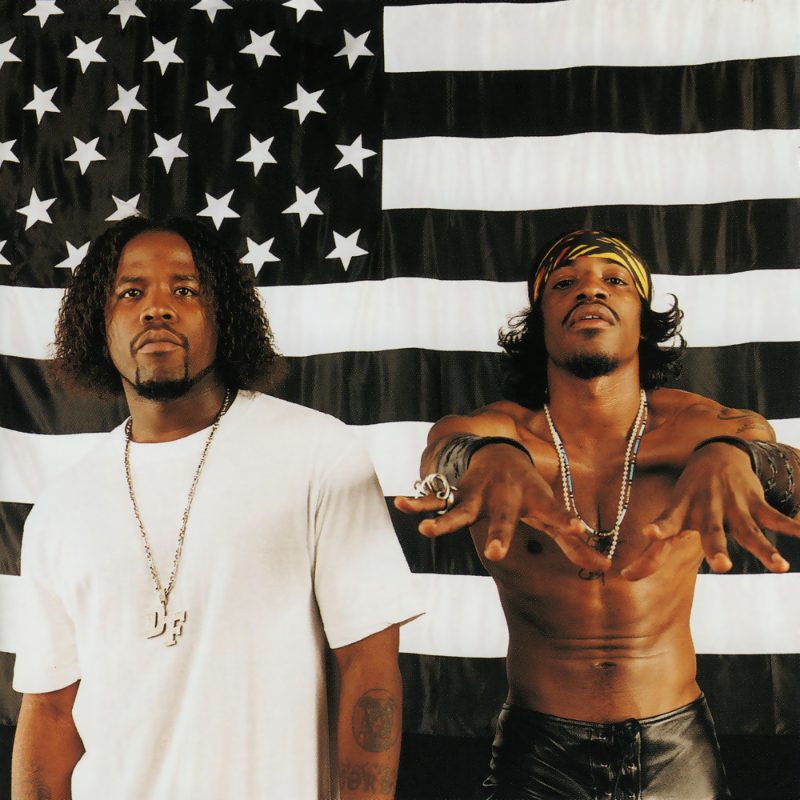
Stankonia by OutKast (2000) — what a copy is worth and which pressing to own, in a full Lead-In dossier: OutKast's most inventive album, made in the Atlanta studio they'd bought and renamed. 'B.O.B.' and 'Ms.
Stankonia by OutKast (2000) — what a copy is worth and which pressing to own, in a full Lead-In dossier: OutKast's most inventive album, made in the Atlanta studio they'd bought and renamed. 'B.O.B.' and 'Ms.
OutKast's fourth album: 24 tracks and 73 minutes, made in the Atlanta studio they'd bought and renamed. It holds two of their finest singles, and you can hear the partnership starting to split.
Stankonia is OutKast's most inventive album and their least consistent. Built in a room they owned, 'B.O.B.' and 'Ms. Jackson' are as good as anything they made. The 73 minutes around those songs catch a duo starting to work apart.
Big Boi once told the Boston Globe about hearing 'B.O.B.' for the first time. He came back to find André Benjamin laying synths over a beat that ran at 154 beats per minute. He added a verse, then took the song home and played it to his kids. Radio was less sure. The single went to R&B and crossover stations on 29 August 2000. By late September Billboard was reporting fewer radio adds than had been expected. In Britain it got no higher than #61. Yet the Village Voice's critics' poll ranked it the third-best single of the year. Radio and the critics had heard two different records.
That gap is the story of Stankonia, OutKast's fourth album, released on 31 October 2000. It's their most adventurous record, and most of its risks pay off. 'B.O.B.' and 'Ms. Jackson' are as good as anything in their catalogue. It's also the record where the duo start to come apart in plain hearing. Writing for Pitchfork in 2013, Andrew Nosnitsky called it the least consistent of their four proper albums, and possibly the worst. He also said it does the most. Both halves of that are right. What holds it back is its shape: 24 tracks, 73:07, and too much that doesn't need to be there.
Part of the reason is a building. In midtown Atlanta stood a two-storey studio that had once been Bobby Brown's Bosstown. OutKast had cut their first vocals there, on a remix of TLC's 'What About Your Friends'. They recorded much of their debut there too. After Brown it passed to Allen Sides and Gary Belz. John Frye, who'd worked there as an assistant, brokered its sale to OutKast. Vibe dated the purchase to February 1999; Clash, in a 2020 retrospective, puts it in 1998. They called it Stankonia. André told Vibe what owning it meant. Nobody could throw them out for the next booking, so they could spend a whole day on a kick drum and a snare. He told Billboard the album took about a year to record. It was a tape record, too. John Frye told Sound On Sound that he refurbished an SSL console and fitted new Studer tape machines. Pro Tools, kept in one small room, played very little part.
The other reason was boredom. Both men said around then that they'd stopped listening to current rap. Big Boi told Billboard that everyone was using the same formula: a beat, a rapper and a sung hook. On 'B.O.B.', at least, the answer was speed. In Nosnitsky's account, Big Boi heard it as Miami bass brought up to date, and André credited rave. Mr. DJ, the third member of their production team Earthtone III, remembered a rave he and André went to in a church. There were thousands of people dancing, a lot of them white kids, and the pair decided to make music for a crowd they weren't reaching. Stankonia wasn't only after a new sound. It was after a new crowd.
The opening tells you what kind of record this is. 'Intro' has harmonium and tabla, played by Chaterpal and Rajinder Kala. Kris Ex, in Pitchfork's 2018 Sunday Review, heard the duo playfully reworking the Atlanta bounce of the acts copying them. Then comes 'Gasoline Dreams'. Nathan Brackett, who reviewed the album for Rolling Stone, called it hard and guitar-driven. It has David Whild on guitar and Khujo of Goodie Mob as a third voice. Brackett cast Big Boi as the one who represents and André as the one who comments, though he heard commentary even in the street songs. On this track it's Big Boi's verse that makes America's problems personal. By the end of the second track the album has left behind the sound that made OutKast's name. Brackett said as much, writing that they'd dropped the easy beats and drawl they helped create.
'B.O.B.' makes the case for all of it. Paul Lester heard drum'n'bass in it when he reviewed the album for the Guardian in November 2000. Nosnitsky put its tempo past 150 beats per minute. The sleeve credits two guitarists, with David Whild as soloist, keyboards from Kenneth Wright, Matt Still and Earthtone III, a DJ on scratches and the Morris Brown College Gospel Choir. At 2:57 the rapping drops out for 28 seconds, the one long break in the song. Then a chant of the title starts at 3:25, and Brackett heard the choir chanting at the end. On paper it's far too much. On the record it's the most exciting single OutKast ever put out.
'Ms. Jackson' is the other peak. André told Vibe what he was after. He wanted to ask what a former partner's mother must think of you, once things go wrong and there's a child involved. The partner was Erykah Badu, the mother of his son Seven. The sleeve names a small cast: Aaron Mills on bass, André on guitar, and Rajinder Kala on congas played backwards. Big Boi remembered Mills recording his bass in a rainstorm, and said that session told him this was where he'd always record. After the last vocal at 3:52, the music carries on for 38 seconds. On the Hot 100 dated 17 February 2001 it was #1, in its 15th week on the chart. It was OutKast's first #1, and their first top 10.
Around those two songs, the record keeps changing shape. 'So Fresh, So Clean' is an Organized Noize production with Sleepy Brown on Fender Rhodes. Nosnitsky heard it as a return to Curtis Mayfield's pimp funk. Billboard's preview heard 'Humble Mumble' start as salsa and flip into a club groove. Lester heard 'Red Velvet' as bleak electro trip-hop, with the voices sped up. 'Toilet Tisha', about a pregnant teenager, opens with a long introduction before anyone speaks. The closer, 'Stankonia (Stanklove)', runs 6:51 and ends in a slowed coda. Nosnitsky suggests it gave many listeners their first taste of Houston's chopped-and-screwed style. That range is why the record still sounds fresh.
The cost of that range shows in the credits. André doesn't appear on 'Snappin' & Trappin'' or 'We Luv Deez Hoez'. Big Boi doesn't appear on '?' or 'Stanklove'. Jeff Weiss, introducing Pitchfork's 2013 retrospective, saw the first creative rifts here. The pair travelled separately, he wrote, and many of André's beats started with him playing acoustic guitar at home. Vibe's December 2000 cover story put the separate cars down to lifestyle: Big Boi smoked on the road, and André, a strict vegetarian, had given up drugs and alcohol. Vibe raised rumours that they were less friends than business partners, only to let Big Boi wave them away. They hung out all the time, he said. Nosnitsky, looking back, called the album's half-controlled chaos partly a side-effect of a break-up already happening in slow motion. Robert Christgau, who gave the album an A, put the difference more lightly. Big Boi wants you to know every song has a hook, he wrote, while André's chief interest is the ideas. On the great tracks that friction drives the music. Elsewhere it sounds like two records taking turns.
That's where the weak stretches come from. Seven interludes sit among the 24 tracks, adding 3:45 between them and breaking the flow every few songs. The weakest songs are 'We Luv Deez Hoez' and 'I'll Call Before I Come', which build long songs on short jokes. Christgau's one complaint, inside that A, was that the pair still took gangsta rap's idea of crime as self-improvement too seriously. 'Gangsta Sh*t', produced by Carl Mo, repeats its title 33 times. Take those three out and the album loses very little. Nosnitsky argued that the ideas fly past so fast that the failures are hard to notice. That's generous. Over 73 minutes, you notice.
None of this hurt it at the time. It entered the Billboard 200 at #2 on the chart dated 18 November 2000, with 525,844 copies in its first week. Only Jay-Z's The Dynasty sold more. ATLiens and Aquemini had also opened at #2, with 230,000 and 227,000. Stankonia more than doubled them. The critics were as keen. Brackett gave it 4 stars in Rolling Stone, and the Village Voice's Pazz & Jop poll named it the album of 2000. At the Grammys on 27 February 2002 it won Best Rap Album, and 'Ms. Jackson' won the award for a duo or group. It was nominated for Album of the Year too, and lost to the O Brother, Where Art Thou? soundtrack. By then it had sold 3.81 million copies in the US. In 2021 the RIAA certified it 5× Platinum.
Its standing has kept rising, though the case for its influence is thinner than the praise. Rolling Stone's 500 Greatest Albums put it at #64 in 2020. Pitchfork gave it 9.5 in that 2018 Sunday Review, where Kris Ex heard OutKast's impact in acts from Migos to Kendrick Lamar. Clash credits albums like Stankonia with making room for Young Thug. Those are critics' readings, not testimony from the artists. The clearest heir is OutKast's own next record, Speakerboxxx/The Love Below, partly made at Stankonia. Sound On Sound reported that the two worked on it largely independently. It sold more than 11 million copies, by Pitchfork's count, and it was a double album. The split you can hear on Stankonia became the format.
So what is Stankonia worth now? At its best it's as inventive as rap got in 2000, and the production is its real achievement. A studio they owned, and a year to spend in it, let them try everything. 'B.O.B.' and 'Ms. Jackson' still sound like nobody else, and 'Humble Mumble' and 'Toilet Tisha' aren't far behind. What hasn't lasted is the shape. There's a great shorter album inside these 73 minutes, made by two partners who were already pulling apart. The critics of 2000 got the peaks right, and Nosnitsky got the whole right. Play it for the peaks, and keep a thumb near the skip button.
The original to own is the 2000 US double LP, LaFace/Arista 73008-26072-1, with a hype sticker naming 'B.O.B.' and 'Ms. Jackson' and an insert of photos, lyrics and credits. Its runouts are etched 73008-26072-1 RE1 SA through RE1 SD, and Dave Kutch mastered it at Absolute Audio in New York. The catch is that later records reuse the number. The 2005 repress has the same RE1 runouts, but its sleeve reads ℗ & © 2005. The late-2000s Sony repress reads 73008260721-A WG/NRP in the runouts and has no Arista logo on the labels. The 2025 Target white edition has MPO runouts.
© The Lead-In · an independent, reader-supported music publication.