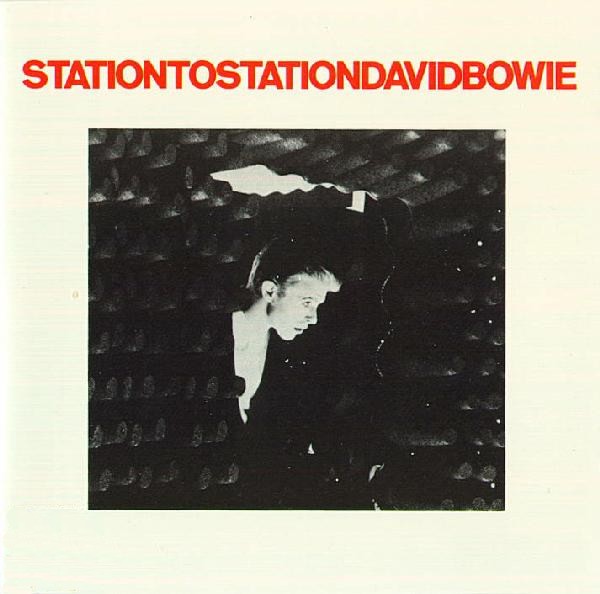
Bowie's bridge from Young Americans to Berlin opens with a guitar made to sound like a train, then marches for more than 3 minutes before he sings. That wait is its boldest idea.
- Released
- 23 January 1976 (RCA)
- Label
- RCA Victor (US and UK, APL1-1327)
- Producer(s)
- David Bowie and Harry Maslin
- Runtime
- 37:46 (6 tracks, US label timings)
- Chart peak (US)
- #3 (Billboard Top LPs & Tape, charts dated 28 February and 6 March 1976)
- Chart peak (UK)
- #5 (Official Albums Chart, 14 February 1976)
- Certifications
- RIAA Gold (26 February 1976); Music Canada Gold (1976); BPI Gold (9 August 2013)
- Awards & honours
- #52 on Rolling Stone's 500 Greatest Albums of All Time (2020), up from #324 in 2012. NME's #2 album of 1976, behind Bob Dylan's Desire
Station to Station sounds like the work of a man in total control, made by one who later couldn't recall the sessions. The control came from Carlos Alomar's rhythm section and a strict way of working. The flaw is length: not every track earns it.
Station to Station opens with a guitar doing an impression of a train. It's Earl Slick's, and it may be the only part of the sessions Bowie kept. Ian Mathers noted in Stylus in 2004 that Bowie's one memory of making the album was telling Slick what guitar sound he wanted there. Most of the rest of autumn 1975 was gone. Rolling Stone reports that he was living mainly on peppers and milk, and that his weight fell below 100 pounds. On VH1 in 1999 he called it the darkest time of his life, and said he could barely recall it.
The record he made in that state is one of the tidiest things in his catalogue. Stuart Berman, reviewing the 2010 reissue for Pitchfork, called it Bowie's most carefully built album. The care wasn't only Bowie's, though. It came from three players who laid down every track before anyone else touched it, and from a working method that never depended on the singer being well. Station to Station is a great record because that machine held. Its flaw is that the machine sometimes kept running after the song had finished.
He hadn't planned to make it. In April 1975 Bowie announced he was retiring from rock and roll, which he called a boring dead end. He'd moved to Los Angeles to become a film star instead. From June to August he was in New Mexico, playing Thomas Jerome Newton, the alien of Nicolas Roeg's The Man Who Fell to Earth. He worked on music in the downtime. Roeg had warned him that Newton would be hard to shake, and he was right. Back in Los Angeles, Newton's brittle detachment grew into a new character, the Thin White Duke, whom Bowie called “a nasty character indeed”. Later that year “Fame” gave him his first American #1, and the retirement was quietly forgotten.
For a co-producer he chose Harry Maslin, who'd shared the production credit on “Fame”. They booked Cherokee Studios, at 751 North Fairfax Avenue in Hollywood, for the autumn of 1975. Carlos Alomar, a veteran of the Young Americans sessions, wanted a cleaner way to work, and Bowie took it. He sketched a song. Then Alomar, George Murray on bass and Dennis Davis on drums built the rhythm track. Rolling Stone calls them the DAM Trio. Slick's guitar and Roy Bittan's piano went on top, and Bowie's vocals came last. Alomar says locking the rhythm down first gave everyone a bird's-eye view of the song. Rolling Stone says the method set the way Bowie recorded, and the core of his band, for years to come.
The room wasn't clean, but it wasn't uniform either. Slick told the Guardian in 2021 that he and Bowie used heavily, while the rhythm section “didn't imbibe anything close to the silliness” they did. Had the trio matched them, he reckons, the record would have been ruined. Alomar doesn't claim the sessions were dry. He told Rolling Stone that whether the work ran on coke or anything else, Bowie still made the decisions. Roy Bittan arrived by chance, when Slick ran into him at the Sunset Marquis during the Born to Run tour. The next day Bowie asked whether he knew who Professor Longhair was. Bittan ended up imitating Longhair, starting on “TVC 15”, and by his own account he played on every song but “Wild Is the Wind”. By Slick's comparison, the steadiest heads in the room belonged to the three men keeping time.
The title track is where the method pays off. After the train, the band settles into a slow march, and Bowie doesn't sing until 3:18. That's more than 3 minutes of train and march at the start of a hit album, and it's the boldest decision on the record. The wait builds a dread that no verse could. The title meant the Stations of the Cross, not railway stations, and Bowie drew on the Kabbalah too. In 2001 he admitted a smaller, earthlier debt. He'd bought Neu! 2 around 1975. He said its guitar drone against Dinger's drumming left a slight mark on the title track.
Then the song changes gear. The march gives way to a fast groove, and the incantation turns into dance music. Between 7:35 and 8:25 the voice drops out and the band simply drives. The Guardian's Alexis Petridis singles out Slick's solo at the end as dazzling and angular. Billboard's reviewer in January 1976 thought the 10-minute title cut dragged. Billboard had it backwards. It's the one track on the album whose length is the point. The slow half makes you wait for the fast half, and the waiting is the drama.
“Golden Years” is the record's concession to radio, and it worked. It was the first thing the band cut, and it was on the British chart by the end of November 1975, about 2 months before the album. It peaked at #8 in Britain. In America it climbed slowly to #10 in April 1976. Bowie claimed he'd written it for Elvis Presley, who turned it down. “TVC 15” is stranger. Christgau heard Lou Reed, disco and Huey Smith in it, and called it irresistible. Rolling Stone heard New Orleans R&B turned into robotic funk, and Bittan's Longhair piano is the New Orleans half. Neither song breaks the record. They're the breathing space between the long pieces, and the sequence needs them.
“Stay” is where the band shows what it was for. Alomar told Rolling Stone that its introduction was so hard to play it was like trying to hold on to a bull. He calls the song the real breakthrough, the point where they stopped making another funk record. Bowie sings from 1:16 to 3:42, and then the band plays on for more than 2 minutes without him. Petridis counts Slick's playing on it among the record's astonishing performances. On an album often called cold, this coda is the hottest thing on it.
The ballads are where the record is weakest and where it's strongest. Rolling Stone hears “Word on a Wing” as a hymn about Bowie's confusion over religion. On VH1 in 1999 he called it a call for help. It's sincere, and it's the one track where Christgau's 1976 complaint lands: he thought all six cuts ran too long. The voice comes in at 0:38 and the title comes round 7 times. By the last of them the song has nothing left to add. “Wild Is the Wind” is a different matter. Christgau traced it to Johnny Mathis, and Nina Simone made it the title track of her 1966 album. Bowie had befriended Simone in 1974. Christgau also said Bowie sounded as if he were singing via satellite. On this song he was wrong. Alomar says the two ballads took the album into a more human area, and this one is the warmest vocal on the record.
The record sold fast. It entered the American chart at #88 on 7 February 1976 and reached #3 on 28 February. No Bowie album would place higher there until The Next Day in 2013. In Britain it peaked at #5. Billboard called it “another good disco effort”, and NME made it the second-best album of 1976, behind Bob Dylan's Desire. The Isolar tour opened in Vancouver on 2 February. By then the Duke had started talking. In interviews of the period, Rolling Stone recalls, Bowie praised Hitler and called for “a right-wing, totally dictatorial tyranny”. You can't hear any of that in the grooves. You can hear the chill that made the character possible.
Its reputation now rests partly on what came next. Rolling Stone hears it as the bridge from the plastic soul of Young Americans to the chilly electronics of the Berlin records. Low followed a year later, made partly at the Château d'Hérouville in France, with Alomar and Davis still in the band. That's the real line of descent, and it runs mostly through Bowie himself. Wider claims are harder to support. Ian Mathers argued in Stylus that few had anticipated the sound and few copied it, calling it “an orphaned, abandoned style”. He's right, because nobody else had this band or this state of mind. The standing has grown regardless. Rolling Stone ranked it #324 among the greatest albums in 2012, and #52 in 2020.
Is it a cold record? Critics split on that. Christgau heard a singer at a distance. Lester Bangs, an outspoken Bowie sceptic, heard “a beautiful, swelling, intensely romantic melancholy”. Both were right, about different parts of it. The singer spends most of the record at arm's length, even on the songs that ask for help. The warmth is in the playing, and especially in the three men who built each track before he arrived to sing over it.
So Station to Station earns its place near the top of Bowie's catalogue, though not as the work of a genius in a trance. It's great because a band and a method carried a man who could barely carry himself. The title track and “Stay” are as good as anything he recorded in the 1970s, and “Wild Is the Wind” is his finest singing of the decade. “Word on a Wing” outstays its welcome, and the album's chill keeps some listeners outside it for good. Play it for the title track's long wait and the coda of “Stay”. Forgive the 2 minutes it could lose.
Pressing guide — the one to own
The original to own depends on where you live. In Britain it's RCA APL1-1327 on orange labels, pressed at RCA's own plant in Washington, with a one-sided credits insert. In America it's the same number on tan labels, cut by Allen Zentz: look for “Az” in the runouts, with “H” for Hollywood or “I” for Indianapolis. Both have the single sleeve with the black-and-white film still. Early copies credit the photographer as “Shapiro”.