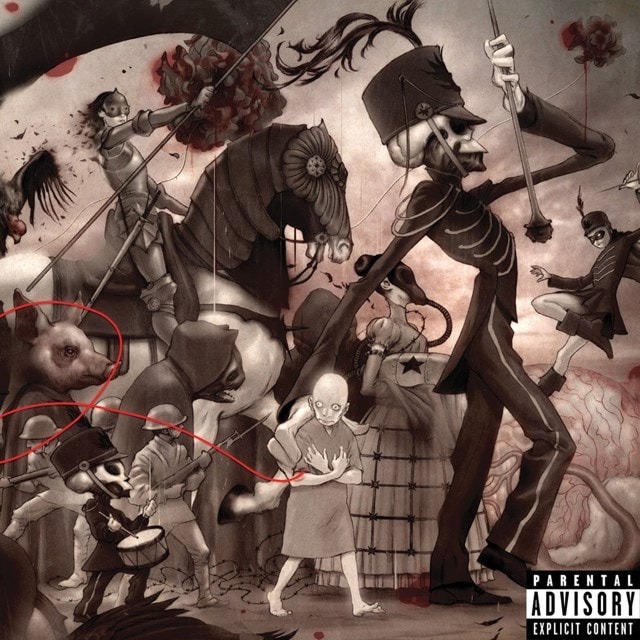
My Chemical Romance's third album, a 2006 concept record about a dying man, made with Green Day's producer. Its sources are old. The way it's put together still isn't.
- Released
- 23 October 2006 (UK and Europe); 24 October 2006 (US)
- Label
- Reprise
- Producer(s)
- Rob Cavallo and My Chemical Romance
- Runtime
- 48:58 for the 13 listed tracks; 51:51 with the hidden track 'Blood'
- Chart peak (US)
- #2 (Billboard 200, chart dated 11 November 2006), with 240,000 copies in its first week
- Chart peak (UK)
- #2 (Official Albums Chart, week of 29 October 2006), behind Robbie Williams's Rudebox
- Certifications
- RIAA 4× Platinum (December 2023); BPI 4× Platinum (July 2026); Music Canada 4× Platinum (January 2026)
- Awards & honours
- Grammy nomination for Best Boxed or Special Limited Edition Package (2008), for the limited CD box. #361 in Rolling Stone's 500 Greatest Albums (2020)
The Black Parade is remembered as emo's grand rock opera. Its story is thin and its grandeur is borrowed from the 1970s. What lasts is the construction: 13 songs sequenced, produced and played as a single piece by a band determined to be remembered.
On 29 October 2020, Andrew Lloyd Webber posted a TikTok that set two openings side by side. First he played the start of The Phantom of the Opera and asked musical-theatre fans what it brought to mind. Then he played a single G, the note that opens 'Welcome to the Black Parade', and put the same question to everyone else. A note from a 2006 rock song had become a cue. The song was a UK #1 for 2 weeks in October 2006. In July 2025 the RIAA certified it 7× Platinum. By then 12 of the album's 13 songs carried an RIAA award of their own.
That afterlife makes The Black Parade sound like the rock opera that conquered a generation. It's narrower than that, and sturdier. Reviewing it for Rolling Stone in October 2006, David Fricke called it the best mid-Seventies record of the year. He meant it as praise, and it still describes the album better than most of the praise that followed. The story of a dying man is thin. The sound is openly second-hand. What My Chemical Romance and their producer, Rob Cavallo, did was fit those borrowed parts into 13 songs that play as one piece. That construction, more than the concept or any new idea, is why it has lasted.
The band had reasons to reach. Three Cheers for Sweet Revenge had made them big in 2004. Tom Bryant's 2014 biography says that, home from touring in late 2005, they feared they'd been a flash in the pan. Gerard Way worried that the band's image would stay tied to that record. His brother Mikey, the bassist, said around the release that they wanted this to be the album they'd be remembered for. The model was close at hand. In 2005 they'd supported Green Day on the American Idiot tour. Cavallo had produced Green Day's Dookie and American Idiot, and American Idiot had topped the Billboard 200 in October 2004. NME's review pointed out that the two records shared a label, a producer, a video director and an A&R department.
The legend puts the making of all this in a haunted mansion. The paperwork puts it somewhere more ordinary. The band began writing and demoing with Cavallo at the Paramour, a hilltop mansion above Silver Lake in Los Angeles, in early March 2006. MTV reported that month that the sessions would move to a studio in Burbank on 10 April. The sleeve names Eldorado Recording Studios in Burbank for the recording, and Capitol Studios in Hollywood for the strings and horns. Way himself has called the Paramour weeks pre-production. Recording was finished by 10 August, when the band said so in a statement about injuries from a video shoot.
The house still left its mark. Way had night terrors there and taped his account of them on waking, and that tape opens 'Sleep'. Mikey Way was struggling with depression and drinking. He later told Bryant that making the record was when it all came to a head. Ray Toro told the drummer, Bob Bryar, he'd seen a ghost. The idea of a concept album was older than the house. Way had hinted at one as early as February 2005. He set out the finished premise to MTV in August 2006. Death, he said, comes for you as your strongest memory. For the album's dying narrator, the Patient, that memory is his father taking him to a parade as a child.
The band would play the record as that parade, under an alter ego called the Black Parade. Way called it "just our alter ego for this record". It's a strong premise, and it gave the band a uniform and a stage show. As a story, though, it's a frame rather than a plot. Way has said he wrote 'Teenagers' about how kids are viewed, outside the Patient's story altogether. The premise sets the album's mood and gives its sequence a shape. It doesn't give the songs much of a narrative to carry.
The sequencing is where the album earns its reputation. 'The End.' lasts 1:52, and Fricke heard it as a fanfare off Alice Cooper's Billion Dollar Babies. Way is singing by 0:06. From 0:34 the vocal stops for half a minute. The track closes on a flatlining heart monitor, which cuts straight into 'Dead!'. That's the album's best joke about its own subject. 'Dead!' sings its title for the first time at 0:38. Fricke heard Queen's 'Keep Yourself Alive' in it, and NME's Dan Martin heard Green Day's 'Holiday'. Both are right, and that's the record in miniature: 2004 punk and 1973 Queen in one song.
'Welcome to the Black Parade' makes the whole argument in 5:11. The piano opens on that G, and Way's voice arrives at 0:12. Twice in the next 2 minutes the vocal drops out, from about 0:58 and again from 1:37. Fricke heard the record's one shot of hope in the song's second half. Its marching-band outro was the part the Observer's reviewer liked least. The song was older than the album. Bryant says it began as 'The Five of Us Are Dying' and nearly didn't make the record. It was rebuilt around a new piano introduction, and who wrote that is disputed. Bryant says the band attached a line Cavallo had already written. Way has since said that he wrote it and Cavallo played it. Either way, the march that ends it is the one place where the concept and the music are the same thing.
The middle of the album is where the billing outruns the songs. 'Cancer' is the exception. At 2:22 it's the shortest song after 'The End.', and NME's Dan Martin heard just Way and a piano. Cavallo has said, by Bryant's account, that he and Way wrote it in 8 minutes. It's the least dressed-up song on the album, and the better for it. 'Mama' is the reverse. It carries the album's one famous guest, Liza Minnelli. Fricke described her part as a short duet with two big lines. Way said in 2019 that she recorded it in New York while the band worked at Capitol in Los Angeles. The credit promises a collaboration. The track delivers a cameo. 'Sleep' is stronger because its theatre is real. It opens on Way's tape, and the title isn't sung until 1:27.
What holds the record together is the sound. Cavallo co-produced with the band, David Campbell arranged the strings and horns, and Chris Lord-Alge mixed all of it. Every song passes through the same hands. NME's Dan Martin heard the band change costume from song to song, from stadium punk to vaudeville, with musical theatre as the overarching style. Fricke called the result "vacuum-packed overkill". Read together, the two reviews describe one thing: a wide range of styles pressed into a single sound. The closer, 'Famous Last Words', grew from a sketch of Toro's called 'The Saddest Music in the World'. It ends the listed album at 48:58. After 1:30 of silence comes a hidden track, 'Blood', with Jamie Muhoberac on piano.
The case against the album was made at the time, and it deserves a hearing. Jaimie Hodgson gave it 1 star in the Observer and called the band "Meat Loaf's spoilt nephews". Theon Weber gave it a C+ in Stylus. He found Way's vocal tics repetitive and judged the record catchy but unimportant to anyone past adolescence. Even Fricke called the poetry rickety. He found the excess gave diminishing returns, leaning too hard on a drumroll he likened to an avenging army. By 'Disenchanted' and 'Famous Last Words' it had lost its shine for him, and he thought the album should have ended on 'Teenagers'. The fairest version of the complaint is about invention. Fricke heard Alice Cooper, Queen and ELO. Betty Clarke, in the Guardian, heard Queen, the Sgt Pepper marching band and the Doors. Cavallo had promised touches of Queen and the Doors 7 months before release. A record whose producer can name its sources in advance isn't breaking new ground.
None of that held it back. The album sold 240,000 copies in its first American week, against the band's previous best of 38,000. It still finished second, behind the Hannah Montana soundtrack. In Britain it entered at #2 behind Robbie Williams's Rudebox, and it has spent 73 weeks on the chart. By 2026 it was 4× Platinum in the US, the UK and Canada. The song Weber picked as the highlight, 'Teenagers', became a 6× Platinum single in America. By certification, the song Way wrote outside the story is the album's second-biggest hit. The reaction wasn't only commercial. After the Daily Mail linked the band to what it called a suicide cult, fans protested at Marble Arch in London in May 2008.
Its influence is clearest where people have gone back to it by name. The band carried the alter-ego idea into Danger Days in 2010. In 2016 Rock Sound gathered other bands for a tribute album, and Twenty One Pilots' version of 'Cancer' reached #91 on the Hot 100. A 2019 New York Times piece heard 'Cancer' in that band's own song 'Goner'. Rolling Stone put the album at #361 in its 500 greatest albums in 2020, and Kerrang! called it the greatest emo album in 2021. Critics had liked it from the start: at the end of 2006, Spin ranked it #5 of the year and NME #10. In 2024 the band played it in full at the When We Were Young festival, and in 2025 they took it round stadiums. Lloyd Webber's TikTok belongs on the same list: a song whose first note is enough.
So the reputation has the scale right and the reasons wrong. The story is a costume, and the famous guest has two lines. The grandest gestures were old when Fricke heard them in 2006. What the album does better than the records it borrows from is hold itself together. The 13 listed songs run under 49 minutes, and few of them outstay their idea. 'Dead!', 'Cancer' and 'Sleep' would hold up on any album, concept or not. Admire it as a piece of construction, and don't mistake it for an invention. It's a very good record held back by a thin story and borrowed grandeur, and the G still works.
Pressing guide — the one to own
The first vinyl is the 2007 US gatefold double LP, Reprise 44427-1, released on 11 December 2007, more than a year after the CD. It carries James Jean's painting on the front and stamped runouts on all four sides, reading '2-44427' and '73049E'. The collector's piece is the deluxe box from the same day, 116796-1. It holds two 180g LPs pressed by RTI from lacquers cut by Stan Ricker, in an edition of 2,500 according to its catalogue notes.